


How an NFL Team Can Win Without Completing a Pass
Updated: 3 days ago
The direct answer is that passing completions are only one way to create points and protect possession. A team can survive without one when its rushing attack keeps producing efficient gains, its defense creates short fields, its special teams converts those fields into points and game conditions make passing riskier than running.
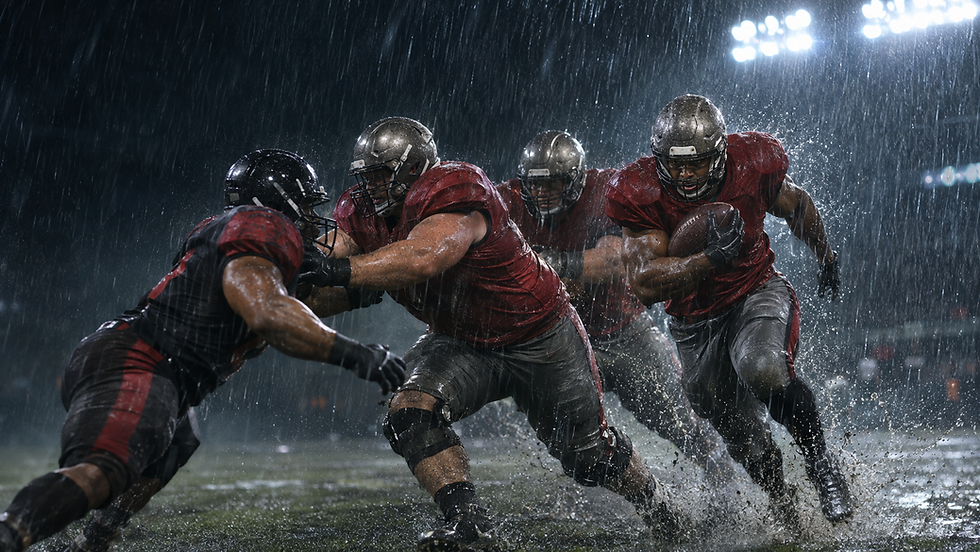
Tampa Bay supplied an extreme modern example on November 1, 2026. The Buccaneers beat Atlanta 16 to 0 in heavy rain even though Baker Mayfield completed none of his three passes. Tampa Bay ran for a franchise record 324 yards, intercepted Michael Penix Jr. four times and became the first team since Buffalo in 1974 to win without a completion.

1. The run game must replace explosive passing value
A no completion offense cannot live on two yard carries. It needs repeated positive gains and enough explosive runs to move the ball without facing obvious third and long situations. Bucky Irving rushed 27 times for 170 yards and a touchdown. Kenneth Gainwell added 140 yards. Together they gained 310 yards on 52 carries, which is just under six yards per attempt.
That efficiency changes the play caller’s math. On second and medium, the offense can stay in its full run menu instead of asking the quarterback to handle a wet football in a predictable passing situation. The defense must keep fitting the run, which creates opportunities for wide zone, cutbacks, power and quarterback checks at the line.
2. Ball security becomes more valuable than passing volume
Bad weather compresses the game. Every dropback adds exchange, grip and catch risk. Tampa Bay did not announce a permanent no pass philosophy. Todd Bowles said the conditions dictated the plan. Once the rain and wind showed that the football was difficult to control, avoiding unnecessary throws became a rational risk decision.
This does not mean the offense was perfect. Tampa Bay lost a potential touchdown on a fumble into the end zone. The lesson is narrower: after seeing the weather and the defense, the Buccaneers reduced the number of high variance plays they needed to attempt.
3. Takeaways can manufacture the missing passing yards
A normal passing game helps flip field position and create short scoring drives. Tampa Bay’s defense supplied that value instead. Four interceptions repeatedly ended Atlanta possessions and gave the Buccaneers extra chances. The offense did not need to produce 300 passing yards because the defense prevented Atlanta from sustaining its own drives.
Turnover margin is volatile, so this is not a dependable weekly plan. It is still central to explaining this particular win. When one team protects the ball and the other throws four interceptions, the team with almost no passing production can still control the scoring environment.
4. Field position turns small gains into points
Three Chase McLaughlin field goals gave Tampa Bay nine points before the lone touchdown. That is how a defense and special teams unit help a run heavy offense. The offense does not need to travel the full field every time. It needs to gain enough yards to improve the kick, avoid a damaging loss and finish the possession with points.
Field position also affects the opponent. A punt backed by a disciplined coverage unit forces the other offense to drive farther in difficult weather. Every extra snap creates another chance for a penalty, bad exchange or turnover.
5. The quarterback still has a job without completions
Mayfield’s contribution was not measured by passing yards. He had to identify fronts, choose the correct run, handle wet exchanges, manage the clock and keep the offense out of avoidable mistakes. He also changed the operation to shotgun and pistol looks because receiving the snap that way was easier in the conditions.
That is real quarterback play even if the box score says zero completions. The position is responsible for organizing the offense before the ball is thrown, not merely for throwing it.
The strongest counterargument
This is not a model that Tampa Bay should copy in normal conditions. Four interceptions, historic rushing efficiency and extreme rain are unusual. A better passing opponent would force the Buccaneers to score more, and a defense with a healthier lead could load the box until the run game stalled.
Football Nation’s conclusion is that the game proves an NFL offense can temporarily replace passing production, not that passing is optional. The formula requires unusual strength in several other areas at the same time.
Fantasy football consequence
Do not project another zero completion game. Weather and matchup conditions change too quickly. The useful fantasy signal is Tampa Bay’s commitment to the run. Irving’s 27 carries and 170 yards confirm a feature workload when the game script cooperates. Gainwell’s 25 carries show that a second back can matter when Tampa Bay controls the game and chooses volume over passing.
Mayfield’s Week 8 result should be treated as an extreme outlier rather than a new baseline. Receivers also should not be downgraded solely because a rain game erased their production. Their Week 9 value depends on practice participation, weather and whether Tampa Bay must throw to keep pace.
Next checkpoint
Tampa Bay visits Chicago in Week 9. The next checkpoint is whether the Buccaneers retain a run first identity under normal weather, how they divide early down work between Irving and Gainwell, and whether the passing rate rebounds immediately. That game will tell us whether Week 8 revealed a durable offensive preference or only an intelligent one day adjustment.
Sources and reporting cutoff
Confirmed facts were checked against the Buccaneers’ official game recap, which records the 16 to 0 score, 324 rushing yards, four interceptions and zero completions.
Historical context and the coaching explanation were checked against NFL.com’s November 2 report.
The embedded public status is the official Tampa Bay Buccaneers X post, opened and verified at its direct status URL.
Reporting cutoff: November 2, 2026 at 4:24 p.m. Central. Comparison period: Tampa Bay’s Week 8 game and the Super Bowl era through November 2, 2026. Scheme explanations and fantasy conclusions are Football Nation analysis.

Comments