


What Is an Illegal Formation in Football? NFL Rule Explained
Updated: Sep 13
An NFL offense is in an illegal formation at the snap if it does not have at least seven players on the line of scrimmage, eligible receivers on both ends of that line, every player clearly on or off the line, and properly numbered or reported players in eligible positions. The standard penalty is five yards. That is the direct answer—but the “seven on the line” shortcut misses the covered-receiver and eligibility rules that cause many flags.
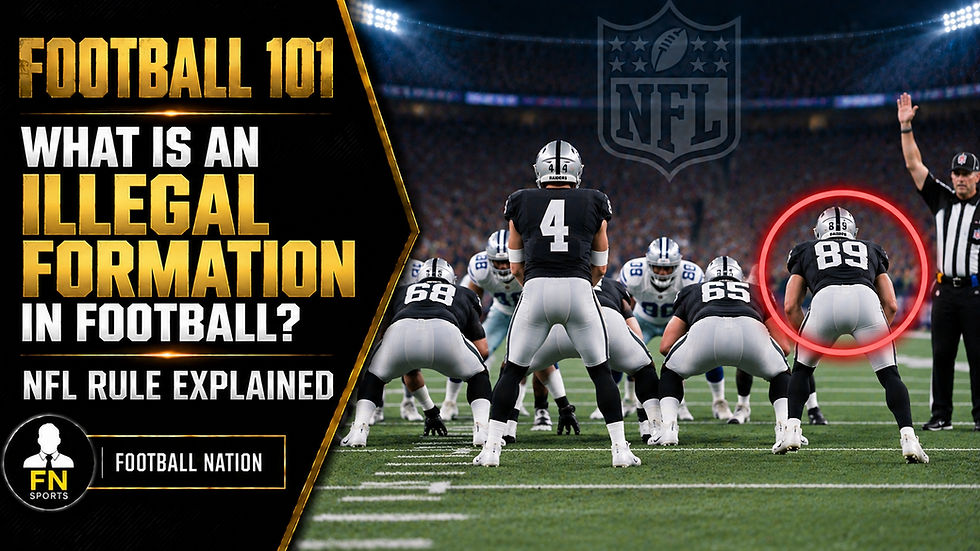
What makes an NFL offensive formation legal?
Rule 7, Section 5, Article 1 of the 2026 NFL rulebook gives the offense five requirements at the snap. It must place seven or more players on the line; eligible receivers must occupy both ends; the players between those ends must be ineligible receivers; nobody may be out of bounds; and everyone must be clearly on or clearly off the line, except for the limited player-position rule directly behind the snapper. Players in eligible positions also must wear eligible numbers unless they properly report a change of status.
The formation is judged at the snap, not when the offense first breaks the huddle. Players can shift and reset, but the final picture must satisfy every requirement. That makes the quarterback’s cadence important: the offense uses the pre-snap rhythm to confirm the formation, identify the defense and avoid snapping before a receiver or tackle becomes properly set.
Seven on the line means at least seven
The most familiar requirement is “seven on the line,” but the exact rule says seven or more. With 11 offensive players, seven on the line leaves four in the backfield; eight on the line leaves three in the backfield. The offense cannot place five players in the backfield because that would leave only six on the line. Officials use each player’s helmet and body position relative to the ball to determine whether he is on the line of scrimmage.
The diagram shows the cleanest count. In the legal example, the two players at the ends of the seven-man line occupy eligible positions, the five players between them form the ineligible core, and four players are clearly in the backfield. The six-man-line example is illegal even though all 11 players are on the field. The covered-receiver example has enough players on the line, but alignment changes who is eligible.
What is a covered receiver?
Only the players at the two ends of the line may be eligible receivers. Suppose a tight end is on the line and a wide receiver also steps onto the line outside him. The outside receiver becomes the end man; the tight end is now “covered up” inside the line and is ineligible to catch a forward pass. The offense may still have a legal formation if the numbering and reporting rules are satisfied, but the covered player cannot release downfield as an eligible receiver or catch a forward pass.
This is why receivers often check with the nearest official before the snap. A wideout who intends to be off the line may point or look toward the official to confirm his alignment. That exchange is not ceremonial. A few inches can determine whether the receiver is clearly in the backfield, whether the tight end remains uncovered and whether the formation preserves two eligible ends.
Jersey numbers and reporting eligibility
NFL numbers communicate normal eligibility. Players wearing ineligible numbers—50 through 79 and 90 through 99—may line up in an eligible position only after reporting the change to the referee. The referee then informs the defense. Conversely, a player with an eligible number can report as ineligible and join the normal five-player interior core, subject to the rule’s positional limits. Reporting does not erase formation rules; it changes the player’s declared status for that play.
A common misconception is that an extra offensive lineman becomes eligible merely because the stadium announcer says he reported. Reporting allows him to occupy an eligible position legally, but he still must be at an eligible end and follow the pass-eligibility rules. If another player covers him on the line, or if the offense misaligns the rest of the formation, the report does not rescue the play.
Clearly on or clearly off the line
The rule prohibits a player from taking a position that is neither clearly on nor clearly off the line, with a narrow allowance for one player directly behind the snapper. This prevents an offense from hiding eligibility through ambiguous alignment. It also explains why the tackle, slot receiver and outside receiver may make tiny pre-snap adjustments. The official needs an unmistakable picture, not an educated guess.
The tackle box does not decide whether a player is on the line. It is a different rulebook area used for subjects such as intentional grounding and certain blocking restrictions. Formation legality comes from the player’s relationship to the line of scrimmage, the other offensive players and his eligibility status.
Illegal formation vs. false start, shift and motion
These pre-snap fouls sound similar but occur for different reasons. A false start is an abrupt movement that simulates the start of the play, so officials kill the play before the snap. An illegal shift involves two or more players changing position without the entire offense becoming set for one full second after the final shift. Illegal motion generally occurs when the one moving backfield player is moving toward the line at the snap, or when another motion restriction is violated. Illegal formation is the final alignment itself.
Defensive encroachment, offside and neutral-zone infractions concern the defense’s relationship to the neutral zone, not the offense’s distribution of players. Broadcasts sometimes group all of these under “pre-snap penalties,” but learning the trigger tells you why some plays are stopped immediately while others produce a flag at the snap.
Penalty and what happens next
Illegal formation by the offense costs five yards. Because it is an at-the-snap foul, enforcement is from the previous spot and the down is repeated unless another enforcement rule changes the result. The official signal is the same rotating-forearms motion also used for false start and certain other formation-related fouls, so the referee’s announcement supplies the specific violation.
Special teams also have their own formation restrictions. Kickoffs, punts, field goals and tries include alignment rules for the kicking and receiving teams, and violations can also carry five yards. This article’s seven-player-line test applies to an ordinary offensive scrimmage formation; it should not be blindly transferred to the NFL’s current kickoff setup zones or defensive alignment rules on kicks.
The strongest misconception
The biggest misconception is that counting seven bodies settles everything. A team can have seven or eight players on the line and still create an eligibility problem by covering a receiver, using the wrong number without reporting, placing someone out of bounds or leaving a player in a vague position between on and off. The correct mental checklist is alignment plus eligibility, not alignment alone.
Football Nation takeaway
On the next replay, pause at the snap and count from one end of the offensive line to the other. You need at least seven. Then identify the two end players, verify that everyone between them is ineligible, and check that the backs are clearly off the line. Finally, account for any reported eligible or ineligible player. If any part fails, the offense faces a five-yard illegal-formation penalty. The next factual checkpoint is the NFL’s annual rules publication and any in-season official ruling; the NFL Football Operations rulebook hub controls if the league changes alignment or reporting requirements.


Comments