top of page

Why Do Offensive Linemen Report as Eligible Receivers?

When an NFL offensive lineman reports as eligible, he is telling the referee that his jersey number normally identifies him as an ineligible receiver but that he intends to line up in an eligible position for the next play. The referee informs the defense, the stadium announces the number, and the player may catch a legal forward pass only if his formation and alignment also satisfy the rules.


The important distinction is simple: reporting changes the player's declared status; it does not erase formation rules. A tackle wearing No. 72 cannot whisper to the referee, remain covered inside the line and suddenly become a receiver. He still has to occupy a legal eligible spot when the ball is snapped.


What does “reporting eligible” mean?


NFL jersey numbers help officials and defenders identify likely pass receivers before the snap. NFL Football Operations' football terminology guide places offensive skill players in the eligible-number groups of 0–49 and 80–89. Numbers 50–79 and 90–99 are treated as ineligible numbers on offense unless the player properly reports a change of position.


Rule 5, Section 3 of the 2026 NFL Rulebook allows a player wearing an ineligible number to line up as an eligible pass receiver or T-formation quarterback. It also allows the reverse: an eligible-number player may report as ineligible and join the normal five-player interior core.


Jersey numbers

Normal pass status

What changes it

0–49 and 80–89

Eligible-number group

Alignment can still make the player ineligible; a player may also report as ineligible for the five-man core.

50–79 and 90–99

Ineligible-number group

The player must report before each play and align in an eligible position to become eligible.

Reporting violation

Illegal substitution

Five-yard penalty when the required status change is not reported correctly.


Sources for the table: the 2026 NFL Rulebook, Rule 5, Section 3, and NFL Football Operations' eligible-receiver and jersey-number definitions.


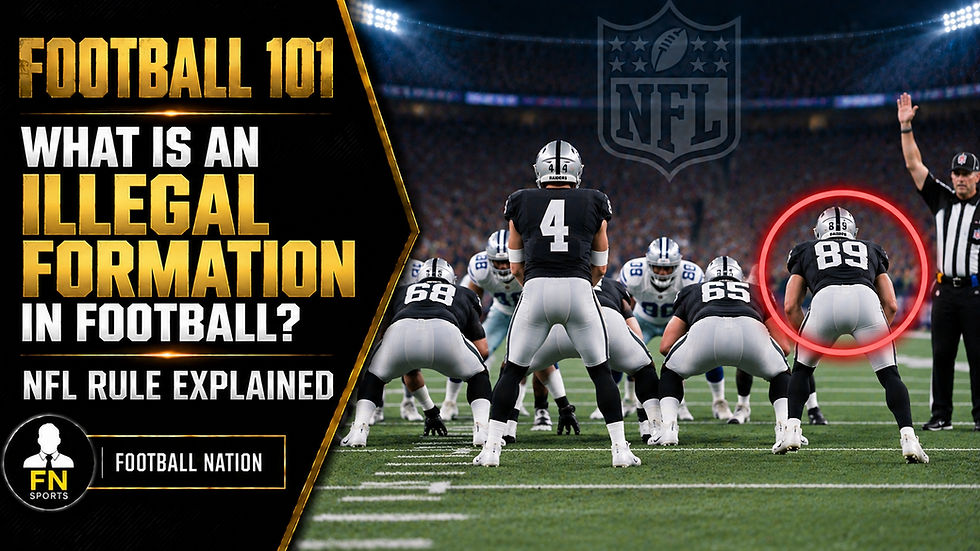
Football Nation diagram showing number 72 reporting to the referee, the defense being notified and the player lining up at the end of the offensive line.
Football Nation teaching graphic: the player reports, the defense is notified, and the player must still line up in an eligible position.

The three-step reporting process


  • Report immediately. The player approaches the referee and declares the eligibility change before the play. A hand gesture alone should not be treated as a substitute for a clear report.

  • Notify the defense. The referee tells the defensive team which number has changed status. That is why television viewers hear an announcement such as, “Number 72 has reported as eligible.”

  • Align legally. The player must then take an eligible position—typically uncovered on the end of the line or at least one yard behind it. The declaration cannot rescue an illegal alignment.


The referee does not stop the game clock simply to process the report. The ball is held until the referee reaches his normal position, so the offense must communicate early enough to avoid wasting the play clock. Once the snap puts the ball in play, the official judges eligibility from both number status and alignment.


Why alignment still decides who may catch a pass


At least seven offensive players must be on the line of scrimmage, and only the two end players on that line can be eligible. Everyone between those ends is covered and therefore ineligible. Backfield players positioned at least one yard behind the line can also be eligible.


Imagine No. 72 reports and lines up as the rightmost player on the line with no teammate covering him outside. He can release and catch. If a wide receiver then steps onto the line outside No. 72, the receiver covers him. No. 72 becomes ineligible by alignment even though the stadium just announced him as eligible.


That is also why illegal-formation rules and receiver eligibility must be read together. A legal number, a legal report and a legal formation are separate checks. The offense needs all three.


Why would a team use an offensive lineman as a receiver?


The most common reason is extra blocking. A team can place a reserve tackle at tight end in a jumbo package to create a heavier edge for a short-yardage run. The defense must respect that player's ability to release, however, which can slow a linebacker or create a surprise goal-line target.


The pass is usually the constraint, not the foundation. The offense may show the same heavy look several times, run behind the extra lineman and later leak him into the flat. A defense that sells out against the run can lose track of the reported player precisely because his body type and number suggest blocker.


Reporting can also help an offense build unusual surfaces. A tackle can align beside a tight end, participate in split-zone blocking or create an unbalanced line. But coaches must count carefully: adding a sixth lineman changes which players are on the line, who is covered and whether the formation still has the required five ineligible interior players.


Does the player have to report every play?


Yes. The 2026 rulebook says the player must report before each play while continuously remaining in the changed position. His original number status returns after specified resets, including a timeout, the end of a quarter, the two-minute warning, a foul, replay review, touchdown, scrimmage kick, change of possession or one legal snap on the sideline.


That repeated announcement may sound redundant, but it protects the defense from carrying an old declaration forward. It also prevents an offense from using substitutions or shifting personnel to hide who is actually eligible.


What happens if the report is missed?


Failure to notify the referee when required is illegal substitution and costs five yards. The same penalty applies when an eligible-number player reports as ineligible but lines up outside the normal five-player core. If an ineligible player releases too far downfield on a forward pass, that is a separate ineligible receiver downfield penalty with its own five-yard enforcement.


The strongest misconception is that the announcement itself grants blanket permission to catch. It does not. Reporting solves the number problem. Alignment solves the formation problem. The route and pass still must be legal.


How defenses respond


Defenders first identify the announced number, then locate him in the formation. If No. 72 is uncovered at the end, a linebacker or defensive back must include him in the pass distribution. If he is covered, the defense can treat him as a blocker—but still has to account for the eligible player outside him.


Heavy personnel can also disguise spacing. A reported lineman may begin near the core while three receivers form a trips alignment away from him. The defense has to balance run strength, eligible-receiver count and coverage leverage before the snap.


Frequently asked questions


Can an offensive lineman catch a pass after reporting eligible?

Yes, provided he reports correctly, lines up in an eligible position and catches a legal forward pass. Reporting alone is not enough.

The announcement tells the defense that a player wearing an ordinarily ineligible number has changed status for the upcoming play.

No. He must report before each play while staying in the changed role, and several events reset his original number status.

Yes. An eligible-number player may report as ineligible, but he must line up within the normal five-player interior core required by the rule.

No. Reporting changes number status. Being uncovered at the end of the line, or aligning legally in the backfield, determines whether the player is actually eligible by formation.


Football Nation takeaway


When you hear an official announce that No. 72 is eligible, look at the formation—not just the player. Find the two ends of the line and see whether another receiver covers the lineman. The report tells the defense to account for him; the alignment tells everyone whether he can actually catch the pass. That two-step check turns a confusing stadium announcement into an easy pre-snap read.

Comments


bottom of page