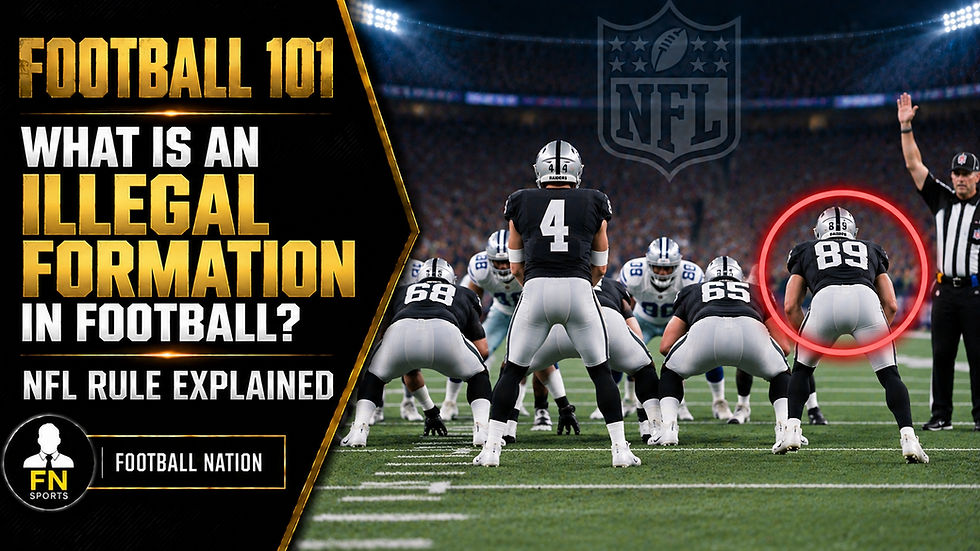
What Is an Ineligible Receiver Downfield Penalty? NFL Rule Explained
- Football Nation
- 8 hours ago
- 5 min read
An ineligible receiver downfield penalty occurs when, on a scrimmage play with a legal forward pass, an ineligible offensive player has his entire body more than one yard beyond the line of scrimmage before the pass is thrown. The penalty is five yards from the previous spot. The flag does not depend on that player touching the ball or even being near the intended receiver.
That direct answer matters because broadcasts often reduce the foul to “a lineman went too far.” The actual NFL test is more precise: eligibility, location, timing and contact all matter.
The NFL rule in one table
Checkpoint | NFL standard |
Rule | Rule 8, Section 3, Article 1 |
Legal depth before the pass | The player’s entire body is not more than 1 yard beyond the line |
Basic foul trigger | An ineligible player’s entire body is more than 1 yard downfield before the pass |
Penalty | 5 yards from the previous spot |
The controlling language appears in the official 2026 NFL rulebook. The league’s football terms glossary also explains which alignments and numbers normally make a player ineligible.

Original Football Nation teaching diagram: the gold line is the line of scrimmage, the dashed line is the one-yard limit, and the red lineman is entirely beyond it before the throw.
Who counts as an ineligible receiver?
Most often, the player is an interior offensive lineman: the center, either guard or a tackle who is not occupying an eligible end position. Eligibility begins with formation. Only the two players at the ends of the offensive line and players clearly in the backfield can be eligible at the snap. Everyone covered inside those two ends is ineligible.
That is why this penalty connects directly to illegal formation rules. A tight end can become “covered up” when a wide receiver lines up on the line outside him. The tight end may wear an eligible number, but the formation makes him ineligible on that play.
Jersey numbers also communicate normal status. Players wearing 50 through 79 are ordinarily ineligible unless they report as eligible to the referee. Reporting does not erase the formation requirement. A reported lineman still must occupy an eligible position, and a naturally eligible player can still be covered by another player on the line.
Why the line of scrimmage and one-yard limit matter
The line of scrimmage is the reference point. Imagine a second line running parallel to it exactly one yard downfield. Before the pass leaves the passer’s hand, an ineligible player generally avoids the foul as long as his entire body has not moved more than one yard beyond the original line.
“Entire body” is important. The rule is not written as an automatic flag when a helmet, hand or foot first breaks the one-yard plane. Officials judge whether the whole player has crossed the limit. That gives the offensive line a small working area while preserving a clear boundary between pass protection and a downfield run block.
The rule is also about the player’s location before the throw. Once the ball leaves the passer’s hand, Rule 8 allows ineligible receivers to advance farther, subject to restrictions on blocking or contacting a defender downfield until the pass is touched. The release of the pass is therefore the critical timing checkpoint.
The legal-contact exception
There is a narrow but meaningful exception. If an ineligible player initiates legal contact with an opponent within one yard of the line during his initial charge, he can be carried more than one yard downfield while legally blocking or being blocked.
If that contact breaks beyond the one-yard limit, the player can remain stationary, move laterally or retreat until the pass is thrown. What he cannot do is lose contact and continue advancing toward the defense’s goal line. The exception protects normal line play; it does not give a lineman permission to disengage and become a downfield lead blocker before a pass.
This is why a freeze-frame can mislead. A lineman may appear two yards downfield when the pass is released but still be legal because continuous contact drove both players there. The full sequence determines the call.
Why RPOs create so many close calls
Run-pass options put two assignments on the same clock. The offensive line often fires forward as if the play is a run, while the quarterback reads a defender and decides whether to hand off, keep the ball or throw. If the quarterback waits, a lineman can finish his initial block and drift beyond the one-yard allowance before the pass leaves his hand.
The solution is usually timing, not hesitation by every blocker. The quarterback must make the read promptly, the receiver’s route must present quickly and the linemen must understand how long they can climb before the throw. A late RPO pass can turn a successful gain into first-and-15 even when the quarterback and receiver execute their part correctly.
The snap starts that timing chain. A clean mesh point and fast decision keep the blocking plan synchronized with the pass.
Does a screen pass make downfield linemen legal?
No—not automatically. A screen pass is designed to release blockers into space, but the NFL rule still cares about when the ball is thrown and how the linemen got downfield. The offense usually protects itself by throwing quickly, keeping legal contact during the initial charge or releasing blockers after the ball leaves the passer’s hand.
The common statement that “it is behind the line, so linemen can go anywhere” is too broad for the NFL rule. Pass location can affect other fouls, but Rule 8-3-1 is triggered on a scrimmage play with a legal forward pass and does not give every behind-the-line completion a blanket exemption.
Ineligible downfield vs. illegal touching
Ineligible downfield is a positioning foul. The player does not need to touch the pass. Illegal touching concerns who actually touches or catches a forward pass and can arise from different eligibility problems.
A single play can make viewers think about both rules: a covered tight end releases beyond the line and catches the ball. The formation may have made him ineligible, his route may create a downfield issue and the catch may raise illegal-touching questions. The referee’s announcement identifies the enforced foul; the concepts should not be treated as interchangeable.
The tackle box and the quarterback’s pocket are also separate rulebook areas. They matter for issues such as intentional grounding and protection, but neither replaces the one-yard test.
The strongest misconception
The biggest misconception is that any offensive lineman seen downfield before a pass must be flagged. That ignores three parts of the rule: the entire-body standard, the one-yard allowance and the legal-contact exception. The reverse misconception is just as risky: a short pass or screen does not give linemen unlimited freedom to release early.
A better replay checklist is:
Was a legal forward pass thrown?
Was the player ineligible by number, report or formation?
Was his entire body more than one yard beyond the line before the throw?
Did continuous legal contact create the exception?
If the first three answers are yes and the fourth is no, the offense has committed ineligible receiver downfield.
Football Nation takeaway
Watch the quarterback’s hand and the lineman’s feet in the same replay. Mark the original line of scrimmage, picture the one-yard boundary and freeze the moment the ball leaves the passer. Then check whether contact carried the blocker downfield or whether he released and kept advancing.
The penalty is only five yards, but it can erase an explosive RPO, screen or play-action completion and put the offense behind schedule. The next factual checkpoint is the NFL’s annual rulebook publication or an official in-season interpretation. Until that changes, Rule 8-3-1’s four-part test—eligibility, entire body, one yard and timing—is the cleanest way to understand the call.


Comments