


What Counts as Defensive Pass Interference in the NFL?
Defensive pass interference is contact more than one yard beyond the line of scrimmage that significantly hinders an eligible receiver's chance to catch a forward pass. For the defense, the restricted window begins when the quarterback releases the ball and ends when any player touches it. The foul gives the offense a first down at the spot, which is why one flag on a deep throw can change field position more than almost any other ordinary penalty.
The test is not simply whether the defender touched the receiver. Officials check where the contact occurred, whether the pass came from behind the line, whether the ball was still airborne, whether the act actually restricted the catch opportunity, and whether the pass was clearly catchable. Both players retain an equal right to the ball.
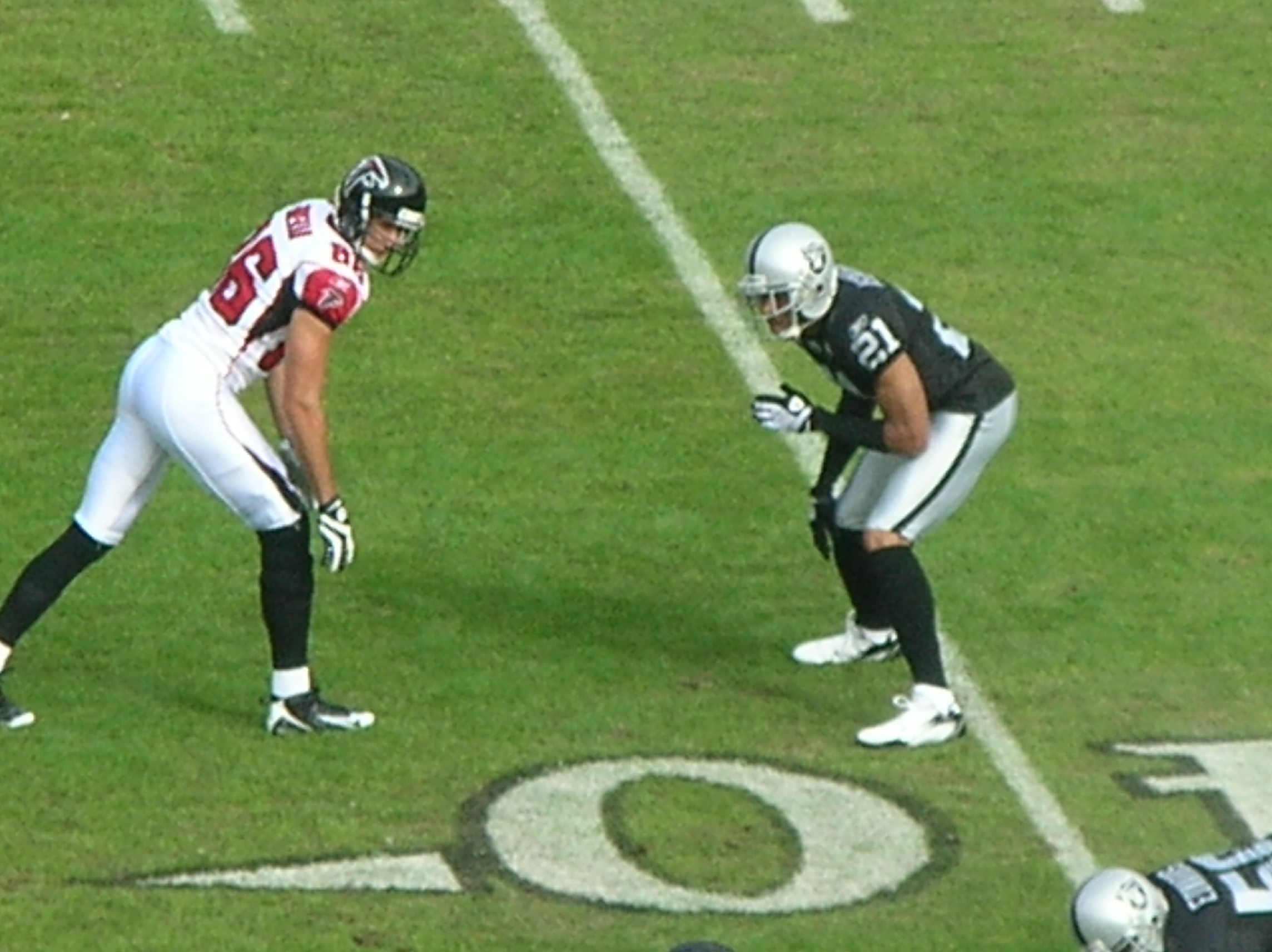
Photo source and license: BrokenSphere image on Wikimedia Commons (CC BY-SA 3.0).
The rule in plain English
Rule 8, Section 5, Article 1 limits pass interference to acts more than one yard beyond the line. A pass thrown from behind the line can produce interference whether that pass is otherwise legal or illegal and whether it crosses the line. Contact at or within one yard of the line is not pass interference, although holding or another contact foul can apply.
Once the ball is airborne, eligible offensive and defensive players have the same right to its path. A defender may gain position, track the ball, and make incidental contact while competing for it. A receiver also cannot push a defender away to create separation. The official judges restriction, not which player is on offense.
Quick ruling table
Play detail | Ruling |
|---|---|
Defender plays through the receiver's back and restricts the catch | Pass interference |
Defender grabs an arm before the ball arrives | Pass interference |
Both players make a legitimate play and their feet tangle | No interference |
A hand touches but does not restrict the opponent | No interference |
Contact occurs after a player touches the pass | Interference window has ended |
The pass is clearly uncatchable by the involved players | No pass interference |
When the restriction begins and ends
For the defense, the window starts when the ball leaves the passer's hand. Contact before the throw may be illegal contact or defensive holding, but it is not yet defensive pass interference. The pass must originate from behind the line, and the challenged contact must be more than one yard downfield.
The window closes when any player touches the ball. Heavy contact after a tip therefore is not pass interference, though holding or unnecessary roughness could still apply. This timing separates the foul from the NFL's five-yard illegal-contact rule, which governs certain acts before the throw while the quarterback remains in the pocket. For related eligibility questions, see who can catch a forward pass and what happens when an ineligible receiver touches the ball.
What contact draws a flag
Article 2 lists the clearest prohibited acts: playing through an opponent's back; grabbing an arm so he cannot reach for the pass; extending an arm across the body as an arm bar; cutting off an opponent's path with contact while not playing the ball; hooking and turning the opponent before the ball arrives; and shoving to create separation.
Playing the ball matters, but it is not a magic exemption. A defender can look back and still interfere with an arm bar or grab. A defender whose head never turns does not automatically foul if he keeps legal position and the contact is incidental. Restriction is the controlling fact.
The official NFL Officiating post below demonstrates the positioning principle: a defender who locates the ball and establishes his space is entitled to it, so a receiver running into him does not automatically create defensive pass interference.
What contact is legal
Article 3 protects normal competition for the ball. Incidental hand, arm, or body contact is legal when both players are competing for the pass, or even when neither is looking for it. If officials are unsure whether contact was incidental, the rule directs them to no interference. Inadvertent foot entanglement is also permitted in those circumstances.
A player may place a hand on an opponent if it does not restrict him, and a player who gains position while trying to catch the ball may keep it. Contact that would otherwise qualify is disregarded when the pass is clearly uncatchable. “Uncatchable” means clearly beyond a realistic opportunity, not merely difficult; officials consider the players' location, speed, reach, direction, and the ball's flight.
The head-turn myth
The rulebook does not create a separate failure-to-look-back foul. Head position is evidence of whether a defender was playing the ball, but the question is whether contact significantly hindered the opponent. A defender looking at the receiver can avoid a flag without restriction; a defender looking for the ball can still be flagged for a grab, arm bar, or contact through the back.
How the penalty is enforced
Defensive pass interference awards a first down at the spot of the foul; the NFL does not cap ordinary enforcement at 15 yards. If interference occurs behind the defensive goal line and the previous spot was at or outside the two-yard line, the offense normally receives first down at the one. If the snap began inside the two, enforcement is half the distance to the goal.
Two realistic examples
Example 1: On third-and-12, a receiver runs a go route. After the throw, the cornerback hooks the receiver's near arm and turns his body at the defense's 30 before the ball arrives. The contact is more than one yard downfield and restricts a catchable pass. The defense is called for interference, and the offense receives a first down at the 30.
Example 2: A receiver and cornerback both track a sideline throw. Their feet tangle inadvertently and they fall as the ball lands nearby. Because both were playing the ball and the contact was incidental, there is no interference. If a linebacker tipped the pass before the tangle, the interference window had already ended for an additional reason.
How to separate similar flags
A grab or encircling action before the pass may be defensive holding, a five-yard penalty and automatic first down. An illegal redirect before the throw can be illegal contact. After the throw, a catch-opportunity restriction becomes pass interference.
Legal press coverage permits controlled contact near the line before the throw; it does not authorize grabbing or downfield restriction. Offensive pass interference uses the same basic catch-opportunity principle while the ball is airborne, but the offense also faces restrictions beginning at the snap.
What fans should watch for
Use five questions: Was the pass thrown from behind the line? Was the contact more than one yard downfield? Was the ball airborne and untouched? Did the act restrict the opponent? Was the pass clearly catchable? On replay, the receiver's arms and hips often reveal a hook, turn, or arm restriction more clearly than a wide camera angle.
Football Nation conclusion
Defensive pass interference is not a no-contact rule. It is a catch-opportunity rule. Contact becomes a foul when it occurs in the downfield, airborne window and significantly restricts an eligible player. Incidental contact, legal position, clearly uncatchable passes, and action after a touch are the major exceptions. Track timing, position, and restriction—in that order.


Comments