


What Counts as Offensive Pass Interference in the NFL?
Offensive pass interference occurs when an offensive player more than one yard beyond the line of scrimmage illegally restricts a defender during a forward-pass play. The two most common versions are a receiver pushing off to create separation while the ball is airborne and an offensive player blocking downfield before the pass is thrown. The NFL penalty is 10 yards from the previous spot.
The fastest way to judge the play is to track three details: the line of scrimmage, the moment the ball leaves the quarterback's hand, and whether the offensive action creates an unfair advantage. Unlike the defense, the offense's pass-interference restrictions begin at the snap, not at the throw.
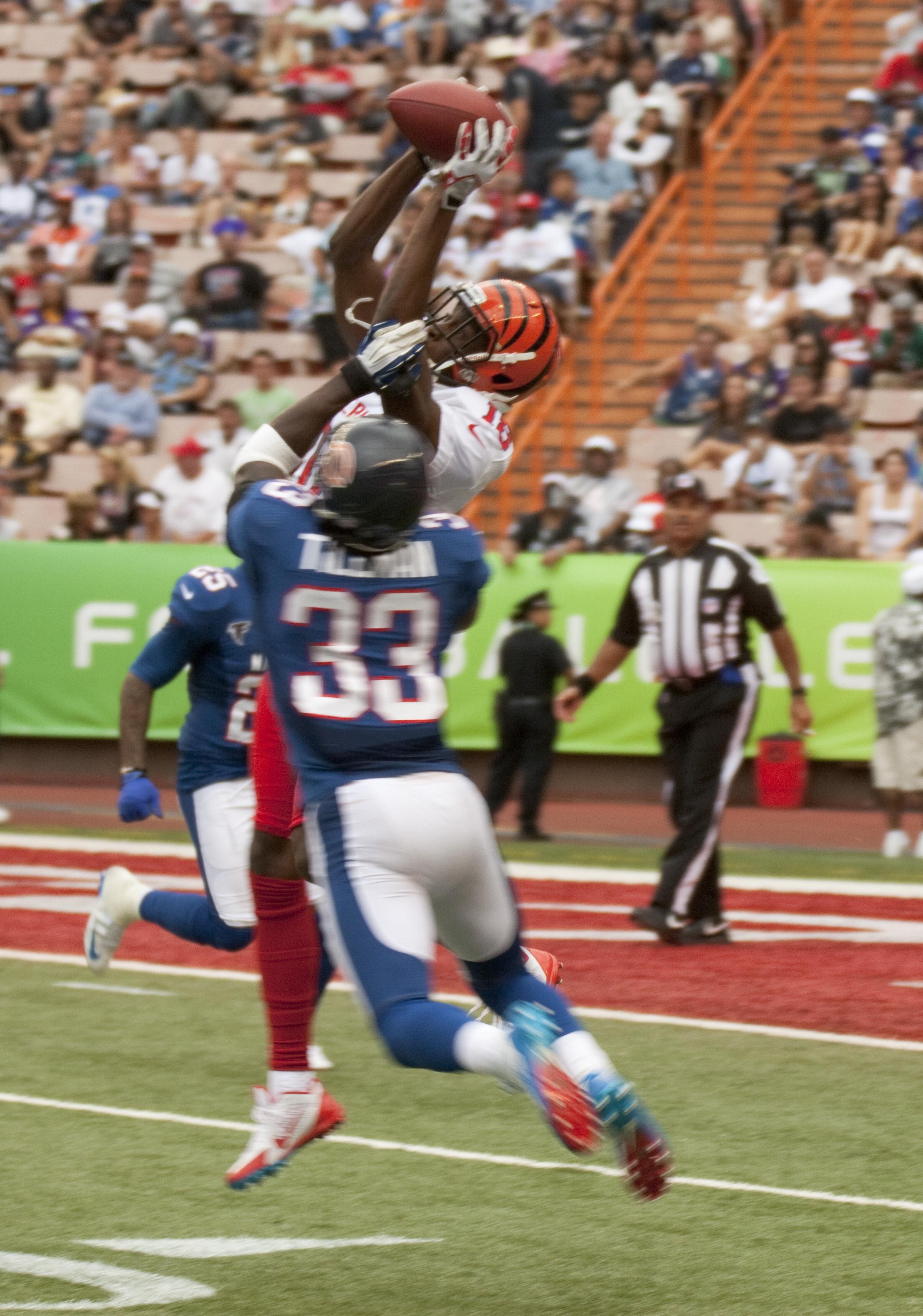
Photo source and license: Sgt. D.R. Cotton/U.S. Marine Corps image on Wikimedia Commons (public domain).
The offensive rule starts at the snap
Rule 8, Section 5, Article 1 says offensive pass-interference restrictions run from the snap until the ball is touched. Defensive restrictions begin only when the ball is thrown. That difference lets officials penalize a receiver, tight end, back, or lineman who blocks too far downfield before the quarterback releases a pass.
Pass interference applies only to acts more than one yard beyond the line of scrimmage and only when a forward pass is thrown from behind the line. Contact at or within one yard is not pass interference, though offensive holding or another foul can still apply.
Quick ruling table
Offensive action | Ruling |
|---|---|
Receiver fully extends an arm and creates separation before the catch | Offensive pass interference |
Receiver merely places a hand without restricting the defender | Legal |
Teammate blocks a defender more than one yard downfield before the throw | Offensive pass interference |
Block occurs while the pass is airborne and near the intended receiver | Offensive pass interference |
Receiver runs through traffic without initiating a block | Usually legal |
Feet tangle inadvertently while both players compete for the ball | No interference |
Downfield block occurs even though the pass is uncatchable | Blocking restriction can still produce OPI |
Push-offs while the ball is airborne
Article 2 applies the same catch-opportunity restrictions to both teams once the pass is in flight. An offensive player cannot play through a defender's back, grab an arm, hook and turn the opponent, cut off his path with contact while not playing the ball, or shove the defender away to create separation.
A visible straight arm is powerful evidence, but the arm alone is not the foul. The extension must restrict the defender or create separation. A receiver can use his hands to locate an opponent, protect his space, or make incidental contact without automatically committing interference. Officials look for the defender's body to move, turn, slow, or lose a realistic chance to play the pass because of the receiver's action.
The official NFL Officiating video below shows the textbook distinction: the receiver extends his arm while the ball is airborne and gains separation, producing offensive pass interference.
Downfield blocks before the pass
Article 4 adds a rule that is unique to the offense. An offensive player cannot block more than one yard beyond the line clearly before the pass is thrown. The purpose is simple: an offense should not be able to remove a coverage defender while another receiver catches a forward pass behind or beside that block.
The same article prohibits a block more than one yard downfield while the ball is airborne when the block occurs near the receiver to whom the pass is thrown. This is the rule behind many flags on receiver screens, crossing concepts, and designed traffic plays.
When a pick or rub route is legal
A route combination may force defenders to navigate traffic without being illegal. A receiver can run his assigned route, occupy space, and avoid contact. The foul appears when he initiates a block or clearly turns the route into a pick more than one yard beyond the line.
Officials watch the player's posture and path. A receiver who keeps running and tries to avoid the defender looks like a route runner. A receiver who squares his shoulders, widens his base, seeks contact, or stops solely to screen a defender looks like a blocker. The ball's location matters during flight: a downfield block must be in the vicinity of the intended receiver.
The ineligible-player exception
Rule 8, Section 3 recognizes a narrow exception for an ineligible player who begins legal contact within one yard of the line and maintains that continuous block while moving downfield. The exception does not give linemen permission to release and seek a new defender. After the pass is thrown, an ineligible player more than one yard downfield generally cannot block or contact a defender until the ball is touched.
For the formation side of that question, who can catch a forward pass in the NFL explains how alignment, jersey number, and reporting status establish eligibility before the snap.
This is also why an uncatchable pass does not automatically erase a downfield-blocking foul. The rulebook's uncatchable-pass allowance specifically preserves the blocking restrictions in Rule 8, Sections 3 and 5.
How officials enforce offensive pass interference
The penalty is 10 yards from the previous spot. It is not a spot foul, and it does not carry an automatic loss of down. The down is replayed after enforcement. A touchdown or long completion can therefore disappear, with the offense returning 10 yards behind the original line.
That differs sharply from defensive pass interference, which gives the offense a first down at the foul spot. It also differs from defensive holding and the five-yard illegal-contact rule, both of which include an automatic first down.
Two realistic examples
Example 1: On second-and-8, a receiver runs a comeback. The cornerback is in position, but the receiver fully extends his inside arm into the defender's chest, sends him backward, and catches the pass. The shove creates clear separation while the ball is airborne. The offense loses 10 yards from the previous spot and repeats second down.
Example 2: The offense throws a quick screen. A slot receiver begins blocking a linebacker three yards beyond the line before the quarterback releases the ball. The pass goes to a teammate behind the block. Even if the linebacker was never likely to intercept the throw, the early downfield block is offensive pass interference under Article 4.
The common misunderstanding
Not every collision on a rub route is a foul, and not every receiver who extends an arm has pushed off. The rule requires meaningful restriction or an actual downfield block. At the same time, the offense cannot escape Article 4 merely by arguing that the pass was uncatchable or thrown elsewhere when a prohibited pre-throw block more than one yard downfield helped create the play.
What fans should watch for
First locate the line of scrimmage and count one yard. Then watch the receiver's hands and the defender's reaction. For a pick play, decide whether the receiver is still running a route or has become a blocker. Finally, note whether the ball had been thrown and whether any player had touched it. Those checkpoints explain most OPI flags.
Football Nation conclusion
Offensive pass interference protects defenders from two unfair advantages: being pushed away from a catch and being blocked out of coverage too early. The offense is restricted from the snap until the ball is touched, but ordinary route traffic and incidental contact remain legal. Watch the timing, the one-yard boundary, and whether the action truly creates separation or functions as a block.


Comments