


What Does Expected Fantasy Points Mean? xFP Explained
Updated: Sep 22
Expected fantasy points, usually shortened to xFP, estimates how many fantasy points an average player would score from the same opportunities. It values workload in context: not just how many carries or targets a player receives, but where those chances occur and how valuable they normally are. Use xFP to judge the strength of a role, then compare it with actual production. It is an opportunity model—not a promise that the next score will move toward the estimate.

How is expected fantasy points calculated?
There is no single official NFL xFP formula. Each analytics provider can use different inputs, historical samples and scoring assumptions. ESPN's current method says xFP removes player talent and efficiency from the first pass and focuses on opportunity. For receivers, that can include target depth, field location and position to estimate catches, yards and touchdowns. For runners, the model can account for rush direction, field position and defenders in the box.
Those expected components are converted into the fantasy scoring format. A goal-line carry is therefore worth more expected value than a carry from midfield, and an end-zone target is worth more than a short target far from the goal line. A PPR model also gives receptions value that a standard-scoring model does not.
That distinction matters because raw volume treats unlike chances as equal. Ten low-value touches can carry less fantasy expectation than six opportunities that include receptions and goal-line work.
Why can xFP and actual fantasy points be different?
Actual points reflect what happened. xFP reflects the opportunity an average player received. Talent, blocking, quarterback play, broken tackles, drops, game script, randomness and small samples can push the result above or below the model.
The table uses ESPN's final 2025 PPR leaderboards for wide receivers and running backs. It is a compact illustration of how the gap works, not a 2026 projection.
2025 ESPN PPR example | xFP | Actual points | Actual minus xFP |
|---|---|---|---|
Amon-Ra St. Brown | 305 | 324 | +19 |
Jaxon Smith-Njigba | 287 | 360 | +73 |
Christian McCaffrey | 428 | 417 | -11 |
The positive numbers show production above the model's opportunity estimate; the negative number shows production below it. Neither result automatically predicts reversal. Great players can repeatedly outperform an average-player baseline, while injuries or changing roles can keep an underperformer from catching up.
How to interpret xFP in fantasy football
High xFP and high actual points is the cleanest profile: the player owns a valuable role and is converting it. High xFP with low actual points can identify a possible buy-low candidate, but only if the role and health remain intact. Low xFP with high actual points warns that efficiency or touchdowns may be doing too much work. Low xFP and low actual points usually signals a weak role.
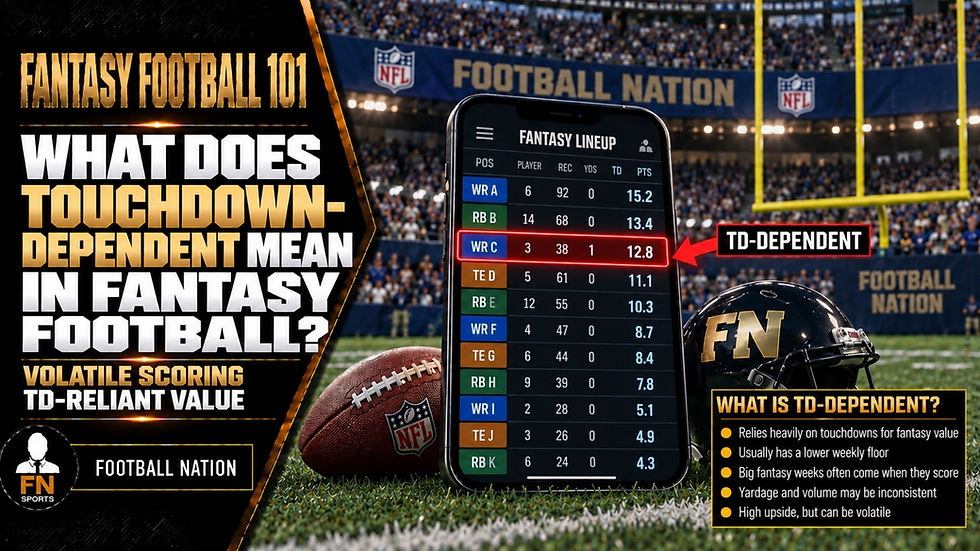
Start the diagnosis with target share and snap share versus route participation. Then check scoring-area work. A player can have strong overall volume but limited touchdown access, while a touchdown-dependent player may score efficiently on a thinner opportunity base.
How should you use xFP for start/sit decisions?
Use xFP as a role check, not a one-number lineup command. The NFL's targets-and-touches analysis shows why snap share, target share, air-yards share and red-zone touches belong in the same workload conversation. A rising xFP trend backed by more routes, targets or goal-line chances is more actionable than one isolated spike.
For a weekly start/sit decision, compare the player's recent xFP, actual points, health, team role and opponent. Also respect lineup-lock deadlines. A useful model cannot help after an early-game player is locked into the wrong slot.
The biggest xFP misconception
Underperforming xFP does not guarantee positive regression. The model says the opportunities historically carried more value than the player produced; it does not know that the player will keep the role, stay healthy or perform like the average baseline. Provider numbers can also disagree because the models and scoring formats differ.
The next factual checkpoint is the next game's workload. Did the player retain routes, carries, targets and high-value chances? If xFP stays high across several weeks while the role remains stable, the buy-low case becomes stronger. If the opportunities disappear, the old gap is no longer actionable.
Football Nation takeaway
Read xFP as the price of opportunity. High expected points tell you a player is being given valuable chances; actual points tell you how those chances finished. Trust a sustained role more than one explosive result, and use the gap to ask better questions—not to make automatic regression bets.
Expected fantasy points FAQs
What does xFP stand for in fantasy football?
xFP stands for expected fantasy points. It estimates the point value of a player's opportunities under a defined scoring model.
Is xFP the same as projected fantasy points?
No. A projection usually forecasts a future game or season and may include player talent, matchup and expected workload. xFP usually evaluates the opportunities a player already received.
Is higher xFP always better?
Generally, higher xFP means a more valuable workload. It still needs context from health, role stability, scoring format and the quality of the offense.
What does it mean when actual points are below xFP?
The player produced less than the model expected from the workload. That can create a buy-low signal, but it is not proof that better results must follow.
Which scoring format should I use for xFP?
Use the model that matches your league—PPR, half-PPR or standard—because receptions and other settings change the expected value of opportunities.


Comments