


What Does Touchdown-Dependent Mean in Fantasy Football?
Updated: Sep 22
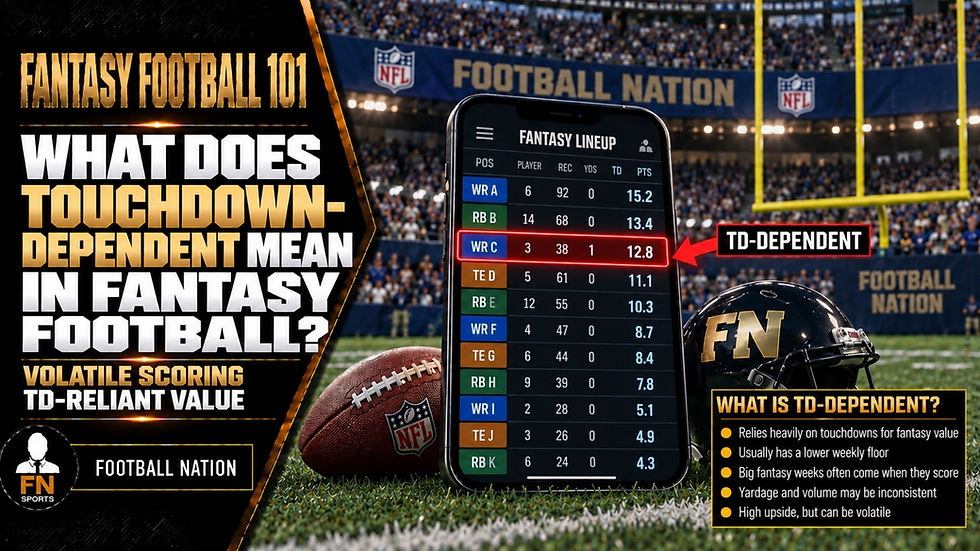
A touchdown-dependent fantasy player gets too much of his weekly value from scoring touchdowns and not enough from repeatable volume such as carries, targets, catches or yards. The player can still be useful, but his fantasy score is more likely to collapse when the touchdown disappears. The practical response is not “never start him.” It is to price the risk and compare his workload with your alternatives.
What makes a player touchdown-dependent?
Touchdowns are valuable but volatile. In common fantasy formats, one offensive touchdown is worth six points. A receiver who catches three passes for 30 yards and a touchdown scores 12 PPR points. Without the touchdown, the same workload produces only six. Half of that useful week came from one play.
A player becomes touchdown-dependent when that pattern repeats: low target share, few carries, modest yardage and a fantasy finish rescued by a score. A runner with regular goal-line work may intentionally carry touchdown upside, but a receiver converting a large share of limited end-zone chances is harder to trust.
Why last season's touchdown total can mislead you
High touchdown totals often fall the following season. ESPN's touchdown-regression study found that 208 of 256 player seasons with at least 10 rushing or receiving touchdowns from 2011 through 2023 were followed by fewer touchdowns the next year. The average decline was 4.9 scores. That does not prove every scorer will regress, but it shows why managers should not simply copy the previous total into a projection.
A current example appears in ESPN's 2026 tight-end profiles. Dallas Goedert scored 11 touchdowns in 2025 despite an expected-touchdown total of 5.1 and only five end-zone targets. Football Nation's analysis: the touchdowns helped the result, but the underlying opportunities make a full repeat difficult to assume.
How to spot touchdown dependency
Start with volume. Review target share for receivers and snap share and route participation for every pass catcher. For running backs, check total touches, goal-line carries and passing-game work. The NFL's targets-and-touches analysis demonstrates why snap share, target share, air-yards share and red-zone touches belong together when judging workload.
Then separate access from conversion. A player consistently earning carries inside the five-yard line or targets in the red zone has a repeatable path to touchdowns. A player scoring on a high percentage of sparse opportunities has a thinner margin.
The same 12 points can carry different risk
This PPR example uses one point per catch, 0.1 per receiving yard and six points per touchdown. Both players score 12, but Player A needs the touchdown while Player B reaches the same total through catches and yards. If each repeats the workload without scoring, Player A falls to six and Player B stays at 12.
PPR profile | With listed workload | Same workload, no TD |
|---|---|---|
Player A: 3 catches, 30 yards, 1 TD | 12 points | 6 points |
Player B: 6 catches, 60 yards, 0 TD | 12 points | 12 points |
Scoring source: arithmetic under the stated PPR assumptions. The example teaches scoring structure; it is not a player projection.
How should you use a touchdown-dependent player?
Use him when you need ceiling, the matchup raises scoring opportunity or your alternative has equally weak volume. Be more cautious when you are favored and need a stable floor. Football Nation's boom-or-bust guide explains that volatility can be useful when it matches the job your lineup needs.
For a weekly start/sit decision compare role before matchup: routes, targets, carries, red-zone opportunities and injury context. A favorable opponent cannot manufacture touches for a player who rarely sees the ball.
The biggest misconception
Touchdown-dependent does not mean bad. Goal-line backs and red-zone specialists can hold legitimate scoring roles. The warning is about the cost of failure: when a touchdown accounts for a large share of projected points, a normal scoreless week can look like a disappearance.
Football Nation takeaway
Treat touchdowns as the reward and volume as the foundation. Start with opportunities, verify access to scoring areas, then decide whether the touchdown risk fits your lineup. Do not chase last week's score without checking how it was built.
Touchdown-dependent fantasy football FAQs
Is every low-volume player touchdown-dependent?
No. The label fits when touchdowns repeatedly supply an unusually large share of fantasy value. One quiet week with a score is not enough.
Are goal-line running backs touchdown-dependent?
Often, but their designed carries near the goal line can make the scoring role more repeatable than a receiver living on rare end-zone targets.
Does touchdown regression mean a player will score fewer times?
No. Regression is a risk signal, not a guarantee. Team quality, role, health and scoring-area opportunities can all change.
Which statistic should I check first?
Start with touches or targets, then add snap share, route participation and red-zone opportunities. No single number tells the whole story.
Should I bench a touchdown-dependent player?
Not automatically. Compare his ceiling, floor and role with your alternatives and choose the risk level your matchup needs.


Comments