


What Does 11 Personnel Mean in Football? Offensive Groupings Explained
Updated: Sep 13
11 personnel means an offense has one running back, one tight end and three wide receivers on the field. The first digit counts running backs; the second counts tight ends. Because the quarterback and five offensive linemen account for six of the offense’s 11 players, the remaining skill-position spots are receivers. That is why “11” translates to 1 RB, 1 TE and 3 WR—not 11 players of one type.
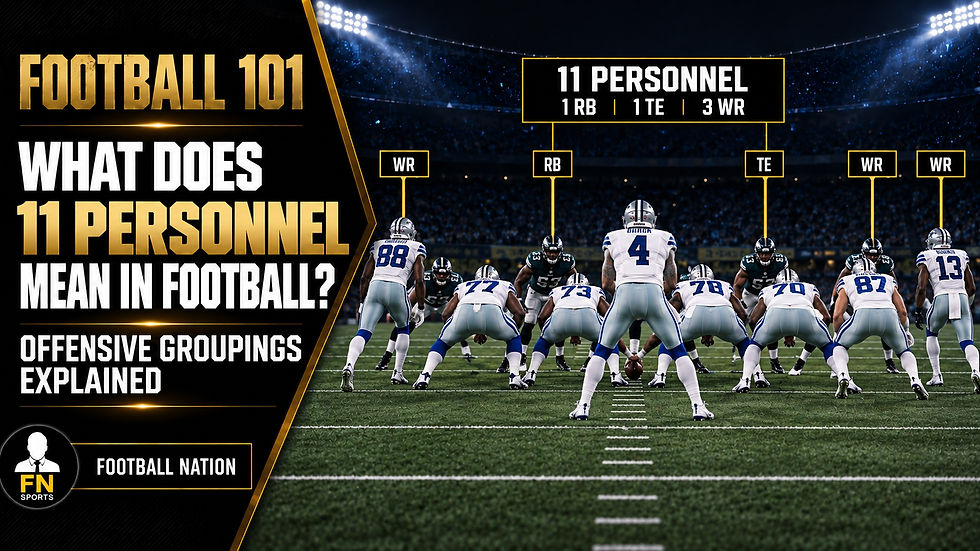
How the personnel code works
Personnel labels are a quick inventory, not a play call. Read the first digit as running backs and the second as tight ends. Subtract those players, the quarterback and five linemen from 11; the remainder are wide receivers. The Kansas City Chiefs’ official explanation uses the same shorthand: 11 personnel is three receivers, one running back and one tight end, while 12 personnel is two receivers, one back and two tight ends.
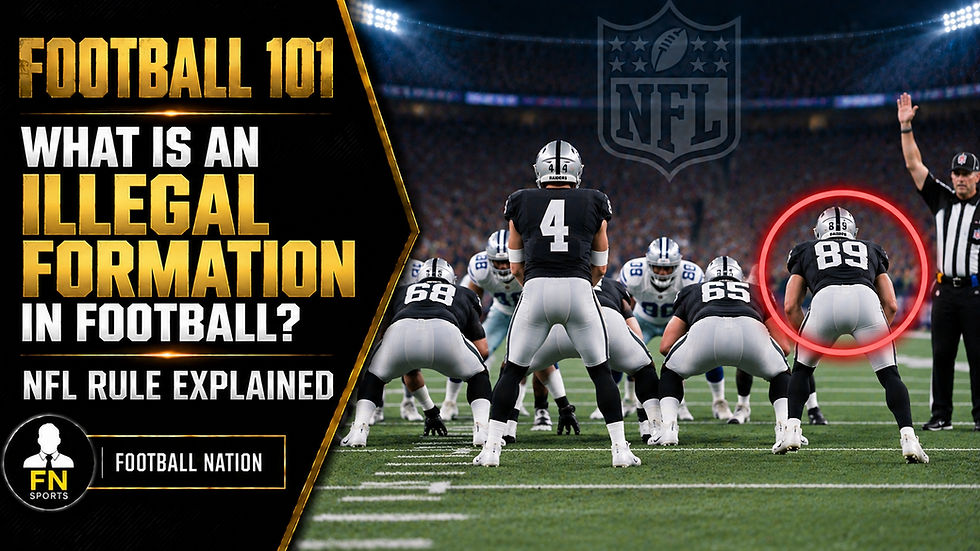
The code assumes the offense is fielding the legal 11-player unit described in the NFL Football Operations glossary. It also assumes five standard offensive linemen and a quarterback, which is why coaches do not say those positions in the package name. Before the snap, those players still must align correctly relative to the line of scrimmage; a correct personnel count does not protect an offense from an illegal formation.

What 11 personnel looks like
A basic 11-personnel huddle contains a quarterback, five linemen, one back, one tight end and three receivers. That roster can produce many pictures. The tight end can attach to the tackle, align in the slot, stand as an H-back or split wide. The running back can align beside the quarterback, behind him or motion out. The receivers can form a two-by-two set, a three-by-one trips set or a condensed bunch.
That flexibility is the package’s appeal. The offense can spread the defense without surrendering every useful run-blocking surface. An attached tight end creates an extra gap and can help run inside zone, while three receivers stretch coverage horizontally and threaten vertical matchups. If the defense answers with smaller defensive backs, the offense may run at a lighter box. If it keeps base personnel on the field, the offense can isolate a linebacker in coverage.
Personnel is not formation
The most important distinction is that personnel tells you who is on the field, while formation tells you where they line up. An offense can use 11 personnel in shotgun trips, under-center twins, empty, a bunch formation or a condensed set. Moving the tight end from the line to the slot changes the formation without changing personnel. Sending the back outside can create an empty formation while the package remains 11.
Motion does not automatically change the package either. A receiver can jet across the formation or a tight end can shift from one side to the other, provided the offense follows the rules governing who must become set. Football Nation’s guide to an illegal shift explains why two players moving simultaneously and failing to reset can draw a flag. The players’ identities stay the same even when their locations change.
Why offenses build around 11 personnel
The package offers a clean run-pass balance. Three receivers create spacing and force the secondary to defend the width of the field. The tight end lets the offense add a blocker, chip an edge rusher or release into a route. The back supplies the run threat, pass protection and a checkdown. The quarterback can reach a large section of the playbook without substituting.
That no-substitution flexibility matters because it can trap the defense in a bad matchup. If the offense moves quickly after seeing a favorable grouping, the defense may not be able to replace a linebacker with a nickel back or add a bigger front. A coach can call a run, play-action pass, quick screen or dropback concept from the same people and similar pre-snap presentation.
For route concepts, three receivers also make it easier to create traffic and leverage. A bunch or stack can generate natural releases, although the offense must avoid turning that traffic into offensive pass interference. The difference between a legal rub and an illegal pick route still depends on timing, contact and whether a receiver is genuinely running a route.
How defenses respond
The common answer to 11 personnel is nickel: five defensive backs, usually with a slot corner replacing a linebacker. Nickel gives the defense more speed for three-receiver formations and makes matchups cleaner. It is not mandatory. A defense may stay in base if its linebackers can cover, use a safety as a hybrid defender or play dime with six defensive backs in an obvious passing situation.
The offensive question is not merely “How many defensive backs are present?” It is where the defense places its bodies. A two-high shell may leave a lighter box but discourage deep throws. A safety rolled down can restore the run fit while exposing one-on-one coverage elsewhere. The package starts the chess match; the formation, motion and coverage answer determine the actual matchup.
11 vs. 12, 21 and 13 personnel
Changing one digit changes the offense’s menu and the defense’s substitution problem. In 12 personnel, a second tight end replaces a receiver, giving the offense two tight ends and two wideouts. That can add blocking strength while preserving four eligible receiving threats. In 21 personnel, a second back—often a fullback—replaces the third receiver, which can support lead runs, split-flow action and play-action. In 13 personnel, a third tight end leaves only one wide receiver, creating a heavy surface that often signals a downhill or short-yardage threat.
None of those packages guarantees a run or pass. A skilled receiving tight end can make 12 personnel behave like a spread set. A versatile fullback can motion from the backfield to the slot in 21. Conversely, an offense can run effectively from 11 if its receivers block and the formation removes defenders from the box. Personnel creates tendencies and matchup options, not certainty.
The strongest misconception
The biggest mistake is treating “11 personnel” as the name of one formation or one play. It is neither. Two offenses can deploy the same 11-player package in completely different shapes and run completely different concepts. Even within one drive, a team can shift from a tight under-center look to an empty shotgun look without changing anyone. If you identify only the package, you have answered who—not where, how or why.
A second mistake is assuming 11 always means pass. Three receivers increase route options, but the package can spread defenders out and create favorable running lanes. Likewise, heavy packages do not guarantee a run. Good offenses use personnel tendencies to influence defensive substitutions, then break those tendencies when the matchup is favorable.
How to identify personnel on a broadcast
Count the running backs and tight ends before counting receivers. Start in the backfield: is there one back or two? Then find the tight end, remembering that he may be detached from the line or moving across the formation. Once you have those two numbers, infer the receiver count. Ignore the quarterback and five linemen for the code.
Then watch what changes after the huddle. A tight end may flex out, a receiver may reduce his split and the back may motion wide. Those movements alter spacing, but they do not alter 11 personnel unless a substitution occurs. On replay, pause before the snap and label every eligible player. After a few series, the code becomes a fast way to anticipate the defense’s likely response.
Football Nation takeaway
Football Nation’s takeaway: 11 personnel is best understood as a versatile roster package—one back, one tight end and three wide receivers—not a formation and not a prediction. It gives an offense enough width to stress coverage, enough blocking structure to run the ball and enough flexibility to change the presentation without substituting. Count the backs, count the tight ends, then study where those players line up. The code tells you who is available; the alignment and motion reveal what the offense is trying to accomplish.


Comments