


What Is a Cadence in Football? Snap Count and Hard Count Explained
Updated: Sep 13
A cadence in football is the quarterback’s full rhythm of words, sounds, pauses and signals before the snap. Its first job is to keep all 11 offensive players synchronized. Its second job is to keep the defense from knowing exactly when the ball will move. The snap count is the specific agreed trigger inside that cadence. A hard count is a deliberate change in volume, emphasis or timing meant to test whether a defender will react early.
The direct answer is simple: cadence is the whole pre-snap communication sequence; snap count is the moment the offense expects the snap; and hard count is a tactic within that sequence. Those terms overlap, but they are not interchangeable.
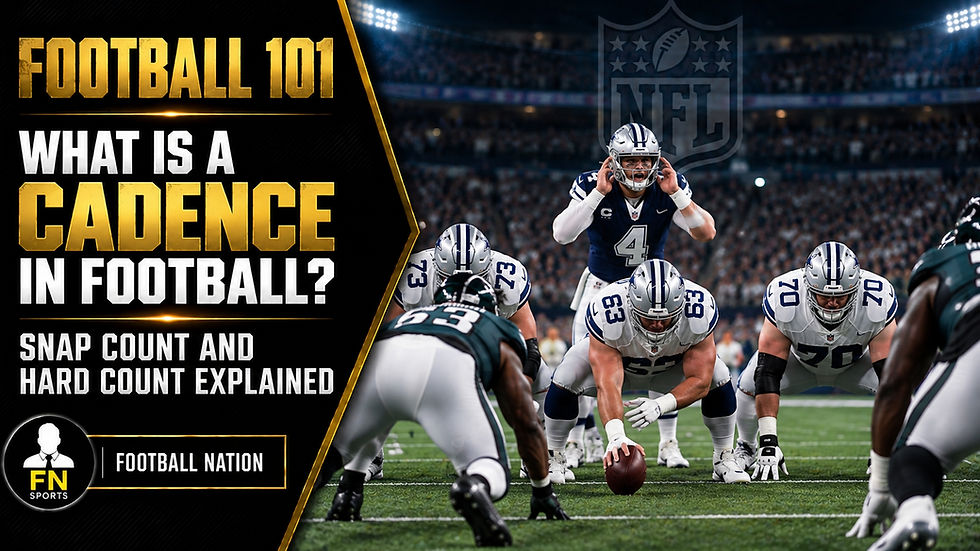
Cadence, snap count and hard count are different
Cadence
Cadence is the quarterback’s repeated pre-snap pattern. It may include a color, number, word, clap, leg lift or pause, depending on the offense and environment. There is no universal NFL phrase that means the same thing for every team. What matters is that the offense understands the pattern and the defense does not know which sound will release the ball.
Snap count
The snap count is the agreed cue that tells the center when to start the play. NFL Football Operations defines it as the quarterback’s signal on which the ball is snapped. The league’s football-terms glossary also separates the snap itself—the action that starts the play—from the signal that triggers it.
Hard count
A hard count changes the expected rhythm. The quarterback may raise the volume, stretch a word, repeat a familiar sound or insert an extra pause. The goal is to make a defender anticipate the snap instead of reacting to the ball. The offense still has to know the real trigger; otherwise, the trick is just as likely to cause an offensive mistake.
How cadence works step by step
First, the offense receives the play and gets aligned. Players must be legally set around the line of scrimmage before the snap. Motion or a shift may occur, but those movements have their own timing rules. Football Nation’s guide to pre-snap motion explains why the moving player and the other ten offensive players still need a shared clock in their heads.
Second, the quarterback identifies the defense and communicates any adjustment. That can involve protection, route or play changes. A hot-route adjustment is one example of a decision that must be communicated before pressure arrives. Cadence gives the offense an organized window to make that change without losing track of the snap.
Third, everyone listens for the agreed signal. The center moves the ball, the offensive line begins its assignment and eligible receivers release. The offense must finish all of this before the play clock expires. The words may sound dramatic on television, but their value is precision, not theater.
Why offenses use cadence
The basic reason is synchronization. Linemen cannot watch the quarterback once they settle into a stance. Receivers may be spread close to the sideline. The center is looking through his legs or at the defense. A consistent verbal or visual system lets the entire unit start together. Even a small timing difference can ruin a block, route or exchange.
The second reason is information. A quarterback can change the rhythm and watch whether a safety rotates, a linebacker creeps toward the line or a pass rusher reveals pressure. Cadence does not magically expose every coverage, but it can force the defense to hold its disguise longer or show its intentions before the play.
The third reason is control. An offense can play quickly, drain the clock or vary the snap timing without changing the play itself. Two calls may sound similar while the ball moves at different moments. That variation stops defensive linemen from getting the same first-step advantage on every down.
How a hard count can create a free-play chance
A successful hard count can pull a defender across the neutral zone before the snap. What happens next depends on the defender’s movement and the official’s ruling. Some neutral-zone and encroachment situations stop the play immediately; offside can sometimes allow the play to continue. Football Nation’s guide to encroachment, offside and neutral-zone infractions explains those distinctions.
The familiar highlight is a quarterback recognizing the flag and taking a deep shot because the offense may keep the penalty if the pass fails. An official NFL video shows Aaron Rodgers using a hard count before a 19-yard completion. But a free play is not guaranteed. The quarterback still has to confirm the play is live, protect the ball and avoid turning a five-yard advantage into a turnover.
The offense can be fooled too
Cadence creates risk because offensive players know the sound but must ignore every false cue around it. A lineman who moves before the snap can be called for a false start. A receiver who forgets the count may be late off the line. The center who snaps on the wrong sound can send the ball past a quarterback who is still reading the defense.
That is why teams practice cadence under noise and pressure. In a loud road stadium, the offense may use a silent count: a visual or physical signal replaces the quarterback’s voice, and the interior line relays the timing. The exact method varies by team. The principle does not—every offensive player must know the trigger while the defense reacts to the ball.
Can the defense imitate the cadence?
Defenders can communicate, but they cannot legally mimic the offense’s signal in a way designed to disrupt the snap. The NFL has specifically reminded teams that imitating a quarterback’s cadence or snap count can be treated as unsportsmanlike conduct. That protection matters because a copied signal could cause the center to snap early or make an offensive lineman move. The league’s cadence-mimicking reminder explains the rule’s purpose.
The biggest misconception
The biggest misconception is that every word in a cadence is a command. Most of the sequence may be rhythm, identification or disguise. Fans hear a quarterback shout a color and assume the play changed, but the same word may be a placeholder, a protection cue or nothing meaningful to an outside listener. Teams can also change what a word means from week to week.
A second misconception is that a hard count is simply yelling louder. Volume can help, but timing is the real weapon. If the quarterback uses the same pause before every snap, defenders can learn it. A useful cadence varies the rhythm without confusing the offense.
What to watch on the next play
Watch the ball and the offensive line rather than guessing from the quarterback’s words. Notice whether the defense shows pressure after the first call, whether the quarterback pauses to gather information and whether the snap comes on a repeated or unexpected beat. On the next third down, compare the quarterback’s voice rhythm with the previous play. The change often tells you more than the actual words.
Frequently asked questions
Is cadence the same as snap count?
No. Cadence is the full pre-snap rhythm and communication sequence. The snap count is the agreed cue inside that sequence that tells the center when to move the ball.
Why do quarterbacks yell numbers and colors?
Those words can communicate a play, protection, identification or timing cue, but there is no universal dictionary. The same sound can mean different things in different offenses.
Does a hard count always try to draw offside?
Usually that is the visible goal, but it can also slow a pass rush or force the defense to reveal movement. The offense must stay disciplined or the tactic can produce its own penalty.
Football Nation takeaway
Cadence is the offense’s shared pre-snap clock. The quarterback controls the rhythm, the snap count identifies the trigger and the hard count tests the defense’s patience. The smartest way to read it is not to decode every shouted word. Watch who moves, when the ball moves and whether the defense gives away information before the snap.


Comments