


What Is a Hard Count in Football? NFL Rule Explained
Updated: Sep 15
A hard count is a deliberate change in a quarterback’s pre-snap cadence—the words, rhythm and pauses used before the snap—to test whether defenders will reveal their intentions or cross the neutral zone too early. The sound itself is legal. The boundary is physical: if the quarterback or another offensive player makes an obvious movement that simulates the snap merely to draw the defense, officials can call a false start on the offense.
That distinction resolves the most common confusion. A defender flinching is not automatically offside, and a quarterback shouting louder is not automatically a foul. Officials judge where players move, whether contact occurs, whether an offensive player reacts, and where the defender is when the ball is snapped.
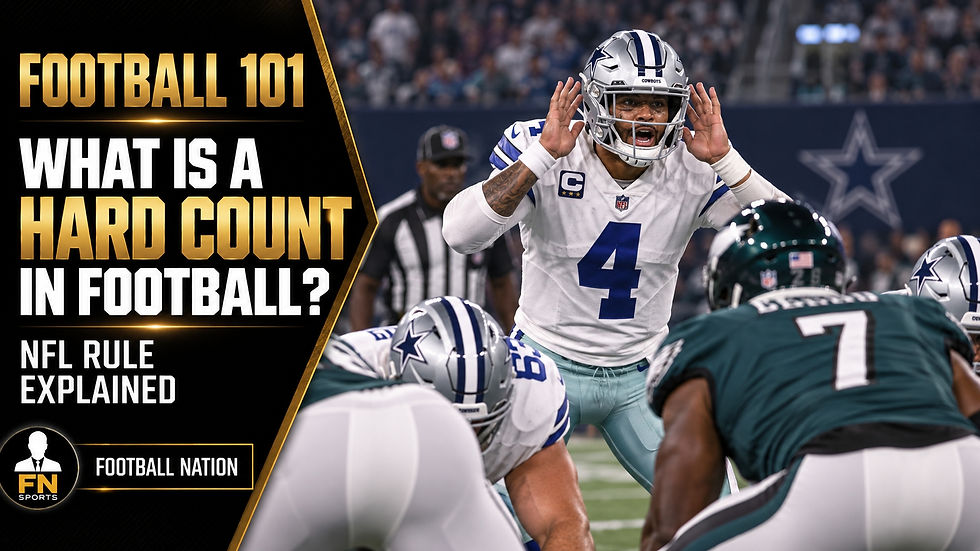
How does a hard count work?
Quarterbacks normally use a repeatable cadence so the center and other ten offensive players can anticipate the snap without looking at the ball. A hard count breaks that expectation. The quarterback may change volume, repeat a word, add a pause or use a dummy command before the real snap signal. The offense knows the plan; the defense must process it in real time.
Cadence is one part of the job described in Football Nation’s quarterback guide. The quarterback also checks the front, identifies pressure, communicates protection and may change the play. A hard count can support those tasks by creating a moment in which a defender tips a blitz or coverage rotation.
Hard count penalties: what each call means
The 2026 NFL Rulebook separates four calls that viewers often blend together. Each carries a five-yard penalty, but the trigger and timing differ.
False start
Trigger: An offensive player simulates the start; an obvious physical attempt to draw the defense can qualify.
Result: Dead ball; 5 yards.
Encroachment
Trigger: A defender enters the neutral zone and contacts an opponent or the ball before the snap.
Result: Dead ball; 5 yards.
Neutral zone infraction
Trigger: A defender enters and has an unimpeded path, or causes a nearby offensive player to react immediately.
Result: Dead ball; 5 yards.
Offside
Trigger: A defender is in or beyond the neutral zone when the ball is snapped.
Result: 5 yards; play may continue.
Source: NFL Rule 7, Section 4. The table summarizes the rule language; a call depends on the complete action around the neutral zone. Football Nation’s penalties explainer provides broader dead-ball and live-ball context.
Why do quarterbacks use a hard count?
The first goal is not always free yardage. A hard count can reveal information. A linebacker who creeps toward the line may confirm pressure. A safety who rotates early may expose a coverage shell. A defensive lineman who shifts at a particular word can show how the front is timing the cadence. That information helps the quarterback decide whether to snap, change protection or check to another concept.
The second goal is to disrupt the pass rush. Edge defenders want to launch at the first legal instant. If they guess the rhythm instead of watching the ball, a changed cadence can make them late or tempt them across the neutral zone. Even without a flag, a fraction of hesitation can help an offensive tackle. The effect is easier to see alongside common offensive formations.
The third goal is situational leverage. On fourth-and-short, an offense may line up with no intention of snapping before a timeout or delay decision. The quarterback tries to coax the defense into surrendering a first down. Readers learning why five yards can change possession should pair this with Football Nation’s guide to what a first down means.
Can the offense move during a hard count?
Players may communicate and legally shift, but the offense cannot simulate the snap with prohibited abrupt movement. A dramatic head bob, shoulder jerk or sudden lunge can turn the tactic against the quarterback. The rule specifically covers an obvious attempt by the quarterback or receiver to draw an opponent offside. A legal vocal cadence does not permit a physical fake start.
Motion and formation rules remain separate. A player moving legally at the snap does not make the cadence illegal, while an improperly set or moving player can create an offensive foul regardless of what the quarterback says. Football Nation’s guides to illegal motion and illegal formation explain those boundaries.
Does every defensive jump create a penalty?
No. A defender can enter the neutral zone and return to his side before the snap without a flag if he does not contact an opponent, create an unimpeded path to the quarterback or kicker, or cause a nearby offensive player to react immediately. That legal retreat is why disciplined linemen are coached not to move just because a defender twitches.
If the entry causes a threatened offensive lineman to react, officials can call a neutral zone infraction and stop the play. If contact occurs, the call is encroachment. If the defender remains across the line when the ball is snapped, it is offside. The official NFL football terms glossary defines the neutral zone as the space between the two lines of scrimmage established by the length of the ball.
What are dummy and silent counts?
A dummy count is a planned cadence word or sound that is not the true snap signal. It lets the quarterback test the defense while the offense stays still. A silent count addresses stadium noise: the offense uses a visual or physical cue that travels through the line to the center. Teams can vary timing in a silent system, but the mechanism is not primarily vocal.
Both methods require preparation. If the offense does not know which signal is live, the hard count is more likely to produce its own false start. The tactic stresses eleven defenders, but it also demands synchronized discipline from eleven offensive players.
The free-play misconception
Fans often expect a deep throw whenever a defender jumps. Sometimes a play continues after offside, letting the offense take a calculated shot because the penalty can erase a bad result. But there is no guaranteed free play. Officials stop the action immediately for encroachment, many neutral zone infractions and situations in which an unblocked defender has a path that creates a safety concern.
The quarterback also must confirm the flag. A defender can legally retreat before the snap, and the offense can commit a separate foul. Throwing recklessly because someone appeared to move can turn a useful tool into a turnover or avoidable hit.
How to spot a hard count on television
Listen for a cadence that changes rhythm instead of focusing only on volume. Watch the ball and line together. Did a defender cross the ball’s plane? Did he touch an offensive player? Did a nearby lineman react? Was the defender still across when the snap occurred? Those clues usually explain the referee’s call.
Also watch the play clock. Late in the count on fourth-and-short, the offense may be testing the defense before taking a timeout. Earlier in the game, the quarterback may be collecting information for a later snap. The value of the hard count is often visible on the next play, not the current one.
Football Nation takeaway
A hard count is controlled pre-snap information gathering, not a magic phrase that automatically creates offside. Vocal variation is legal; snap-simulating physical movement by the offense is not. The defense can recover from an early step in limited circumstances, and the exact five-yard call depends on contact, reaction, access to the quarterback and position at the snap.
When watching live, separate the sound from the movement. The quarterback controls the cadence, but the neutral-zone rules decide the penalty. That distinction makes one of football’s noisiest pre-snap moments much easier to read.


Comments