


When Is an NFL Pass Incomplete? The Dead-Ball Rule Explained
The short answer: an NFL forward pass becomes incomplete—and the ball becomes dead immediately—when the catch process is not finished, the pass goes out of bounds, or the first player to touch it has not legally reestablished inbounds after going out. The down counts, the ball normally returns to the previous spot, and the game clock stops. The crucial word is forward. A backward pass that hits the turf is still a live loose ball.
The rule in plain English
The controlling dead-ball language appears in 2026 NFL Rule 7, Section 2, Article 1(g): a legal or illegal forward pass is dead when it is incomplete. Rule 8, Section 1, Article 4 supplies the working definition and result. It says the down is lost, the ball returns to the previous spot, and the ball is dead immediately when one of the listed incomplete-pass conditions occurs.
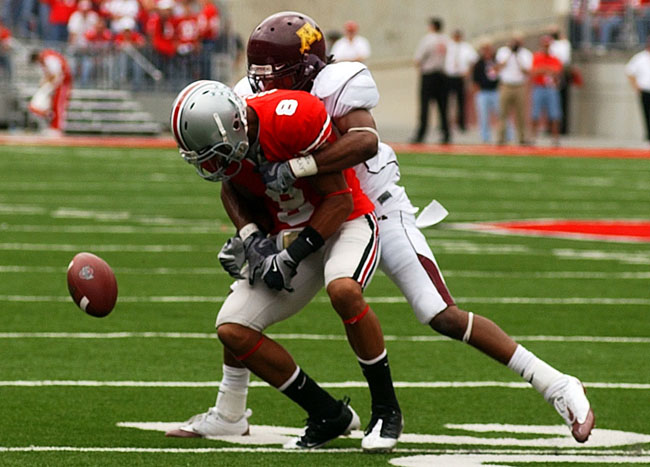
Ohio State safety Aaron Grant loses a pass while Minnesota cornerback Traye Simmons completes the tackle in 2008. Photo: Beth Rankin, CC BY 2.0, via Wikimedia Commons.
Three ways a forward pass becomes incomplete
Trigger | What the official sees | Immediate result |
|---|---|---|
Catch process fails | The receiver never completes control, the inbounds requirement and the football-act/time element | Incomplete; ball dead immediately |
Ball goes out of bounds | The untouched or uncontrolled forward pass crosses a boundary | Incomplete; ball dead immediately |
First toucher has not reestablished | A player who was out of bounds touches the pass before getting both feet—or another qualifying body part—back inbounds | Incomplete; no illegal-touching foul under this clause |
The first row is the one fans debate most. Possession by itself is not always a completed catch. The receiver must satisfy the complete three-part catch standard before losing the ball. If any required piece is missing, the forward pass is incomplete rather than a catch followed by a fumble.
The catch test officials apply
Under Rule 8, Section 1, Article 3, a player must first secure control of the ball before it touches the ground. The player must then touch inbounds with both feet or with any body part other than the hands. After those requirements, the player must clearly perform an act common to the game—such as taking another step, tucking the ball, turning upfield, extending it, or avoiding an opponent—or maintain control long enough to do so.
Football Nation’s full NFL catch-rule guide breaks that sequence down in more detail. For this lesson, the key is simple: if the sequence never reaches a legal catch, there was never runner possession to lose. The loose ball at the end is not a fumble. It is the unfinished forward pass becoming dead.
A public catch-rule discussion from Baltimore Beatdown, embedding former NFL referee Gene Steratore’s three-part explanation. View the original X status.
What happens after the incompletion
For an ordinary incomplete forward pass, the offense has used a down and the next snap comes from the previous spot. A second-and-7 pass from the offense’s 35 that hits the ground becomes third-and-7 at the 35. The offense does not receive the point where the ball landed, and the defense cannot scoop the ball and advance it.
The game clock stops when the forward pass is incomplete under Rule 4, Section 4(f). The next play then starts on the snap, which is why an offense can use legal incompletions to preserve time. A quarterback spike is its own authorized clock-management play; an ordinary throwaway can still produce an intentional-grounding foul if the separate grounding requirements are met. See Football Nation’s quarterback-spike rule guide for the clock-management details.
Do not confuse these five outcomes
Play type | Is the ball live after it hits the ground? | What fans should remember |
|---|---|---|
Incomplete forward pass | No | Down counts; return to previous spot |
Backward or parallel pass | Yes | Either team may recover and advance |
Completed catch, then fumble | Yes | Catch process finished before possession was lost |
Tipped forward pass hits ground | No | A tip does not change the pass from forward to backward |
Intercepted pass | Yes | Defense may advance unless another rule ends the play |
A backward pass is defined by where it first touches a player or the ground relative to the yard line where it left the passer’s hand. Parallel counts as backward. Under Rule 8, Section 7, Article 1, either team may recover and advance it after it touches the ground. The safe viewing habit is to keep watching the officials and the football until the play is clearly killed.
A tip does not rewrite the pass. The rulebook says a pass keeps its original forward-or-backward designation even if it is batted, muffed, punched or kicked in another direction. So a legal forward pass tipped backward and then onto the ground is still incomplete. If a defender catches it before it hits the ground, it is an interception and the play stays live.
A completed catch followed by contact is another category. Once the catch process is finished, the player is a runner. If the runner loses the ball before being down, officials judge a fumble; if the runner is already down, the play ended first. See Football Nation’s guide to down by contact and the separate explanation of forward progress for those dead-ball boundaries.
Two realistic examples
Example 1 — the sideline drop: On third-and-6, a receiver secures the ball near the boundary and plants his right foot inbounds. His left foot lands on the white stripe before he completes the inbounds requirement. The ball then comes loose. The ruling is incomplete. The ball is dead immediately, the down counts, and fourth-and-6 follows from the previous spot.
Example 2 — the dangerous “drop”: On first-and-10, a quarterback flips the ball to a running back stationed one yard behind him. The ball travels parallel to or behind the passer’s release yard line and hits the turf untouched. That is a backward pass, not an incomplete forward pass. The ball remains live, so either team may recover and advance. Stopping because it looked like a screen-pass drop can surrender possession.
Important exceptions and misunderstandings
The most common misunderstanding is that every uncaught pass is dead. Only an incomplete forward pass gets this immediate treatment. Direction—not the play’s name, formation or announcer’s first reaction—separates the dead ball from the live backward pass. The officials compare the release yard line with the first-touch yard line, which can make a nearly flat throw a close replay question.
An illegal forward pass can also be incomplete and dead, but the foul still matters. For example, a second forward pass or a forward throw after the ball crossed the line of scrimmage can trigger loss-of-down and yardage enforcement. “Incomplete” describes what happened to the pass; it does not erase a penalty committed during the down.
Intentional grounding is also a separate judgment. The 2026 rulebook explicitly says the pass does not have to be incomplete for grounding to apply. Officials evaluate pressure, the receiver’s direction and vicinity, pocket location and whether the throw reached the line of scrimmage when the outside-the-pocket exception is claimed. A ball hitting the ground answers the completion question, not every foul question.
The out-of-bounds first-toucher provision has a narrow edge case. If the player touches the pass before legally reestablishing, the pass is incomplete under Rule 8, Section 1, Article 4(c), with no illegal-touching foul under that clause. A player who does reestablish and then first touches the pass can create a different illegal-touching ruling under Article 8. The sequence of feet and touch matters.
What fans should watch for
On a disputed play, ignore the celebration and run the decision in order: Was the pass forward? Did the receiver secure control? Did both feet or another qualifying body part touch inbounds? Did the receiver perform a football act or maintain control long enough? If the answer fails before completion, look for the incomplete signal and the ball returning to the previous spot.
FAQ
Does an incomplete pass stop the clock? Yes. Rule 4, Section 4(f) stops the game clock when a forward pass is incomplete.
Can the defense recover an incomplete pass? No. The ball is dead immediately and returns to the previous spot.
Is a dropped backward pass incomplete? No. A backward or parallel pass that hits the ground remains live.
When does the next play become live? Usually on the next legal snap. Football Nation’s live-ball guide explains the exceptions.
The Football Nation conclusion
An incomplete-pass ruling is more than “the receiver dropped it.” It is a precise dead-ball decision. A forward pass that fails the catch process, leaves the field, or is first touched before an out-of-bounds player reestablishes is dead immediately; the down counts and the ball returns to the previous spot. Remember the contrast that saves possessions: forward pass on the ground, stop; backward pass on the ground, keep playing.
Rule references: 2026 NFL Rulebook, Rule 7, Section 2, Article 1(g); Rule 8, Section 1, Articles 3–4 and Section 7, Article 1; and Rule 4, Section 4(f).


Comments