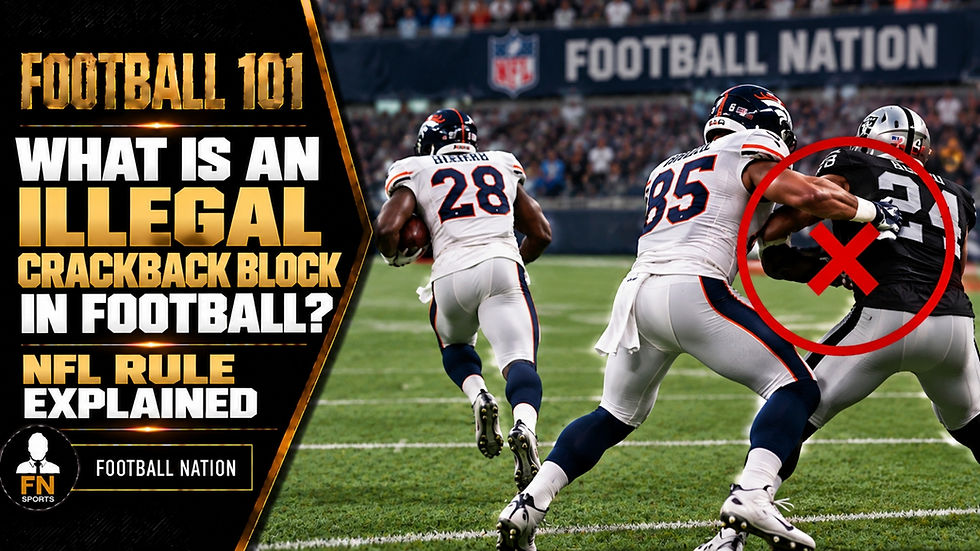
What Is a Chop Block in Football? NFL Rule and Penalty Explained
- Football Nation
- 10 hours ago
- 5 min read

A chop block in football is an illegal high-low combination in which two offensive players block the same defender: one engages him above the waist while the other contacts him at the thigh or lower. In the NFL, every chop block is a 15-yard penalty. The key is not simply that somebody goes low. The key is that a second blocker is also engaging, confronting or immediately following with contact on that same defender high.
That distinction is why the call can be confusing at full speed. A legal-looking double-team can become a foul when one blocker drops to the legs, and a low block that looks violent is not automatically a chop if there is no second high blocker. Start with three questions: Is it the same defender? Are there two offensive blockers? Is one high while the other is low? If all three answers are yes, officials are looking at chop-block territory.
The NFL definition of a chop block
The current NFL chop-block rule appears in Rule 12, Section 2, Article 5. It defines the foul as an offensive block in which one player contacts a defender in the thigh-or-lower area while another offensive player engages that defender above the waist. The league's rule is broader than a perfectly simultaneous hit. Timing, posture and the sequence of the two blocks can still make the play illegal.
This usually happens near the line of scrimmage where offensive linemen, tight ends and backs share blocking assignments. A defender who is anchored against high contact cannot freely protect his legs from a second blocker. That trapped-body position is what separates the chop from an ordinary one-on-one block.

How officials recognize the foul
On pass plays and kicking plays, the NFL lists several high-low patterns. The obvious version is simultaneous contact: one blocker is physically engaged above the waist while a teammate hits low. But the rule also covers a delayed low hit after the high contact breaks if the high blocker is still confronting the defender. It covers a “lure,” when the high blocker assumes a pass-blocking posture in front of the defender while the teammate chops low. And it covers a reverse chop, when the low contact arrives first and the high contact follows simultaneously or immediately afterward.
That matters in the passing pocket because a guard or center may pass a rusher to a teammate while another blocker is cutting across the formation. The absence of one frozen frame showing both blockers touching at once does not automatically make the combination legal. Officials judge the whole blocking sequence.
Running plays have their own listed patterns. A backfield player cannot chop a defender who is engaged above the waist by another blocker. An offensive lineman also cannot go low after that defender has already been engaged by a teammate, whether the earlier engagement was high or low. These details prevent blocking schemes from using timing as a loophole.
Chop block vs. cut block: what is the difference?
A cut block describes one blocker intentionally going low, usually toward the front of a defender. A chop block describes a two-blocker combination against the same defender. They are not interchangeable terms. Some solo low blocks may be legal depending on the play, location, direction and the league's other restrictions; every NFL chop block is illegal.
The phrase “he got cut” therefore does not prove a chop-block foul. Fans should identify the second blocker before using the term. The 2026 NFL rulebook separately lists chop blocks, illegal low blocks, clipping, peel-back blocks and illegal cut blocks. Each has its own elements even though several involve contact below the waist.
Location still matters for other blocking rules. The tackle box helps define the spatial context for several offensive and quarterback rules, but it does not create a safe zone for chop blocks. If the high-low combination satisfies Article 5, the fact that it occurred between the tackles does not erase the foul.
Common examples viewers can spot
1. The center holds high while the guard dives low
A defensive tackle is fighting the center's chest-level block. The guard comes from the side and contacts the defender at the thigh. Same defender, two blockers, high plus low: chop block.
2. The running back cuts a rusher occupied by a lineman
A pass rusher is squared up with a tackle in a pass-blocking posture. The back crosses the formation and hits the rusher low. Even if the tackle's hands have just separated, the tackle may still be confronting the defender, which can satisfy the NFL's delayed-contact or lure language.
3. The low block arrives first
A lineman contacts the defender low, then a teammate immediately engages the defender above the waist. That is the reverse-chop pattern. The order of contact does not make the high-low combination safe or legal.
What is not automatically a chop block?
One offensive player blocking low by himself is not automatically a chop block, although a separate low-block rule may still make it illegal. Two blockers engaging one defender above the waist is a double-team, not a chop. A defender merely brushing a second blocker also does not necessarily complete the foul. The rule includes a note for situations in which the defender initiates the above-waist contact or a blocker is only slipping or escaping and the engagement is incidental.
This is similar to other NFL penalties where one visible action is only part of the test. For example, illegal contact depends on distance, eligible-receiver status and whether the quarterback still has the ball in the pocket. Chop-block analysis likewise depends on participants, target area, timing and engagement—not just how dramatic the collision looks.
What is the penalty for a chop block?
The NFL penalty is 15 yards. It is a major drive-changing offensive foul: a successful run or completed pass can be erased, and the offense can be pushed into a long-yardage situation. The flag is separate from any later league review or discipline. For fans, the immediate scoreboard impact is the 15-yard enforcement announced by the referee.
Because the foul occurs after the snap, it differs from a dead-ball pre-snap violation such as a false start. The play may continue before officials sort out who engaged the defender high, who went low and when each block occurred. Broadcast replays are often needed to show the combination clearly.
Why the rule exists
The rule protects a defender who is already occupied above the waist and cannot fully see, avoid or absorb low contact from a second direction. It also gives coaches a bright-line teaching point: coordinated blocking cannot trap one player's upper body while attacking his legs. Offensive linemen can still work double-teams, climb to linebackers and exchange pass-rush assignments, but their technique must avoid the prohibited high-low combination.
The strongest misconception
The biggest misconception is that every block at knee level is a chop block. It is not. “Chop” requires the combination. The better viewing habit is to widen your focus rather than staring only at the low hitter. Find the defender's torso, then check whether another offensive player is engaged, confronting him in pass posture or arriving high immediately after the low contact.
Football Nation takeaway
Remember the formula: same defender, two offensive blockers, one high and one at the thigh or lower. In the NFL, that combination is illegal and costs 15 yards, including delayed, lure and reverse-chop versions described by Article 5. A solo cut block is a different concept and must be judged under the separate low-block restrictions. The next factual checkpoint is any future annual NFL rulebook update; until then, the 2026 rulebook and the league's video-rulebook page are the controlling references for NFL games.


Comments