top of page

What Is Clipping in Football? NFL Rule and Penalty Explained

Clipping is a 15-yard personal foul in the NFL: a player blocks a non-runner from behind and below the waist. That four-part test—block, from behind, below the waist, against a non-runner—is the fastest way to understand the call. The rule has a narrow close-line exception, but it never permits contact at or below the knees. This guide explains the current standard, the exceptions and the plays that look similar without actually being clipping.

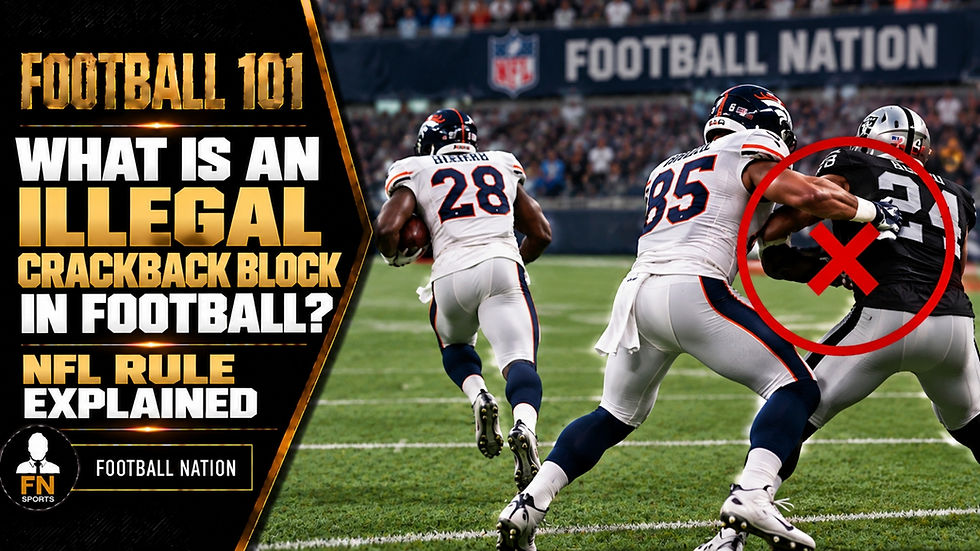
Football Nation illustration of an illegal clipping block from behind and below the waist on a non-runner.
Original Football Nation illustration: clipping is a 15-yard foul when a non-runner is blocked from behind and below the waist.

What counts as clipping in football?

The NFL’s official clipping rule appears in Rule 12, Section 2, Article 1. It defines clipping as blocking an opponent from behind below the waist and prohibits it against a non-runner. Each word matters. A low block from the front is not clipping under this definition, though another low-block restriction can still make it illegal. Contact from behind above the waist is not clipping either, though it can become an illegal block in the back or holding. And the rule does not protect the runner in the same way because tackling the ball carrier necessarily allows contact from pursuit angles.

The four tests officials apply

First, there must be a block. Clipping is a blocking foul, not a label for every collision near a player’s legs. Second, the initial action must come from behind. Officials judge the blocker’s path and the opponent’s opportunity to see or ward off contact. Third, contact must be below the waist. Fourth, the opponent must be a non-runner. The football’s location therefore matters: a defender chasing the ball carrier is protected by the clipping rule, while the player possessing the ball is treated as a runner.

Football Nation teaching diagram showing clipping from behind, below the waist, against a non-runner, with a 15-yard penalty.
Football Nation teaching graphic: the four core elements of an NFL clipping foul and the close-line limitation.

A useful replay method is to freeze the frame just before contact. Identify the ball carrier, draw an imaginary line through the defender’s shoulders, then locate the blocker’s first meaningful contact. If the defender is not the runner, the blocker arrives through the defender’s back, and the contact lands below the waist, the essential clipping elements are present.

How the close-line exception works

The main exception applies to offensive blocking in close-line play. The 2026 NFL rulebook allows clipping above the knees in that tightly defined area, but not at or below the knees. “Close-line play” is not the whole tackle box or every interior run. It is a rulebook term tied to players initially positioned close to the line of scrimmage. That distinction is why simply saying “linemen can clip inside” is dangerously incomplete.

There is also a flow restriction. An offensive lineman cannot use the exception to clip above the knees a defender who was aligned opposite another offensive lineman more than one position away when that defender is moving with the ball’s flow away from the blocker. The rulebook’s example is an offensive tackle clipping a nose tackle on a sweep away. In plain English: the exception is for immediate close-line action, not a license to chase across the formation and cut down a defender from behind.

When similar contact is not clipping

The rule supplies several important judgments. A block from the side is not clipping. If the opponent turns his back as the block is being made, it is not clipping when he could see or ward off the block. When a blocker moving in the same direction first makes contact on the opponent’s side and that continuous contact later shifts behind and below the waist, it is not clipping. Those provisions keep the foul focused on the dangerous surprise block rather than punishing every moving collision that finishes at an awkward angle.

One action overrides those protections: roll-up contact. If a blocker’s legal or illegal block is followed by the blocker rolling onto the back or side of a defender’s legs, the NFL treats it as clipping, including during close-line play. The initial shoulder or hand placement does not sanitize a dangerous finish into the legs.

Clipping vs. a block in the back, chop block and peel-back block

Clipping is often confused with three different fouls. A conventional block in the back involves contact from behind above the waist, so the contact level separates it from clipping. A chop block is a high-low combination in which two offensive players engage the same defender; clipping can involve one blocker and is defined by the rear angle. A peel-back block focuses on an offensive player moving toward his own end line and contacting an opponent from the side and below the waist under the rule’s directional test. The NFL’s peel-back rule also carries 15 yards, but it is not merely another name for clipping.

A blindside block is different again: it depends on the blocker’s path toward or parallel to his own end line and forcible contact with the helmet, forearm or shoulder. The contact does not have to be below the waist. Fans should resist sorting every unexpected block into one bucket; angle, height, direction, number of blockers and who has the ball all change the rule.

Penalty and enforcement

The penalty for clipping is 15 yards. Like other live-ball fouls, the final result depends on the enforcement spot, possession and whether other fouls occurred. The simple broadcast shorthand—“15-yard personal foul”—is correct, but it does not by itself tell you where the next snap will occur. That requires the full play context and the NFL’s enforcement rules. Officials use the personal-foul signal and announce clipping to identify the prohibited act.

The strongest misconception

The biggest misconception is that clipping means any low block from behind. The actual rule is narrower and more precise. It protects a non-runner, contains side-contact and continuous-contact provisions, recognizes a limited close-line exception above the knees, and separately condemns rolling into the back or side of the legs. Conversely, a block that misses one clipping element can still violate the league’s other safety rules. “Not clipping” never automatically means “legal.” For example, formation, location and the blocker’s direction can trigger other restrictions inside or outside the tackle box.

Why the rule matters

A defender engaged with the play cannot brace for a low hit arriving from directly behind. The clipping rule removes that high-risk combination while preserving limited, immediate line play above the knees. It also gives coaches a teachable progression: keep the head and shoulders in front or to the side, avoid the back of the legs, never roll through a defender’s knees, and do not assume interior positioning creates immunity.

Football Nation takeaway

Use this checklist on the next replay: Was the opponent a non-runner? Did the blocker approach from behind? Was the contact below the waist? Did it occur outside the narrow close-line allowance—or at or below the knees, where that allowance never applies? Four yes answers point directly to clipping and a 15-yard penalty. The next factual checkpoint is the NFL’s annual rulebook and officiating guidance; if the league changes blocking zones or exceptions, those official materials control. Until then, the clearest distinction is simple: clipping attacks a non-runner from behind and below the waist.

Comments


bottom of page