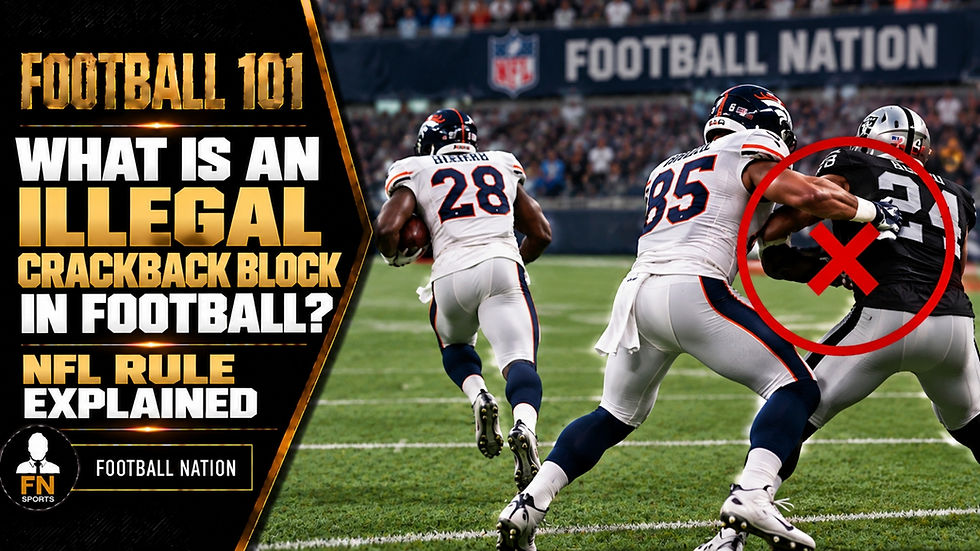
What Is an Illegal Crackback Block in Football? NFL Rule Explained
- Football Nation
- 4 hours ago
- 6 min read
An illegal crackback block is a 15-yard NFL foul that starts with where the blocker lines up and how he moves. In the clearest version, an offensive player begins outside the tackle or in the backfield, moves inward toward the position from which the ball was snapped, and contacts a defender below the waist within five yards of the line of scrimmage. The name describes the blocker's path back toward the formation; it does not make every forceful block from the side illegal.
The quickest way to judge the play on television is to use three questions: Where was the blocker at the snap? Did he travel back toward the snap point? Where did the contact land? When the qualifying alignment, inward path and prohibited low contact all appear in the restricted area, officials have the Article 6 crackback foul.
What the NFL rule actually says
The 2026 NFL Rulebook places crackback blocks in Rule 12, Section 2, Article 6. The play must occur in an area extending five yards on either side of the line of scrimmage, including close-line play. The blocker also must be moving toward the position from which the ball was snapped.
Article 6 identifies three ways the blocker can qualify. He can be set more than two yards outside an offensive tackle. He can start in the backfield and then move to a position more than two yards outside the tackle. Or he can be in the backfield and in motion when the ball is snapped. That origin test is why replay begins before the hit, not at it.
The two-yard threshold is measured from the offensive tackle, not from the center of the field. It also should not be confused with the tackle box, a separate rulebook concept used for other decisions. For a crackback ruling, the official needs the blocker’s pre-snap relationship to the tackle, his path and the contact point.
How to spot an illegal crackback block
Start with alignment. A slot receiver split well outside the tackle is an obvious candidate, but a back can qualify too. If the player begins tight to the formation and never meets one of Article 6’s origin conditions, a low block might implicate another rule, but it is not automatically a crackback foul.
Next, follow the path. The blocker must move back toward the position from which the ball was snapped. A receiver running straight downfield or continuing toward the sideline is not taking the characteristic crackback angle. The rule is concerned with the inward return toward traffic.
Then find the contact point. The classic illegal action is contact at or below the defender’s waist. An inward block delivered above the waist can avoid this crackback-specific low-block element, but it still must be legal under the rest of the rulebook. Open hands do not excuse grabbing or restriction, which can become offensive holding.
Finally, locate the block relative to the line. Article 6’s crackback area reaches five yards behind and five yards beyond the line of scrimmage. A similar-looking collision elsewhere may be judged under a different blocking rule. That is why a single freeze-frame rarely proves the call.

A common game example
Picture a slot receiver aligned four yards outside the tackle. The offense runs the ball inside, and a linebacker flows laterally toward the runner. The receiver folds back toward the original snap point and dives into the linebacker’s thigh near the line of scrimmage. Alignment, direction, area and low contact all match the crackback test, so the offense is exposed to a 15-yard penalty even if the runner is already through the hole.
Backfield motion matters as well. The NFL’s 2017 health-and-safety changes expanded the protection to a backfield player in motion at the snap, even when he did not first move more than two yards outside the tackle. That closes a loophole in which motion could create the same dangerous low, inward block from a different starting picture.
What is not automatically a crackback foul
A receiver is allowed to come inside and block. If he stays above the waist, approaches from a legal angle and uses legal technique, the inward movement alone does not produce the Article 6 foul. Likewise, simply calling a hit “blindside” does not establish a crackback. The official must match the complete definition.
There is another important caution: avoiding the crackback definition does not make every collision legal. A blocker can still commit holding, use illegal helmet contact, deliver a prohibited blindside block or violate another low-block restriction. “Not a crackback” means only that this particular rule is not the right label.
Crackback vs. blindside block, chop block and clipping
A blindside block is defined primarily by the blocker’s path toward or parallel to his own end line and by prohibited forcible contact. A crackback block begins with the blocker’s alignment and inward path toward the snap point, then applies the restricted-contact test. The plays can look similar because the defender may not see either one coming, but the rulebook questions are different.
A chop block involves two offensive players applying a high-low combination to the same defender. A crackback needs only one qualifying blocker. Clipping focuses on blocking a non-runner from behind and below the waist. Crackback focuses on the blocker’s starting position, inward movement and restricted area. One dangerous play can resemble more than one category, so officials use the definition that fits the full sequence.
Why the rule exists
The defender targeted by a crackback is usually reading the runner or fighting through interior traffic. He may not see the receiver returning from outside, and low contact can arrive while his weight is planted. The restriction is designed to remove that vulnerable hit without banning receivers from blocking altogether.
The rule is part of a longer safety trend. The NFL’s health-and-safety rule history documents expanding protections for defenseless players and repeated limits on dangerous low blocks. The 2017 motion-player addition shows how the league has refined the crackback rule when offensive movement created the same risk from a new alignment.
What the 15-yard penalty changes
Article 6 sets a 15-yard penalty. Because it is an offensive foul, it can erase a productive run, turn a manageable series into long yardage and wipe out the exact advantage the block was meant to create. The broader Football Nation penalties guide explains why enforcement can look different depending on when and where an offensive foul occurs.
The most common misconception is that “crackback” is just another name for any unseen hit. It is not. The label requires a qualifying blocker, an inward path, the restricted area near the line and prohibited contact. If one element is missing, viewers should look for a different rule instead of forcing the crackback label.
The next factual checkpoint
The annual NFL rulebook is the next checkpoint because blocking restrictions can be revised during the offseason. Until the league changes Article 6, the useful viewing formula is alignment, path, area, contact point. That four-step sequence is more reliable than judging the violence of the hit alone.
Football Nation takeaway
When a flag follows an outside receiver folding into the formation, rewind to the snap. If the blocker qualified by alignment or backfield motion, traveled toward the original ball position and struck low within five yards of the line, the 15-yard crackback call has a clear rulebook basis. If the contact was above the waist, keep watching for holding, blindside contact or another foul before assuming the block was legal.
Illegal crackback block FAQs
Is every crackback block illegal? In NFL rulebook language, Article 6 defines the prohibited crackback block. Fans sometimes use the term loosely for any receiver blocking inward, but a legal above-waist inward block is not automatically the foul.
What is the penalty for an illegal crackback block? The NFL penalty is 15 yards.
Can a receiver legally block back toward the ball? Yes. He must avoid the prohibited low contact and comply with every other blocking rule, including holding, blindside-block and helmet-contact restrictions.
Is a crackback block the same as a blindside block? No. The rules examine different elements, although a single collision can look similar and may implicate more than one safety restriction.


Comments