top of page

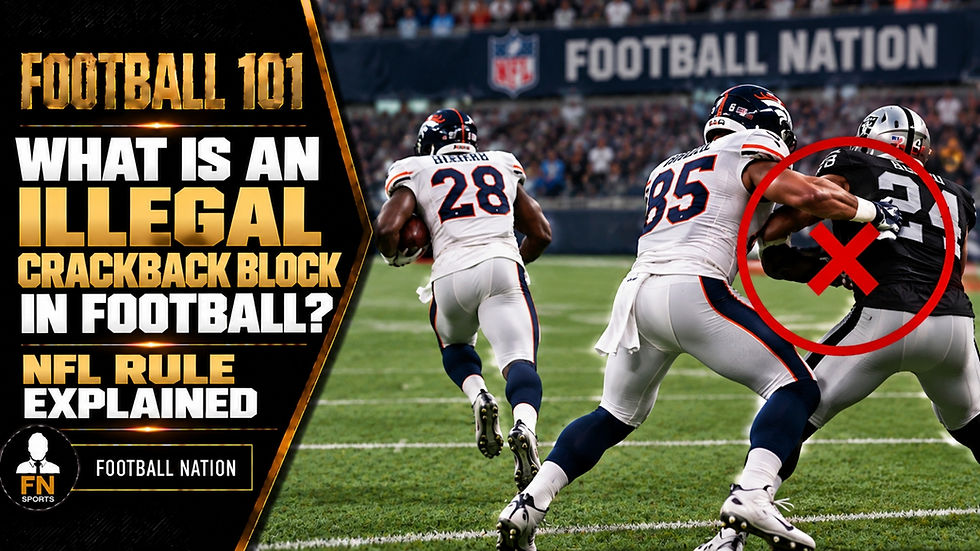
What Is a Crackback Block in Football? NFL Rule Explained

Direct answer: A crackback block is an inward block delivered by an offensive player who begins outside the core of the formation or comes from the backfield. The block itself is not automatically illegal. Under the 2026 NFL rule, it becomes an illegal crackback when the alignment, movement and location requirements are met and the blocker contacts the defender below the waist or uses prohibited force against a defender in a defenseless posture. The penalty is 15 yards.

That distinction matters because broadcasters often use “crackback” to describe the blocking path, while the flag depends on the contact. A receiver can legally block toward the formation if he stays within the rules. The viewer’s job is to separate the design from the foul.

The NFL definition

NFL Rule 12, Section 2, Article 6 creates a three-part test. First, the block must occur within five yards on either side of the line of scrimmage. Second, the offensive player must be moving toward the position from which the ball was snapped. Third, the blocker must come from one of the alignments named in the rule: set more than two yards outside the tackle, from the backfield after moving more than two yards outside the tackle, or from a backfield position while in motion at the snap.

Once those conditions are present, two kinds of contact are prohibited. The blocker cannot contact the defender below the waist. He also cannot initiate the kinds of head, neck or other forcible contact prohibited against a defenseless player. The official 2026 NFL rulebook lists a 15-yard penalty.

The five-yard language is easiest to understand with Football Nation’s line of scrimmage guide. Imagine a band extending five yards into the offensive backfield and five yards beyond the line. Article 6 applies to the crackback action inside that band.

Football Nation crackback-block viewing diagram showing a wide receiver moving inward toward a defender inside the NFL rule's five-yard area.
Football Nation teaching diagram: check the blocker's alignment, inward path, five-yard location and contact point. Original 1600×900 graphic.

How the play is designed

Offenses use crackback action to change the blocking angle on an edge defender or pursuing linebacker. A wide receiver aligns outside, sells a route or waits for the snap, then works back toward the ball. Instead of asking a tight end or tackle to reach a defender moving outside, the offense attacks from the opposite direction.

That angle can support outside runs, reverses, receiver screens and option concepts. On Power O, the inward block may help control an edge defender while the kick-out and pulling guard form the interior lane. On Pin-and-Pull, a receiver can prevent an outside defender from beating the pullers to the perimeter. A screen pass can also ask a receiver to block inward while teammates release into space.

The legal coaching point is position and control. The receiver must identify the correct target, approach on a visible path and strike legally. A dramatic collision is not required. Often the best block is simply getting the body between the defender and the ball carrier.

Legal crackback action vs. an illegal crackback

A receiver starting wide and blocking toward the formation is not enough by itself to draw a flag. The official must confirm the rule’s alignment and movement elements, the five-yard location and prohibited contact. A controlled block to the defender’s torso can be legal if it does not violate the separate blindside or defenseless-player rules.

The illegal version commonly appears when the blocker dives at the defender’s legs, launches into the head or neck area, or delivers prohibited forcible contact to a player who cannot reasonably protect himself. The same collision can also implicate another safety rule. Officials classify the action by the elements they see, not by the label a broadcaster uses first.

That is why “crackback” and “blindside” are not synonyms. A blindside-block foul under Article 7 focuses on the blocker’s path toward or parallel to his own end line and forcible contact with the helmet, forearm or shoulder, subject to the rule’s close-line-play exception. The NFL’s blindside-block rule-change explanation shows why the league treats that as a separate safety test. A crackback foul under Article 6 focuses on the specified outside or backfield alignment, movement toward the snap point, the five-yard area and the prohibited contact. One play can look like both concepts, but the rule tests are different.

Crackback block vs. chop block

Football Nation’s chop-block explainer covers a different foul. A chop block involves two offensive blockers attacking the same defender in a prohibited high-low combination. A crackback can involve one blocker coming inward from the perimeter.

Both fouls can include low contact and both cost 15 yards in the NFL, which explains the confusion. The fastest distinction is to count blockers. If two offensive players combine high and low on the same defender, think chop block. If one outside or backfield player travels inward and delivers prohibited contact within the rule’s area, think illegal crackback.

Why the rule exists

The defender targeted by crackback action is often pursuing the ball and looking away from the blocker. He may be trying to set the edge, scrape over the top or chase a screen from inside-out. Football Nation’s force-defender guide explains why that player’s eyes naturally follow the runner and blocking surface.

The rule does not remove perimeter blocking. It removes specific low and defenseless-player contact from a high-risk angle. The NFL’s health-and-safety rules history notes that the league expanded crackback restrictions in 2017 to include a backfield player in motion even when he was not more than two yards outside the tackle box at the snap. The current rulebook carries that protection forward.

How to recognize the call on television

Start with the blocker before watching the collision. Was he a flexed receiver more than two yards outside the tackle, a back who moved wide, or a back in motion at the snap? Next, watch his path. Is he traveling inward toward the original snap point? Then locate the contact relative to the line of scrimmage.

Finally, evaluate the strike. Contact below the waist is the clearest crackback trigger. For higher contact, look for forcible contact to the head or neck area or another act prohibited against a defenseless player. A legal torso block that the defender can see or ward off may look physical without satisfying the foul.

The replay angle matters. The broadcast view may hide the blocker’s pre-snap alignment, while the end-zone replay may hide how far outside he began. Officials can communicate across the crew because one official may see the formation and another may see the contact point.

The biggest misconceptions

The biggest misconception is that every inward receiver block is illegal. It is not. “Crackback” can describe the path; “illegal crackback” requires prohibited contact under the rule. The second misconception is that any hit from the side is automatically a blindside block. Direction, force, body part and location still matter.

The third misconception is that a low block by itself must be a chop block. A chop needs the second blocker and high-low combination. An illegal crackback can be a one-on-one low block from the qualifying alignment and path.

Crackback block FAQ

Is every crackback block illegal in the NFL?

No. An inward block is not automatically a foul. Article 6 prohibits low contact and specified defenseless-player contact when the rule’s alignment, movement and location conditions are fulfilled.

What is the penalty for an illegal crackback block?

The NFL penalty is 15 yards.

Can a wide receiver legally block a linebacker?

Yes. A receiver can make a legal block if the contact, location and technique comply with the crackback, blindside and other blocking rules.

What is the difference between a crackback and a blindside block?

Crackback rules focus on an outside or backfield blocker moving toward the snap point inside the specified five-yard area. Blindside rules focus on the blocker’s path toward or parallel to his own end line and prohibited forcible contact.

What is the difference between a crackback and a chop block?

A crackback usually describes one perimeter or backfield blocker coming inward. A chop block is a prohibited two-blocker high-low combination against the same defender.

Football Nation takeaway

Football Nation’s verdict: identify the path first and the foul second. A crackback is an inward blocking action; it becomes an illegal NFL crackback only when the Article 6 alignment, movement and five-yard conditions are present and the contact is below the waist or prohibited against a defenseless player. Remember the viewing sequence: where did the blocker start, where was he moving, where did contact occur and what part of the defender did he strike?

Sources and visual credits

Rules verified through the 2026 NFL Rulebook, NFL Football Operations’ health-and-safety rules history and the NFL’s blindside-block rule-change explanation. Cover and body diagram are original Football Nation graphics created August 21, 2026. They use anonymous players, no real-person likeness, no team marks and no licensed photograph. Both images are 1600 by 900.

Comments


bottom of page