top of page

What Is a Scramble Drill in Football? How Receivers Get Open

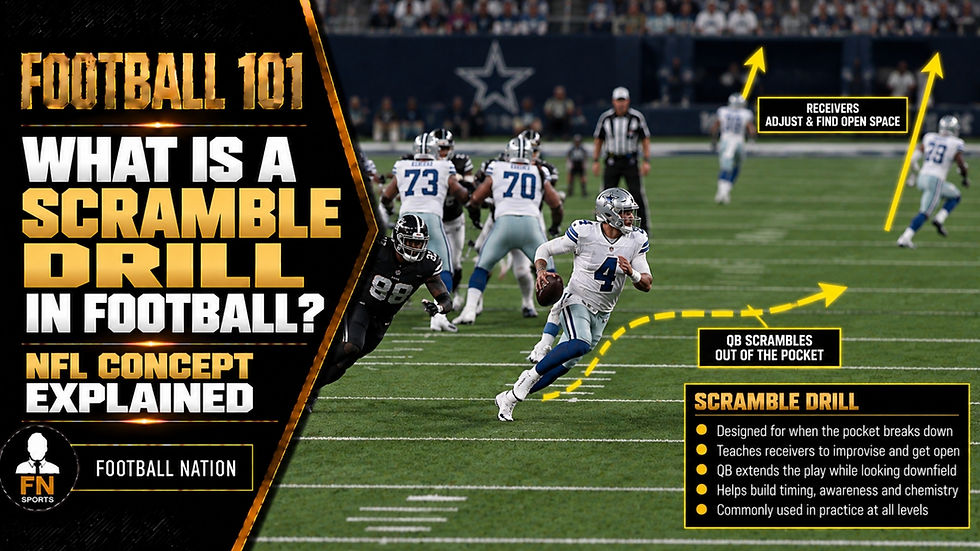
A scramble drill is the offense’s coordinated response when a called pass play breaks down and the quarterback escapes the pocket while still looking to throw. Receivers stop following the original route exactly and move according to practiced adjustment rules—changing direction, changing depth and creating clear throwing lanes.

The direct answer: a scramble drill is organized improvisation. It is not a designed quarterback run, an option route or five receivers freelancing toward the ball. The quarterback buys time behind the line of scrimmage; the receivers react to his movement without crowding one another; and everyone tries to turn a failed first picture into a legal second-reaction pass.

When does the scramble drill begin?

It begins when the normal timing and structure disappear. Pressure may force the quarterback out of the pocket. Coverage may erase the first reads. A receiver may complete his route before the quarterback has a clean throwing lane. At that point, the scheduled concept has largely done its work, and the offense enters an off-schedule phase.

That makes the scramble drill different from a hot route. A hot route is a built-in answer to an unblocked rusher. A scramble drill develops later, after the quarterback extends the play.

It is also different from an option route. An option route gives a receiver approved endings based on leverage or coverage while the play remains on schedule. A scramble adjustment happens because the original route structure is no longer producing a throw.

Official team reporting consistently describes this as practiced work, not luck. Packers receiver Matthew Golden said Green Bay rehearsed the scramble drill immediately before a 31-yard third-down conversion in 2025, and Christian Watson said the team worked on it frequently. Seattle coach Pete Carroll emphasized finding openings and spacing when the first play breaks down.

How receivers adjust without colliding

There is no universal NFL scramble-drill chart. Each offense teaches its own landmarks, signals and priorities. Still, a common principle survives across systems: preserve levels. If every receiver runs toward the quarterback at the same depth, one defender can cover multiple targets and the passer loses a clean window.

A useful teaching model looks like this:

• A deep receiver works back toward the quarterback or finds open space along the boundary.

• A short receiver can turn upfield to occupy a defender and create a deeper target.

• A middle receiver can cross the field with the quarterback’s movement.

• A backside receiver can continue across the formation into the passer’s new sightline.

These are examples, not NFL-wide laws. The assignment can change with formation, route distribution, field position and the quarterback’s escape direction. The important part is the relationship between routes: one short, one intermediate and one deep target are more useful than three receivers standing together.

Football Nation teaching diagram showing a quarterback rolling right while four receivers adjust at separate short, middle and deep levels during a scramble drill.
Original AI-assisted Football Nation teaching graphic: receivers change direction and depth while preserving short, intermediate and deep throwing lanes.

The receiver’s original path still matters. A player running a seam route may become the deepest target, while a back who began as the checkdown can climb or uncover near the sideline. Understanding the route tree helps viewers see what changed.

What the quarterback must do

The quarterback’s first responsibility is to stay a passer as long as the situation allows. He must escape pressure, keep two hands on the ball in traffic, regain balance and continue scanning downfield. A wild sprint can make the receivers’ rules impossible to read; controlled movement gives them time to uncover.

Direction matters. When the quarterback rolls right, receivers generally need to enter his visible throwing lanes. Throwing back across the body is dangerous because underneath defenders can recover into the path.

The line of scrimmage creates the hard legal boundary. Under Rule 8 of the 2026 NFL Rulebook, a forward pass is illegal if the passer’s entire body is beyond the line when he releases it. The scramble drill therefore contains a constant choice: stay behind the line and keep the pass alive, or cross it and become a runner.

The passer also cannot assume a receiver remains eligible after leaving the field. The rulebook’s illegal-touching provision says an eligible receiver who voluntarily goes out of bounds and reestablishes inbounds generally cannot be the first player to touch a forward pass. Sideline awareness is part of getting quarterback-friendly.

Why scramble drills are hard to defend

Coverage is designed to match the original route spacing and the quarterback’s expected timing. When the play extends, defenders must cover for several additional seconds while also reacting to the quarterback as a possible runner. In man coverage, a defender may lose sight of the passer while chasing a receiver who suddenly reverses direction. In zone, defenders can be pulled away from their original landmarks as routes change levels.

The route stem explains how a receiver manipulates leverage before the main break. The scramble drill asks for a second manipulation after that break: recognize where the defender is looking, change speed and uncover into space the quarterback can actually reach.

The offensive line cannot block forever, and linemen must avoid holding as defenders redirect. Every extra moment can let the quarterback reset and receivers separate. The final movement is unscripted; the spacing and repetition behind it are not.

The biggest misconception: scramble does not mean random

The phrase sounds like backyard football, but NFL offenses practice these situations. The exact route adjustment may be improvised, yet the players share rules about direction, depth and open space. The quarterback and receiver also build a feel for one another through repetition. That is why experienced pairs often appear to make the same decision at the same instant.

A scramble drill is not a designed rollout, bootleg or read-option. Those plays intentionally move the quarterback from the snap. The drill begins only after the original design loses its timing.

Extending a play can create an explosive completion, but also a sack, fumble or late interception. Sometimes the best response is to throw the ball away legally or take the safe outlet.

What to watch on the next broadcast

First, find the line of scrimmage and watch whether the quarterback stays behind it. Second, track the deepest receiver and the shortest receiver rather than following only the ball. If one works back while the other climbs, the offense is rebuilding its spacing.

Then watch the quarterback’s shoulders. A passer who slows, resets and squares to the target is preparing a real throw; a passer crossing the line has ended that possibility. Finally, check whether the receiver moved with the quarterback, exposed his chest and stayed in bounds.

The Packers’ 2025 example is a useful checkpoint: Golden said the offense had practiced the exact kind of off-schedule response that produced a major third-down gain. When a broadcast praises “chemistry,” look for the hidden structure—separated levels, shared direction and a quarterback who keeps his eyes up.

Football Nation takeaway

A scramble drill is the offense’s second play within the play. The called concept creates the first set of routes; the quarterback’s escape triggers a practiced set of adjustments. The goal is not simply to run toward the passer. It is to preserve spacing, enter his sightline and offer a legal target before protection collapses.

On replay, ignore the catch for a moment. Watch how the receivers redistribute themselves after the quarterback leaves the pocket. If they create short, intermediate and deep answers without bunching together, you are seeing a successful scramble drill before the ball is even thrown.

Scramble drill FAQ

Is a scramble drill a designed play?

No. It is the coordinated response after the designed pass play breaks down. Teams practice the response even though they cannot script the exact movement of every defender.

Do all NFL teams use the same scramble rules?

No. The spacing principles are similar, but terminology, landmarks and receiver assignments vary by offense.

Should receivers always run toward the quarterback?

No. That can collapse the spacing. One receiver may work back, another may go deep and another may cross with the quarterback.

Can the quarterback pass after crossing the line of scrimmage?

No. A forward pass is illegal when the passer’s entire body is beyond the line of scrimmage at release.

Is a scramble drill the same as a quarterback scramble?

No. A quarterback scramble ends with the passer running. A scramble drill describes the coordinated passing response while the quarterback remains eligible to throw.

Visual disclosure: The cover and teaching diagram are original AI-assisted Football Nation illustrations created for this article. They depict anonymous players and a generic field, with no real-player likeness, team logo or licensed photograph.

Sources

Comments


bottom of page