


What Is First-Read Target Share in Fantasy Football?
Updated: Sep 22
First-read target share is a charting metric that estimates how often a receiver is the quarterback’s initial option in the passing progression. It can reveal designed offensive priority that ordinary target totals sometimes hide. For fantasy football, the best use is as a confirmation tool: favor players who combine strong first-read involvement with a full route role, then verify what a data provider actually puts in the denominator.
Do not treat the number as a universal formula. Some sites measure a player’s share of his team’s first-read targets. Others describe the percentage of that player’s targets that came on the first read, while still others publish a first-read target rate. Those percentages answer related but different questions.
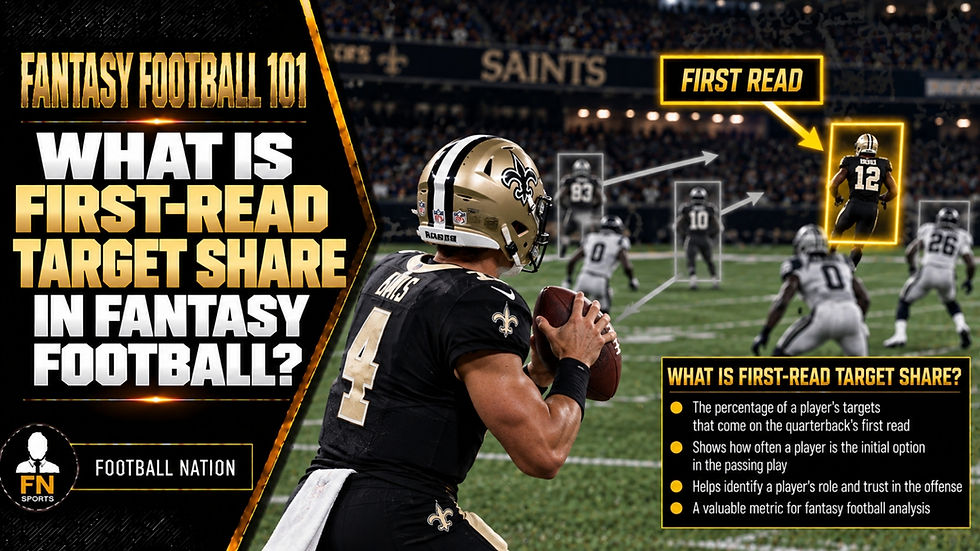
What counts as the first read?
The first read is the option the quarterback is coached to evaluate first after the snap, usually based on the play design and a coverage key. It is not automatically the receiver closest to the quarterback, the player who ultimately gets the ball or the offense’s best receiver. Coverage can erase the preferred option and force the quarterback to move to a second read or a checkdown.
That distinction separates this metric from ordinary target share. Target share asks how much of the team’s total passing volume went to a player. First-read data asks how often that player occupied the offense’s preferred place in the progression. A receiver can earn targets late in the play without being the designed priority, and he can also be the first read on plays where coverage sends the ball elsewhere.
StatRankings, whose page was updated August 18, 2026, defines its version as the percentage of a player’s targets that occurred as the quarterback’s first read. The provider’s published definition is why its percentages should be compared only with other StatRankings figures, not pasted beside a differently calculated number from another source.
What the 2025 leaderboard looked like
PFF’s February 18, 2026 review charted first-read targets from Week 1 through Super Bowl LX. Among 38 skill-position players with at least 75 first-read targets, these five led PFF’s first-read target-rate sample. The table preserves PFF’s label; it does not convert the figures into another provider’s version of first-read target share.
Player | Team | PFF first-read target rate |
|---|---|---|
Puka Nacua | Rams | 43.0% |
Jaxon Smith-Njigba | Seahawks | 38.3% |
Drake London | Falcons | 37.4% |
Amon-Ra St. Brown | Lions | 35.9% |
Ja’Marr Chase | Bengals | 34.4% |
Why first-read involvement matters for fantasy
Fantasy points follow opportunity, and the NFL’s long-running targets-and-touches analysis treats workload as the starting point for player evaluation. First-read involvement adds intent to that workload. It helps distinguish a receiver whom the offense is actively featuring from one collecting low-priority throws after the initial structure breaks down.
The signal becomes more useful when paired with route participation and targets per route run. High first-read involvement on a part-time route sample can disappear when the player’s package changes. High first-read involvement across a near-every-down route role is harder for a defense—or a fantasy manager—to dismiss.
How to use the metric in drafts and waivers
Drafting: Use first-read data as a tiebreaker between similarly priced receivers. Prefer the player whose route role and designed priority point in the same direction.
Breakout hunting: Look for a rising route share plus rising first-read involvement. That combination suggests the coaching staff is expanding both playing time and responsibility.
Waivers: Treat a one-week spike as a prompt to investigate, not proof. Check injuries, coverage, quarterback changes and whether the player actually ran more routes.
Ceiling evaluation: Combine the metric with WOPR to see whether designed priority also carries meaningful target and air-yard weight.
Scoring chances: Add red-zone touches. First-read volume between the 20s does not guarantee touchdown opportunities.
The biggest risks and misconceptions
First-read charting is interpretive. Analysts can disagree about whether a concept has a strict progression, a leverage read or two simultaneous options. Quarterback pressure, coverage rotation and scramble situations also blur the line between designed and improvised targets. Small samples can swing quickly, especially for part-time players or offenses that change quarterbacks.
The most common mistake is ranking players by a percentage without checking the formula. A 35% first-read target rate from one provider is not automatically better than a 32% first-read target share from another. Use one source, one definition and one comparison period. Then cross-check the player’s routes and total opportunities.
Football Nation takeaway
Use first-read target share to answer one question: whom is the offense trying to feature first? The metric is most actionable when a player also runs a full route tree, earns targets efficiently and receives valuable downfield or red-zone work. It is weakest when the denominator is unclear or the sample comes from a limited package.
For draft decisions, upgrade a receiver when first-read involvement and route participation both rise. Hold your ranking when only the percentage rises. Downgrade the signal if a new quarterback, coordinator, injury return or major target addition changes the progression. That is the evidence that should change the recommendation.
Frequently asked questions
Is first-read target share the same as target share?
No. Target share measures a player’s portion of team targets. First-read metrics isolate designed or charted initial reads, and the denominator varies by provider.
Does the first read always receive the target?
No. Coverage, pressure and leverage can move the quarterback to another option. A player can be the first read without being targeted.
Is a high first-read rate enough to draft a player?
No. Confirm that he runs enough routes and earns valuable targets. A high rate in a narrow package can exaggerate a small role.
When should fantasy managers recheck it?
Recheck after injuries, quarterback changes, coordinator changes or a clear route-role shift. During the season, use multiweek trends rather than reacting to one game.


Comments