


What Are Red-Zone Touches in Fantasy Football?
Updated: Sep 22
Red-zone touches tell you which players are getting the ball where touchdowns are most likely. For fantasy managers, that is often more useful than looking at total touches alone. A running back with 12 opportunities but repeated work near the goal line can carry more weekly touchdown upside than a teammate with 17 touches mostly between the 20s.
The direct answer: a red-zone touch is normally a carry or completed reception inside the opponent's 20-yard line. However, many fantasy tools publish red-zone opportunities instead, combining carries with targets. Check the provider's definition before comparing players. If you need the field concept first, Football Nation's red-zone explainer shows why the 20-yard line is the standard boundary.

What counts as a red-zone touch?
For running backs, analysts usually focus on rushing attempts and receptions inside the 20. For receivers and tight ends, targets are often more practical than receptions because a target records the opportunity even when the pass is incomplete. That difference explains why one site may show “red-zone touches” while another shows “red-zone opportunities” or separates carries and targets.
The safest comparison uses the same source, time period and label for every player. Do not combine one provider's carries-plus-targets number with another provider's carries-plus-receptions number and treat them as identical.
Location | Opportunity being measured | Best fantasy use |
|---|---|---|
Inside the 20 | Red-zone carries, targets or completed touches | Identify players repeatedly involved on scoring drives |
Inside the 10 | High-value rushing and receiving chances | Separate useful volume from stronger touchdown opportunity |
Inside the 5 | Goal-line carries and short-area targets | Find the clearest touchdown-upside roles |
End zone | Targets thrown into the end zone | Evaluate receivers and tight ends who can score without yards after catch |
RotoWire's red-zone analysis emphasizes the same location problem: an opportunity at the 1-yard line is not equivalent to one at the 19. The table is therefore a reading guide, not a claim that every event in a band has one fixed touchdown probability.
Why red-zone work matters in fantasy football
Touchdowns create large fantasy swings, and red-zone usage shows which players are being trusted during scoring drives. It can reveal a role change before the box score makes it obvious: a backup back begins handling inside-the-5 carries, a tight end becomes the first read near the goal line, or a wide receiver keeps drawing end-zone targets without converting them yet.
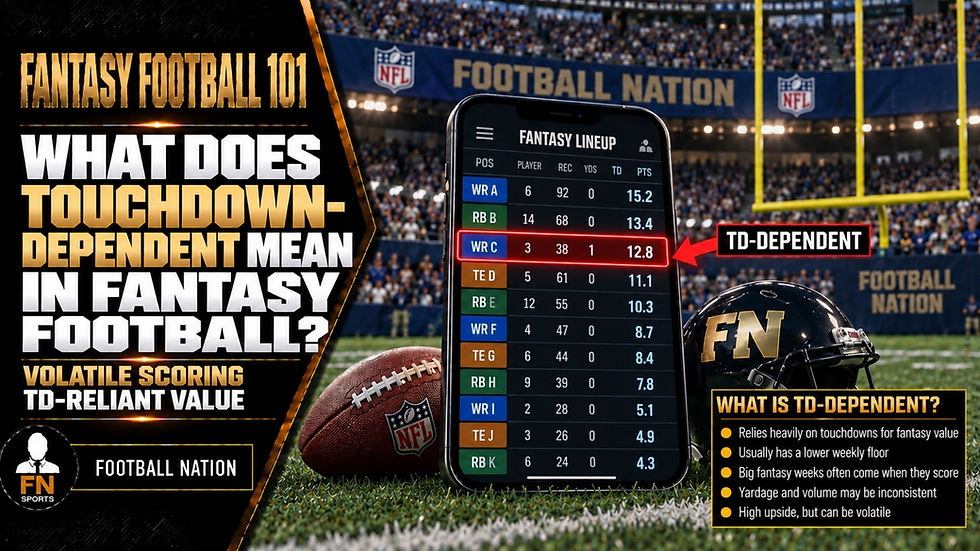
That makes red-zone opportunity a useful partner to expected fantasy points. xFP estimates what a workload should be worth; red-zone data explains why two similar touch totals may have very different scoring value. It also helps diagnose a touchdown-dependent player: repeated scoring-area usage can support the risk, while disappearing goal-line work makes the profile fragile.
NFL.com's targets-and-touches analysis has long used red-zone touches alongside snap share and target share because the measures answer different questions. Snaps show presence, total touches show volume and red-zone work shows scoring-area opportunity.
How should fantasy managers use red-zone touches?
Start with a three- or four-game trend rather than one isolated Sunday. Then separate team opportunity from player share. A back cannot collect goal-line carries if his offense rarely reaches the red zone, while a modest raw total may still be impressive if he owns nearly all of his team's chances.
Next, pair the stat with role evidence. Use targets per route run for target earning, routes and snaps for playing time, and red-zone work for scoring position. A player who rises in all three areas has a stronger case than someone whose fantasy line depends on one broken play.
For a weekly start/sit decision, use red-zone usage as a tiebreaker after projected playing time, matchup and injury status. It should move a close call; it should not rescue a player who may only play a handful of snaps.
The strongest misconception
More red-zone touches do not guarantee more touchdowns. Short samples are noisy, play calls can change by opponent and penalties can erase opportunities. Quarterback keepers, pass interference and a teammate's conversion can also distort what the box score seems to say. Treat the metric as evidence of opportunity, not a promise of results.
Current 2026 fantasy analysis from Fantasy Life illustrates the right approach by connecting red-zone roles to projected upside while still considering depth-chart and offensive context. That is more responsible than assuming last year's touchdown total will simply repeat.
What is the next checkpoint?
During the preseason, identify who stays on the field with the projected starters near the goal line. Once regular-season games begin, track carries inside the 10 and 5, end-zone targets and each player's share of team red-zone opportunities. After several games, the trend becomes more actionable than a single touchdown.
Football Nation takeaway
Red-zone touches are a role signal. Use them to locate touchdown opportunity, then confirm that opportunity with playing time, route involvement and team scoring chances. The best fantasy bet is not automatically the player with the largest raw total; it is the player whose valuable opportunities are repeatable.
Frequently asked questions
Do targets count as red-zone touches?
Strictly speaking, a touch requires possession, so a target is not a touch. Many fantasy databases instead report red-zone opportunities by combining carries and targets. Always read the label.
Is inside the 5 more important than inside the 20?
Usually, because the offense is closer to the goal line. Still, player role, play type and team context matter, so use inside-the-5 work as a high-value subset.
Are red-zone touches predictive?
They can help predict touchdown opportunity, but they do not guarantee touchdowns. Multi-game trends are more useful than one-game totals.
Should receivers be judged by red-zone targets or receptions?
Targets usually show opportunity better. Receptions describe what was completed, while end-zone targets can reveal intended scoring usage even before conversion.
How often should I check red-zone usage?
Check weekly, but make decisions from rolling trends. Reassess quickly after injuries, depth-chart changes or a new goal-line role.


Comments