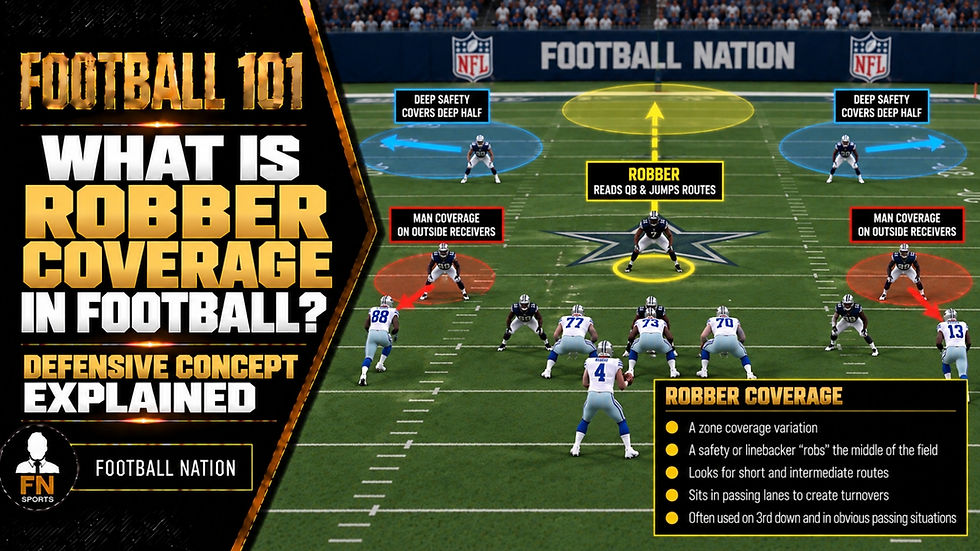
What Is the Levels Concept in Football? High-Low Read Explained
- Football Nation
- 3 hours ago
- 5 min read
The Levels concept is a passing design that sends two receivers across the middle at different depths, usually with a short in-breaker below a deeper dig. The quarterback reads the defender responsible for the space between them. If that defender drops under the deep route, the throw goes to the shallow route. If the defender drives downhill, the quarterback works to the deeper in-breaker. It is a horizontal high-low stretch built to make one coverage player wrong.
That direct answer also explains why Levels is so useful. The offense does not need one receiver to win immediately against perfect leverage. It uses route spacing to create a choice. The concept can be dressed up with motion, play action, bunch sets or different personnel, but the central relationship remains the same: one in-breaking route below another.
How the Levels concept is built
A basic version begins with two eligible receivers aligned on the same side or released into the same middle-of-field area. The underneath receiver breaks inside at roughly five yards. The second receiver pushes farther upfield before running a dig around 10 to 15 yards. Exact landmarks vary by playbook, field position and coverage plan, so the depths in the diagram are a teaching example rather than a universal rule.
The two routes should not arrive in the throwing lane at the same time. The shallow route reaches the middle early and controls the underneath defender. The dig develops behind it. A backside receiver often runs vertically to occupy a deep safety or isolate a corner. Those routes all come from the broader football route tree, but Levels is the coordinated relationship among them.
The Patriots’ official film review showed New England using an underneath in-breaker and a deeper in-cut on the same play. The report specifically described it as a Levels concept, which makes the short-plus-deep pairing a useful NFL example without implying every offense teaches the same progression.

What the quarterback reads
The quarterback first identifies which defender can affect both in-breaking routes. Against many zone structures, that is a hook or middle linebacker. The quarterback then confirms the defender’s movement after the snap. A drop underneath the dig creates space for the shallow in. A downhill reaction to the shallow route opens the dig behind him. The ball should come out as the receiver enters the window, not after the quarterback watches him become completely open.
The read is often described low to high because the shallow route appears first. That phrase does not make the progression universal. Protection, leverage, a backside matchup or a pre-snap alert can change the order. The quarterback may take a one-on-one vertical immediately if the safety rotates toward the Levels side. He may also throw the shallow route quickly against pressure rather than wait for the dig.
Why Levels stresses zone coverage
Zone defenders are responsible for areas and route distribution. Levels places two threats through the same horizontal corridor at different heights. If the hook defender gains depth to close the dig window, the shallow receiver can catch underneath and run. If the defender squeezes the shallow route, the dig crosses into the vacated space. The quarterback is reading the defender’s choice, not guessing a coverage label.
An official Patriots scouting breakdown illustrated this exact conflict against Indianapolis: a short and intermediate dig attacked Cover 2 zones, and the quarterback hit the lower route before later moving up to the deeper route when the linebacker adjusted. The same Patriots film analysis also explained how a backside vertical punished a later rotation. That sequence shows how repeated calls can create a game-within-the-game instead of producing the same throw every time.
Can Levels beat man coverage?
Yes, although the geometry changes. Against man coverage, the high-low read on a zone defender may disappear. The offense instead relies on individual leverage, motion and natural traffic. A short in-breaker can pull its defender across the middle while the deeper route works behind it. Motion can give a receiver a running start and prevent a corner from pressing at the line.
The concept does not automatically become a legal pick. Receivers must run legitimate routes rather than block defenders downfield before the pass is touched. The 2026 NFL Rulebook places offensive pass-interference rules in Rule 8, Section 5. Football Nation’s pick-route explainer covers the distinction between route traffic and an illegal restriction in more detail.
Levels is not Mesh, Flood or Dagger
The strongest misconception is that any two routes at different depths are the same concept. They are not. In Mesh, two shallow crossers approach from opposite sides and pass close together. Levels normally uses two in-breakers stacked vertically in the same general corridor. Mesh emphasizes traffic and horizontal stretch; Levels emphasizes a high-low conflict.
The Flood concept places three routes at deep, intermediate and short depths toward one sideline. Its stretch is more vertical along the boundary. Levels works through the middle with two principal in-breaking routes. Dagger often clears the middle with a vertical route so a deep dig can enter behind it; that is a different route relationship even though a dig may appear in both designs.
How defenses counter Levels
Carry the dig. A linebacker can gain depth under the deeper route while another defender drives on the shallow in. This requires clean zone distribution and often concedes a short completion.
Rob the middle. A safety can rotate down into the dig window. That closes the primary high-low space but can expose the backside vertical or an outside route.
Match the releases. Pattern-match rules let defenders convert zone responsibilities into man-like assignments once the routes declare. Communication has to be immediate.
Win with the rush. Interior pressure prevents the quarterback from stepping into the dig and can force an early throw before the shallow route clears congestion.
How to recognize Levels on television
Start by ignoring the ball and watching the middle of the field. Look for one receiver breaking inside quickly and another breaking inside behind him at a clearly deeper landmark. Then locate the hook defender between them. If he retreats, expect the short throw. If he drives forward, watch the deeper window. Finally, check the backside receiver: a vertical route may be holding the safety or serving as the answer when coverage overplays the middle.
Levels concept FAQ
What is the Levels concept in football?
Levels is a passing concept with two in-breaking routes at different depths, commonly a shallow in below a deeper dig. The quarterback reads the defender between them and throws opposite that defender’s movement.
Is Levels a zone-beater or a man-beater?
It is best known as a zone-beater because it high-lows an underneath defender. It can still work against man coverage through leverage, motion and route spacing, but the quarterback may shift from a defender read to a matchup read.
How deep are the routes in Levels?
A teaching version might pair a five-yard in with a 10- to 15-yard dig. Playbooks adjust those landmarks for down, distance, formation and coverage. The important feature is the vertical separation, not one universal yardage.
Is Levels the same as a drive concept?
Terminology varies. Some systems use Drive for a shallow cross paired with a dig, while Levels may use two in-breakers from the same side. Other playbooks group related designs differently. The route drawing and progression matter more than the label.
Football Nation takeaway
Levels is organized conflict. The shallow route forces an underneath defender to react now; the deeper dig forces him to protect the space behind him. Once you spot those routes stacked across the middle, watch the defender between them. His first committed step usually tells you where the quarterback should go with the ball.
No statistical table was added because the route relationship is geometric, not statistical; the 1600-by-900 teaching diagram shows the decision more clearly. Visual disclosure: the cover and diagram are original Football Nation graphics created with generative AI and reviewed for football accuracy. They do not depict a real player, team or league mark.


Comments