What Is Cover 4 in Football? Quarters Coverage Explained
- Football Nation
- 5 hours ago
- 5 min read
Cover 4 is a zone coverage with four deep defenders: two cornerbacks protect the outside quarters and two safeties protect the inside quarters. It is also called quarters coverage. The name describes the deep structure, not four defenders playing man coverage. Modern versions often use route matching, which means assignments can turn into man like coverage after receivers declare their routes. That combination lets a defense protect against explosive passes while keeping its safeties close enough to help against the run. For a broader starting point, see Football Nation's zone coverage guide.
How Cover 4 Works
The basic picture begins with two safeties deep and two cornerbacks positioned to protect the outside. Three defenders handle the short and intermediate areas while four rushers attack the quarterback. The exact front, personnel and alignment can change, but the math behind the coverage stays recognizable: four defenders divide the deep field, three work underneath and four rush.
In a simple spot drop version, each deep defender protects a quarter of the field. The corner stays on top of vertical routes near the sideline. The safety protects the inside quarter and watches threats from the slot. Underneath linebackers and nickel defenders expand through the hook, curl and flat areas. The goal is to force the quarterback to throw short, then rally and tackle.
Most high level defenses do more than drop to grass. In pattern match coverage, defenders read the releases of the number one and number two receivers on their side. A common rule sends the corner with number one when that receiver goes vertical and the safety with number two when the slot goes vertical. If a receiver breaks short, the coverage can pass him to an underneath defender and free a deep player to help elsewhere. Coaching language varies, so Cover 4 is better understood as a family of related checks than one universal assignment sheet.

Original Football Nation teaching diagram created for this article. No third party photograph, player likeness, team logo or league logo is used.
Why Cover 4 Matters
Cover 4 gives the defense a two high shell before the snap, but it does not have to play softly. Because each safety owns only one quarter instead of an entire half, he can align closer to the line and trigger downhill when the run is confirmed. That makes quarters attractive against offenses that want both vertical shots and a physical running game.
Its importance is also visible in current league data. An official NFL analysis published February 18, 2026 reported that Cover 4 was used on 17.2 percent of pass plays in the 2025 season, up from a 13.9 percent average from 2018 through 2024. The same analysis placed Cover 2 at 13.9 percent and Cover 6 at 9.2 percent in 2025. The numbers show why broadcasters now discuss split safety structures so often. Read the NFL's full coverage trend analysis.
Coverage | 2025 pass play usage | 2018 to 2024 average |
|---|---|---|
Cover 2 | 13.9% | 13.2% |
Cover 4 | 17.2% | 13.9% |
Cover 6 | 9.2% | Not stated |
Source: NFL.com, February 18, 2026. Percentages describe usage on pass plays. The historical Cover 6 average was not stated in the cited analysis.
A Realistic Cover 4 Example
Imagine an offense in a two by two formation with two receivers on each side. The outside receiver runs a go route and the slot runs a seam. Against a common quarters check, the corner carries the outside vertical while the safety matches the slot vertical. The same distribution happens on the other side. Three underneath defenders watch the running back and any short crossing, curl or out routes.
The quarterback now has a difficult choice. Throwing outside challenges a corner who already has top leverage. Throwing the seam challenges a safety who began inside and above the slot. If the defense stays disciplined, the ball usually goes to the back or a short route underneath. If a safety steps forward too quickly on play action, however, the seam can open behind him. This is why the safety's eyes are central to the call.
How Offenses Attack Cover 4
The offense tries to create a conflict for a safety or stretch an underneath defender. Four Verticals forces all four deep defenders to carry a vertical threat and can isolate a safety against a fast slot receiver. Post and dig combinations can pull an inside quarter defender in two directions. Play action can make an aggressive safety step toward the run before a receiver crosses behind him.
Short throws matter too. With only three underneath defenders, the offense can widen the field with quick outs, swings and crossing routes. Bunch formations and pick route concepts can complicate releases and communication. The defense may answer with a special check, a bracket or a different distribution rule rather than remain in one static version of quarters.
Cover 4 Compared With Cover 1, Cover 2 and Cover 3
Cover 1 uses one deep safety with man coverage underneath. Cover 3 divides the deep field into three zones and usually presents a single high safety structure after the snap. Cover 2 has two deep halves, which asks each safety to cover more width and usually leaves five underneath defenders. Cover 4 uses four deep quarters and only three underneath defenders. Cover 6 combines a Cover 2 side with a Cover 4 side, which is why it is often called quarter, quarter, half.
Common Mistakes and Misconceptions
The first mistake is calling every two high look Cover 4. Safeties can rotate after the snap into Cover 3, stay in Cover 2, play Cover 6 or match receivers through another call. The second mistake is assuming quarters is prevent defense. Safeties can be aggressive run defenders, and corners may play tight technique. The third is treating every quarters defense as identical. USA Football's detailed quarters coverage coaching material shows how terminology and route distribution can change between systems.
A final misconception is that match rules erase NFL contact restrictions. They do not. Defenders still must follow the 2026 NFL rulebook and the league's rules governing illegal contact and pass interference. Football Nation's illegal contact guide explains why a defender cannot simply grab a receiver downfield because the coverage converted into a match.
Cover 4 FAQ
Is Cover 4 man or zone coverage?
It is classified as zone coverage because four defenders divide the deep field into quarters. Many modern versions use match rules that become man like after the routes develop.
What is the biggest weakness of Cover 4?
The three underneath defenders must cover a great deal of space, so quick throws, flats and crossing routes can be available. Vertical route combinations can also stress a safety's eyes and leverage.
Why can Cover 4 help stop the run?
Each safety protects only an inside quarter, so he can often align closer to the line and join the run fit once he confirms the ball is handed off. A poor read can still expose a seam behind him.
Is quarters coverage the same as prevent defense?
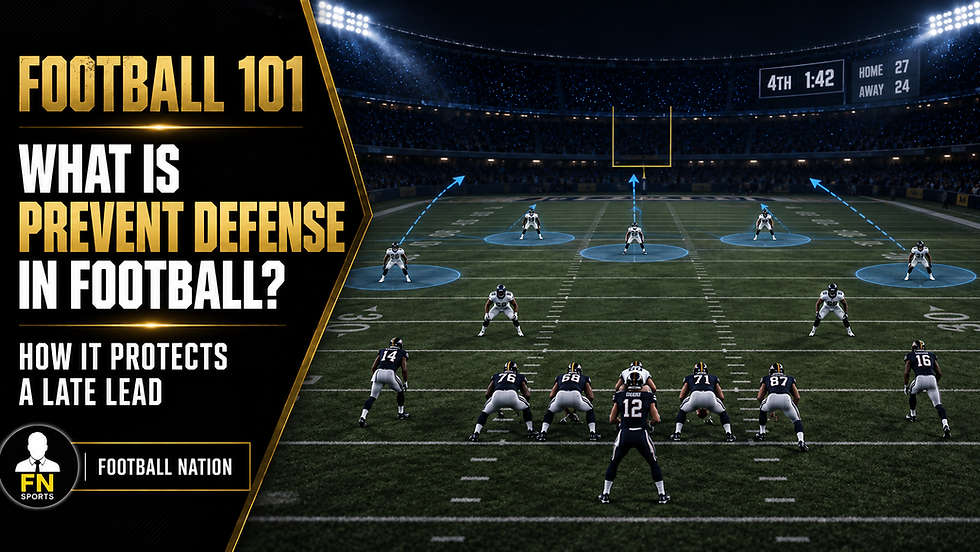
No. Prevent defense is a late game strategy built to protect a lead and keep the ball in front. Quarters can be an aggressive every down coverage with tight matching and active safety support.
How can viewers recognize Cover 4?
Start with two deep safeties and corners who maintain outside depth. After the snap, watch whether both safeties stay high and divide the inside vertical threats while the corners carry the outside routes. Confirm the assignments after the routes develop rather than naming the coverage from the presnap shell alone.
Football Nation Takeaway
Cover 4 is best understood as four deep quarters with flexible match rules. The corners protect the outside verticals, the safeties handle the inside verticals and three underneath defenders rally to shorter throws. Its value comes from balance: it limits explosive passes without removing the safeties from the running game. When watching live, identify the two high shell, follow the number two receiver and watch the nearest safety. That sequence usually reveals whether the defense is truly playing quarters.
Future cluster support should add dedicated guides to Cover 6, Palms coverage, Solo and Poach checks, and how offenses use post dig combinations against split safety defenses.


Comments