


What Is the Pistol Formation in Football? Shotgun vs. Under Center Explained
Updated: Sep 13
The Pistol formation places the quarterback a few yards behind the center and the running back directly behind the quarterback. The quarterback receives a shotgun-style snap, but the running back remains square to the line of scrimmage and can attack downhill. It is a hybrid alignment: some of the quarterback's vision and spacing from shotgun, combined with some of the straight-ahead run action associated with an under-center backfield.
The direct answer: Pistol is a formation, not one specific play and not automatically a read-option offense. Teams can run inside zone, power, counter, play action, dropback passes or option concepts from it. The alignment changes what defenders can see before the snap and how the back approaches the handoff; the actual play call determines what happens next.
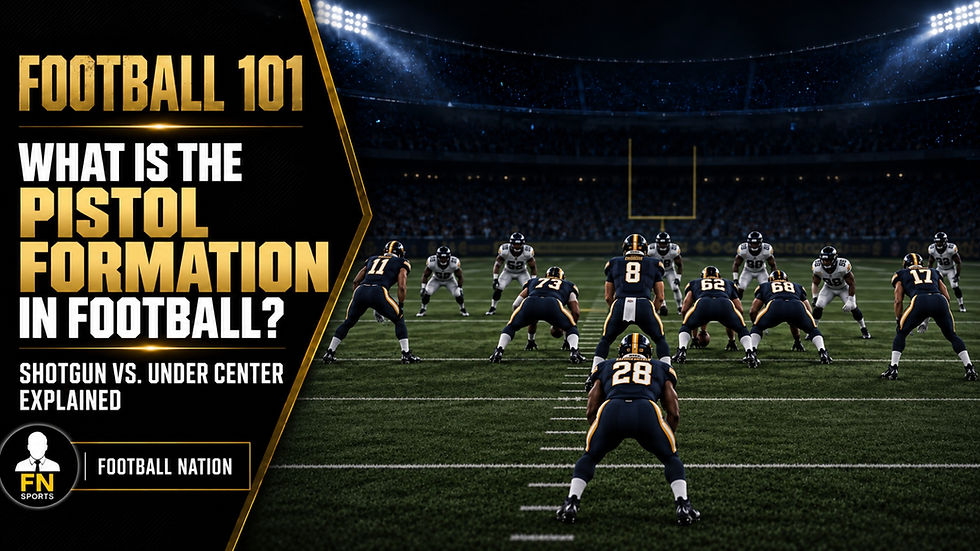
How the Pistol formation lines up
Exact depths vary by team and playbook, but the quarterback is commonly about three to four yards behind the center. The running back aligns directly behind him at roughly six to seven yards from the line of scrimmage. In the classic picture, the center, quarterback and running back form one straight line down the middle of the formation.
That is different from a normal shotgun set, where the quarterback is usually deeper and the running back often aligns beside him. It is also different from under center, where the quarterback begins directly behind the center and turns his back to the defense during many handoffs. Pistol creates a middle ground between those two pictures.

Why coaches use the Pistol
The running back's position is the main advantage. From an offset shotgun alignment, his starting location can hint at the likely path of a handoff. In Pistol, he begins directly behind the quarterback, so he can take the ball toward either side while keeping his shoulders square. That makes the initial direction less obvious and preserves a downhill track.
The quarterback also starts deep enough to scan the defense and handle a shotgun snap. That can support quick throws, option reads and play-action passes without abandoning the threat of a conventional run. The benefit is multiplicity: the offense can present one backfield picture and attach several different answers to it.
The Pistol run game
Pistol works especially well with inside zone because the back can press the line, read the blocks and cut without beginning on a sideways track. It can also support Power O and counter. The formation does not change the blocking rules by itself; it changes the timing, path and defensive picture around those schemes.
Because the back is hidden behind the quarterback from the defense's point of view, linebackers may have a slightly less obvious key. The mesh can look similar whether the ball is handed inside, carried outside by the quarterback or pulled for a pass. That hesitation is valuable, but only if the offense makes its ball handling and blocking sell the same story.
Pistol does not automatically mean read option
A mobile quarterback makes Pistol more dangerous because he can read an edge defender and keep the ball. That is why the formation is closely associated with the run-pass option and zone-read families. But the quarterback does not have to be a major running threat. The formation existed as a way to improve the base run game before option elements became its most famous feature.
NFL.com reported Chris Ault's explanation that an offense can run power, gap, counter, zone and outside schemes from Pistol without using the quarterback as a read runner. The point is the formation's flexibility, not a mandatory quarterback keeper. See the NFL interview with Ault.
How Pistol helps the passing game
A defense that reacts aggressively to the downhill back can open intermediate windows behind the linebackers. The quarterback can show a firm run fake, regain his throwing posture and attack crossers, seams or deep in-breaking routes. A Pistol backfield can also flow into a bootleg, moving the quarterback away from the initial run action.
The formation still has protection tradeoffs. The running back may need extra time to reach an edge rusher or cross the quarterback's face. A low or off-target snap can disrupt the mesh. The quarterback also starts closer to the line than in deeper shotgun, so pass-rush angles and throwing lanes feel different. Pistol is useful because it blends options, not because it eliminates every weakness.
Where the Pistol came from
University of Nevada coach Chris Ault created and installed the Pistol ahead of the 2005 season. Nevada's official athletics history credits the formation with beginning a run of eight consecutive bowl appearances and helping build one of college football's most productive rushing attacks. The University of Nevada account provides the clearest primary-source history.
The name describes the shorter shotgun depth: the quarterback is not under center, but he is also not as deep as a typical shotgun alignment. The idea spread because it allowed teams to pair downhill runs with spread concepts. NFL offenses later adapted the formation to their own personnel rather than copying one complete Nevada playbook.
The biggest misconception
The biggest misconception is calling Pistol a complete offense. It is a formation. An offense can use Pistol for one package, one down-and-distance tendency or most of its run game. Coaches can place tight ends, receivers and extra backs around the core alignment in many ways. A team can even use Pistol with traditional pocket passers, because the quarterback's running ability is an added option rather than a requirement.
That distinction matters when watching personnel. A team can stay in 11 personnel and move between shotgun and Pistol without substituting. The defense sees the same one-back, one-tight-end group but must adjust to a different backfield path and mesh point.
How defenses respond
Defenses try to defeat Pistol by reading offensive-line movement, setting disciplined edges and refusing to chase the first backfield fake. The backside defender must know whether he is responsible for the running back, quarterback or an exchange rule. Linebackers must fit the downhill run without vacating the passing window behind them. The offense wants hesitation; the defense wants clean, fast assignments.
Football Nation takeaway
When an offense lines up in Pistol, check three things: Is the running back directly behind the quarterback? Is the quarterback close enough to threaten a quick downhill handoff? Does the quarterback have a real option read, or is the formation only disguising a conventional run or pass? The core advantage is balance. Pistol keeps the run direction hidden, preserves downhill action and gives the quarterback a shotgun view without requiring the offense to become an option-only system.


Comments