


Which Part of the Football Counts for an NFL First Down?
Updated: 5 hours ago
For an ordinary NFL first down decision, officials compare the forwardmost point of the properly spotted football with the line to gain. The entire ball does not have to cross that line.
Part of Football 101. Explore the guide to choose your next topic.
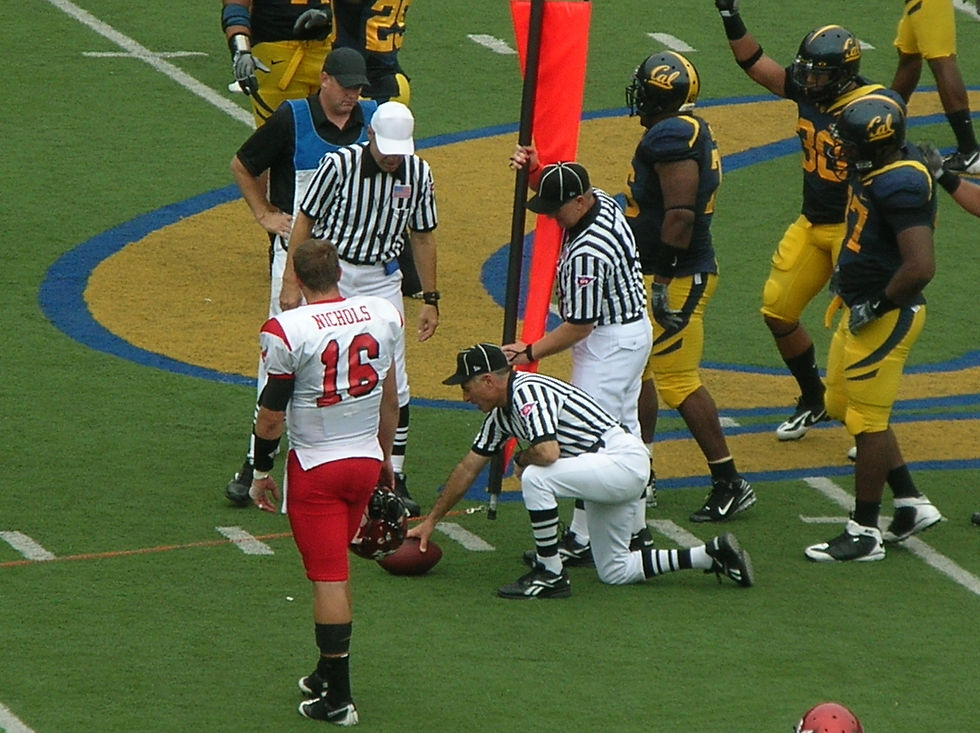
The first question is where the ball became dead or where the runner's protected forward progress ended. Only then can officials decide whether the spot reaches the required distance.
A knee ends the run, but does not spot the ball
When a runner becomes down by contact, officials locate the ball at that moment. A knee touching at the 40 does not necessarily mean the ball belongs at the 40. The runner may have extended it ahead or held it behind his body.
If the ball's forward point legally reaches the line to gain before the run ends, the offense can earn a first down. A reach after the ball is already dead adds nothing.
Officials align the ball for the next snap without moving its established forward point. Rotating a sideways ball is not permission to award extra distance.
Forward progress can preserve an earlier spot
A defender may stop a runner and drive him backward. The forward progress rule can preserve the runner's furthest permitted advance rather than using where he eventually lands.
An airborne receiver who controls the ball and is driven backward can also receive the applicable progress spot, provided he completes the catch. Initial control alone does not excuse a failed catch.
That protection differs from a runner voluntarily retreating to keep the play alive. His earlier position does not automatically remain the spot.
Measurement answers a narrower question
The official measurement compares the established ball spot with the established line to gain. It does not independently decide where a hidden ball was when the runner went down. Television's yellow line is only a viewing aid.
On a close quarterback sneak, therefore, there are two decisions: establish the correct forward point, then compare it with the line. A precise measurement cannot repair an incorrect initial spot by itself.
Examples and illustrations
Keep reading
First down measurement: Understand the line to gain and official measurement process.
The catch process: See why an airborne receiver must finish the catch.
Quarterback sneaks: Apply ball position and progress to a short yardage play.
Browse the Football 101 library.
Rules reviewed October 10, 2026. Source: 2026 NFL Rulebook, Rule 7 Section 3 Article 3; Rule 3 Section 12 Article 1.


Comments