top of page

Why Do Football Officials Throw Their Hats?

Football officials throw their hats to mark an important spot on the field when the yellow flag or bean bag is unavailable—or when the hat is the clearest supplemental marker for the job. The most familiar example is a receiver or kicking-team player going out of bounds during a live play. The hat records where the player left the field so the crew can correctly rule on what happens if that player returns.


The immediate takeaway is simple: a hat on the turf does not automatically mean a penalty. A yellow flag signals that an official has seen a foul. A hat usually preserves information the crew may need later in the play. An official Tampa Bay Buccaneers explanation describes the same boundary-marker mechanic for receivers and punt coverage players.


Why the out-of-bounds spot matters


Imagine a receiver running close to the sideline. He steps on or beyond the boundary, comes back in, and then catches the pass. The official must remember not only that the receiver went out, but where it happened and whether the receiver reestablished himself inbounds.


Under Rule 8, Section 1, Article 8 of the 2026 NFL Rulebook, an eligible offensive receiver commits illegal touching when he goes out of bounds—voluntarily or after being legally forced out—reestablishes inbounds, and is the first player to touch or catch a forward pass thrown from behind the line. The penalty is loss of down at the previous spot. If the receiver touches the pass before reestablishing inbounds, the pass is incomplete.


That is why the hat can matter before the pass even arrives. It gives the rest of the crew a visible reference that the receiver crossed the boundary. The rule is separate from what makes a legal NFL catch: a player can reestablish with both feet or another body part inbounds and still be barred from touching the pass first because he was previously out of bounds. It is also different from an ineligible-receiver-downfield penalty, which concerns originally ineligible players advancing too far before a pass.


Football Nation diagram showing a player step out, an official marking the exit spot with a hat, and the later illegal-touching question.
Original Football Nation diagram: the hat marks the boundary event; later action determines whether the rule changes the play.

A real NFL play that made the hat famous


The distinction became decisive at the end of a 2012 Buccaneers–Saints game. Tampa Bay receiver Mike Williams caught what appeared to be a tying touchdown after he had gone out of bounds and returned. The score was erased because Williams was the first player to touch the pass after reestablishing.


NFL.com’s game account noted that Buccaneers coach Greg Schiano recognized the problem when he saw an official without his hat. The missing hat was not itself the penalty announcement. It showed that the official had marked Williams out of bounds, which supplied the factual basis for the later illegal-touching ruling.


That example also exposes a common misconception. Being pushed out does not automatically restore a receiver’s right to catch the next pass. The current rule covers both a player who leaves on his own and one legally forced out. A separate defensive foul may exist if the contact itself was illegal, but that depends on the location, timing, and nature of the contact.


Hats also matter on punts and free kicks


The same boundary problem appears on special teams, where coverage players sprint near the sideline while blockers try to widen them. It is separate from whether a returner makes a fair catch or muffs a punt, but all of those rulings require the crew to preserve exact observations while the ball remains live.


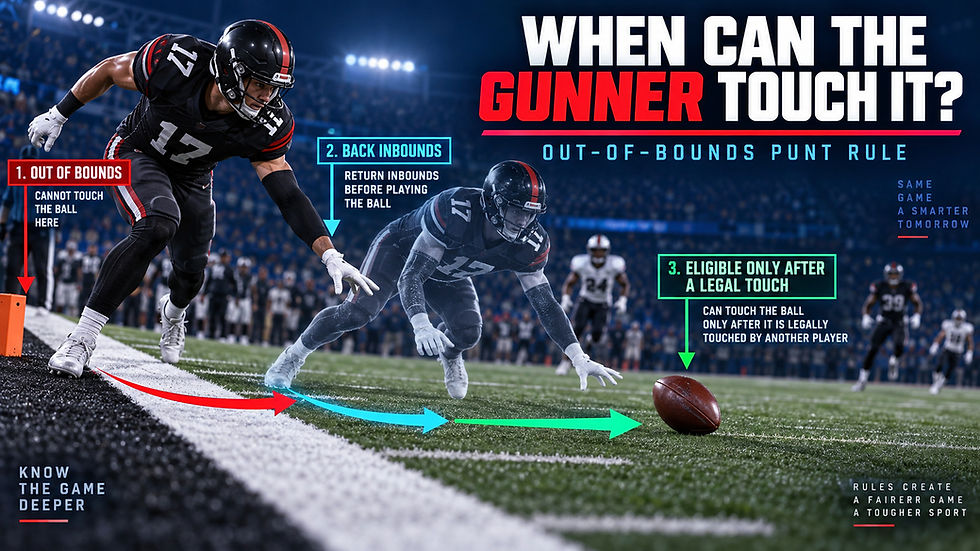
During a scrimmage kick, a kicking-team player who voluntarily goes out of bounds to avoid a block commits a five-yard foul. Whether he left voluntarily or was legally forced out, he also may not be the first kicking-team player to touch or recover the punt beyond the line until another eligible player touches it. A player who stays out and does not try to return within a reasonable time can draw an unsportsmanlike-conduct foul.


Free kicks have parallel restrictions. A kicking-team player who voluntarily leaves to avoid a block before the receiving team touches the ball or the kick ends commits a five-yard foul. A player who goes out—voluntarily or because he was legally forced—also faces restrictions on touching or recovering the kick before the receiving team has touched it. Those rules are distinct from the ball-placement rules that produce a touchback.


The hat gives the crew a durable visual cue while the play continues downfield. That matters because the eventual ruling can depend on several later events: who touches the ball first, whether the player returned, whether the exit was voluntary, and whether a receiving-team player made contact.


Hat vs. flag vs. bean bag


All three objects communicate something, but they do different work.

  • Yellow flag: Signals a foul the official observed. The crew later announces the penalty and enforcement.

  • Bean bag: Marks a non-foul location that may become important, such as the spot of a fumble or certain points during a kick.

  • Hat: Serves as a supplemental marker. It is commonly used to mark where a player went out of bounds, and it can substitute when an official has already used another marker.


The mechanics can vary by play and officiating assignment, so viewers should not treat every hat toss as one specific ruling. The dependable interpretation is narrower: the official is preserving a spot or fact for the crew. Watch what happens next before deciding whether a penalty exists.


Why officials cannot simply remember the spot


An NFL play can continue for several seconds after a player crosses the boundary. The responsible official must keep watching contact, possession, the ball, the goal line, and other players. At the end of the play, the crew may need to combine observations from officials positioned in different parts of the field.


A physical marker turns one observation into shared information. It also helps on replay because whether a player was out of bounds during a scrimmage kick is reviewable when the question affects the ball’s spot or illegal touching. The hat is not the replay decision, but it records the on-field observation that may start the discussion.


This is the same basic logic behind spot mechanics throughout football. Forward progress, the inbounds spot after a runner leaves the field, first touching on a punt, and the location of a fumble can all change possession or enforcement. Precise officiating is often less about the dramatic signal and more about preserving the right location.


What to watch on the next broadcast


When an official’s hat hits the turf, use this sequence:

  1. Find the boundary. Did a receiver or kicking-team player step out?

  2. Track the player. Did he immediately return, remain outside, or touch the ball?

  3. Wait for the yellow flag. The hat by itself does not announce a foul.

  4. Listen for the rule, not the object. “Illegal touching,” “player out of bounds on the kick,” or “voluntarily out of bounds” identifies what was actually enforced.


That approach prevents the most common mistake: seeing a hat and assuming a penalty has already been called.


Frequently asked questions


Is throwing a hat an official NFL signal?

It is an officiating mechanic used to mark information on the field, not one of the referee’s public hand signals that announces a penalty.


Does a hat always mean a player went out of bounds?

No. That is its most recognizable use, especially for receivers and kicking-team players, but the hat is a supplemental marker and can be used when another marker is unavailable.


Can a receiver come back after going out of bounds?

Yes, but returning does not automatically make him eligible to touch the next forward pass first. If he was out and reestablished, Rule 8-1-8 makes first touching or catching the pass a loss-of-down foul.


What if a defender pushed the receiver out?

If the push was legal, the receiver is still covered by the illegal-touching rule when he returns and touches the forward pass first. If the contact itself was illegal, officials can address that separate foul under the applicable contact or pass-interference rule.


Why not use the yellow flag to mark the spot?

Because a flag communicates that the official saw a foul. The official may need to preserve a location before the play produces any foul at all. Using the hat keeps the spot visible without falsely signaling that enforcement is automatic.


Football Nation takeaway


The official’s hat is best understood as a bookmark. It marks an event the crew may need after the play—most often the place where a player went out of bounds. The later action determines whether that information becomes a penalty, an illegal-touching ruling, or simply a recorded spot that never affects the result.

Comments


bottom of page