


George Kittle Will Play Week 1: No Injury Designation vs. Rams
Updated: Sep 10
Updated September 10, 2026. George Kittle will play in Week 1. The San Francisco 49ers gave their star tight end no game designation on the final injury report for the Melbourne opener against the Los Angeles Rams. That removes the question of availability. It does not remove the more important fantasy question: how much will Kittle play in his first game since tearing his right Achilles on January 11?
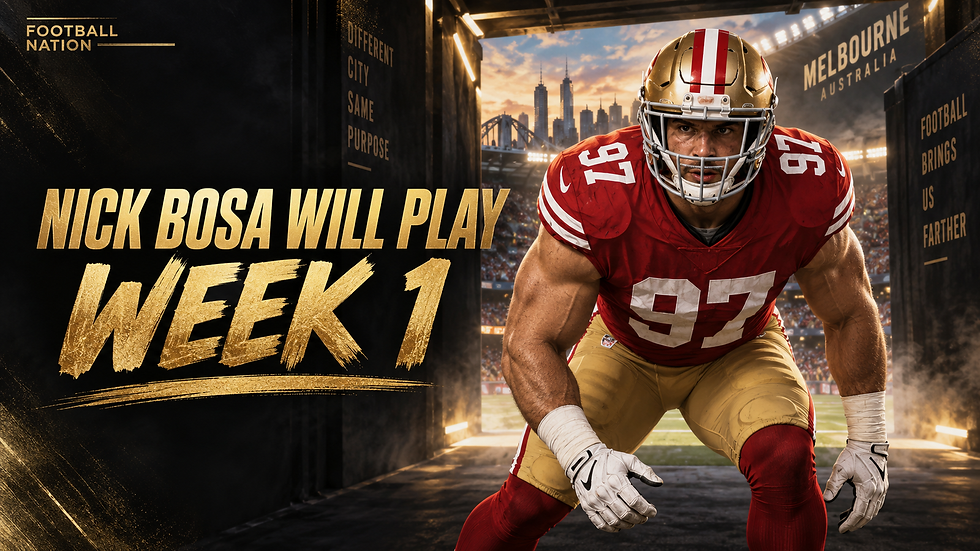
The NFL injury report and the 49ers’ final-status reporting support the same conclusion. Kittle and Nick Bosa are set to play. San Francisco ruled out defensive tackle Alfred Collins and listed offensive lineman James Thompson Jr. as questionable.
What is confirmed about George Kittle’s Week 1 status
Kittle is not questionable, doubtful or out. San Francisco’s decision to omit a game designation means the club expects him to be available. The development completes a rapid rehabilitation arc: the 49ers activated Kittle from the physically unable to perform list on August 23, then advanced him through individual and team work before clearing the final availability hurdle.
The opponent also enters the matchup with a much cleaner skill-position outlook than earlier in the week. Rams receiver Puka Nacua has no injury designation. That matters because the game no longer projects as a contest defined mainly by missing stars. It should feature the central passing-game pieces on both sides, even if Kittle’s snap count is managed.

Kittle’s return timeline and production
Checkpoint | Verified status | Why it matters |
Jan. 11, 2026 | Tore right Achilles in the playoffs | Established the unusually short return timeline |
Aug. 23, 2026 | Activated from the PUP list | Made Kittle eligible to practice and play |
Sept. 10, 2026 | No Week 1 game designation | San Francisco expects him to play against the Rams |
2025 regular season | 57 receptions, 628 yards, 7 TD in 11 games | Shows the receiving ceiling if his route share returns |
Sources for the timeline and production: Reuters’ September 8 Kittle and Bosa report and the 49ers’ official Kittle profile.
The strongest uncertainty is workload, not availability
A clean designation does not promise a normal snap share. Kyle Shanahan has said San Francisco must be smart with Kittle and Bosa, and NFL Network reporter Ian Rapoport has indicated that Kittle is expected to work on a pitch count. The team has not announced a target percentage, route count or blocking limit. Any precise workload claim would be speculation.
That distinction is especially important for a tight end returning from an Achilles tear. Kittle’s value comes from much more than stationary receiving. He blocks edge defenders, changes direction through traffic and creates yards after the catch. San Francisco can protect him by rotating Luke Farrell, Jake Tonges or Khalil Dinkins into some blocking snaps while still using Kittle on high-value passing downs and in the red zone.
Open the injury report on X. The live post remains the reference for the native embed.
Should fantasy managers start George Kittle in Week 1?
Kittle is startable in most season-long leagues because tight end offers few players with his per-route ceiling. In 2025, he produced 57 catches, 628 yards and seven touchdowns in 11 regular-season games. That efficiency means he can deliver a useful fantasy score without a full complement of snaps.
The counterpoint is real: a managed return could leave Kittle touchdown dependent. Fantasy managers with another healthy top-10 option can justify taking the safer route-share projection. Managers choosing between Kittle and a waiver-level tight end should generally accept the risk and start the proven difference-maker. The correct adjustment is to lower the projection, not to treat him as unavailable.
For a broader look at the position and the original recovery assumptions, see Football Nation’s George Kittle fantasy outlook. The latest leaguewide context is in the Week 1 injury tracker.
What Kittle changes for 49ers vs. Rams
Kittle’s presence forces the Rams to account for the middle of the field and gives the 49ers another answer against pressure. Even on reduced snaps, he can influence coverage by occupying a safety or linebacker. That can create cleaner access for San Francisco’s receivers and backs. His blocking also helps disguise whether a heavy formation will produce a run or a pass.
The matchup still demands restraint. A player can be active and materially help his team without producing a full fantasy workload. Readers weighing the wider game can compare Football Nation’s 49ers vs. Rams prediction, start-or-sit guide and player-prop analysis.
The next factual checkpoint
The next checkpoint is San Francisco’s inactive list before kickoff, followed by Kittle’s usage on the opening drives. Watch whether he stays on the field in obvious passing situations, runs routes instead of serving mainly as a blocker and participates in red-zone packages. Those observations will tell fantasy managers more about Week 2 than the simple active-or-inactive label.
Football Nation verdict
Kittle will play, but a normal workload remains unconfirmed. Treat him as a high-upside, higher-risk Week 1 starter. San Francisco’s final injury report ends the availability debate; the first quarter will answer the workload question. The 49ers get a major offensive piece back, while fantasy managers should keep expectations below Kittle’s usual elite baseline until his route share is visible.


Comments