


What Happens If an Ineligible Receiver Touches an NFL Pass?
An ineligible offensive receiver may not be the first player to intentionally touch or catch a legal forward pass. If he catches it anyway, officials flag illegal touching—but the play does not stop. Under the 2026 NFL Rulebook, the ball stays live, and the defense can decline the five-yard penalty if the result of the play is better for it.
The quickest way to read the play is to ask three questions in order: Was the player eligible at the snap? Who touched the pass first? Did the ineligible player intentionally touch it or catch it? That sequence explains why an offensive lineman can sometimes score a touchdown and, on another play, draw a flag for grabbing a desperate throw.
The rule in plain English
Rule 8, Section 1, Article 6 defines who is ineligible. The usual interior linemen are ineligible because they are not on either end of the line and are not at least one yard behind the line at the snap. A player wearing an ordinarily ineligible number also must report to the referee and line up in an eligible position before he can legally receive a forward pass.
Article 7 says a forward pass may be touched or caught by any eligible player. Article 8(a) supplies the enforcement rule: if an originally ineligible offensive player is the first to intentionally touch the pass—or catches it—the offense has committed illegal touching. The penalty is five yards from the previous spot.
This is different from ineligible receiver downfield. Downfield is about where an ineligible player travels before the pass is thrown. Illegal touching is about who contacts the ball. The same lineman can commit either foul, both in unusual circumstances, or neither.
Quick ruling table
Situation | Ruling | Result |
Unreported interior lineman catches the quarterback's pass first | Illegal touching | Five yards from the previous spot; caught ball remains live |
Pass accidentally brushes an ineligible lineman without a catch | No Article 8(a) foul unless officials judge the touch intentional | Play continues |
Eligible receiver tips the pass, then a lineman catches it | Legal touching | All offensive players became eligible after the eligible player's touch |
Defender tips the pass, then a lineman catches it | Legal touching | All offensive players became eligible after the defender's touch |
Lineman reported eligible and aligned legally before the snap | Legal if all other pass rules are satisfied | He is an eligible receiver for that play |
Why the first touch changes everything
Eligibility can change while the ball is in flight. Rule 8, Section 1, Article 5(d) makes every offensive player eligible once a defensive player or an eligible offensive player touches the pass. That is the central exception in Football Nation's guide to who can catch a forward pass. It is why a guard may legally secure a ball that has already bounced off a defender's hand or a receiver's fingertips.
Order matters. If the guard intentionally bats the untouched pass first, the foul already exists; an eligible receiver catching the deflection does not erase it. Reverse the order—receiver first, guard second—and the guard may legally possess the ball. On replay, officials therefore look not only at who ended with the ball but also at the first meaningful contact.
The word intentional also matters. Article 8(a) does not punish every incidental brush. A pass that merely glances off a blocking lineman without deliberate contact and without being caught is not automatically illegal touching under this article. Catching the ball is different: the rule expressly treats the catch as a foul when the player was originally ineligible, whether or not catching it was part of the design.
Why the whistle does not end the play
A common misunderstanding is that an ineligible player's catch makes the ball dead immediately. It does not. The rule explicitly keeps a caught ball live. The player can run, be tackled, fumble or be stripped, and officials sort out the accepted or declined penalty afterward.
That live-ball treatment protects the defense's choice. Imagine an ineligible guard catches a pass, runs three yards and fumbles. If the defense recovers and gets a more favorable result than five yards from the previous spot, it can decline illegal touching and keep the turnover. An official may throw a flag at the catch, but players should continue until the whistle.
The enforcement is also milder than many fans assume. For Article 8(a), it is five yards from the previous spot, not an automatic loss of down. The down still counts because the play occurred. If the foul happens on second-and-10, accepting it normally creates third-and-15.
See the live-ball rule in action
In this public X video, an untouched pass is caught by an ineligible offensive lineman. Notice that the catch is not treated as an instant dead ball: the play finishes, then enforcement follows.
Two realistic examples
Example 1: First touch by the lineman
It is second-and-8 at the offense's 40. Pressure forces the quarterback to dump the ball toward his right guard, who never reported eligible and is covered on the line. The guard reaches up, catches the untouched pass and gains four yards before being tackled.
The guard was originally ineligible and caught the pass first. Officials flag illegal touching. If the defense accepts, the ball returns to the previous spot, five yards are enforced and the next snap is third-and-13. The four-yard gain does not count.
Example 2: A tip makes the lineman eligible
It is third-and-6. A legal forward pass hits an eligible tight end's hands, pops into the air and is caught by the left tackle, who advances beyond the line to gain before being tackled.
The tight end was the first player to touch the pass. At that instant, every offensive player became eligible. The tackle's catch and advance are legal, so the offense earns a first down unless another foul occurred.
How reporting changes the answer
Uniform number alone is not the whole test. An offensive lineman wearing an ineligible number can report to the referee as eligible, and the referee announces that status to the defense and stadium. But reporting does not excuse an illegal formation: the player still must occupy an eligible location, such as the end of the line or the backfield. Football Nation's explainer on why offensive linemen report eligible covers that pre-snap process in depth.
Conversely, a player with an eligible number can become ineligible through alignment. A receiver who is on the line but covered by another teammate outside him is not on the end of the line. That receiver cannot be first to intentionally touch or catch the forward pass even though his jersey number looks like a receiver's number.
What officials and replay review
Officials identify eligible and ineligible players before the snap, then track the pass's first touch. On a crowded deflection, replay can help establish whether a defender or eligible receiver contacted the ball before the lineman secured it. The practical checkpoints are alignment, reporting status, first contact, intent and whether possession was completed.
Fans should also distinguish this rule from the separate loss-of-down foul for an eligible receiver who goes out of bounds and later becomes the first to touch a pass after returning. Officials often mark that out-of-bounds trip with a hat, but Article 8(b) has a different result from the five-yard foul in Article 8(a).
What to watch on Sunday
Before the snap, listen for the referee announcing that a numbered lineman has reported eligible. Then check whether he is actually at the end of the line or in the backfield. After the throw, follow the first touch instead of only the final catch. If a flag appears after a lineman catches the ball, keep watching: the play is still alive, and the defense may prefer the outcome.
Football Nation takeaway
An offensive lineman is not automatically forbidden from ending a play with a forward pass. He is forbidden from being the first to intentionally touch or catch it while originally ineligible. Reporting and alignment can make him eligible before the snap; a touch by a defender or eligible receiver can make him eligible after the throw. The decisive clue is the order of contact—and a flagged catch remains live until the play ends.
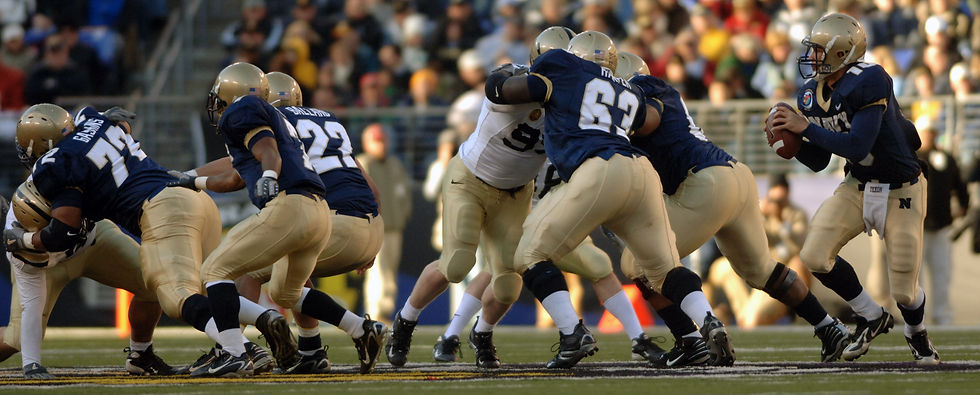
Photo source and license: Herbert D. Banks Jr./U.S. Navy via Wikimedia Commons; public domain in the United States and marked free of known copyright restrictions.


Comments