


Vikings vs. Bears Prediction: Chicago Survives Wentz Start
Friday quarterback decision: Minnesota ruled Kyler Murray out in concussion protocol and named Carson Wentz the starter against Chicago, with J.J. McCarthy as the backup. The confirmed change increases Minnesota's volatility but does not require inventing a Murray return date; his next checkpoint is Week 3 protocol progress.
Sources and context: official Friday report and Football Nation's Week 2 injury coverage.
Minnesota quarterback context: Kyler Murray's concussion status forced Carson Wentz into the Week 2 start.
More Football Nation coverage: Joe Burrow injury update; Nico Collins injury update.
Kyler Murray advances, but has not cleared concussion protocol
Thursday official update: Kyler Murray remained limited for a second straight practice in the concussion protocol. Minnesota has not announced that he is cleared, so Carson Wentz remains the practical quarterback plan for this preview until Friday’s final report. Kyler Murray was limited in Wednesday’s practice as he advances through the concussion protocol. That is a positive step, but Minnesota still needs medical clearance before treating him as available against Chicago.
The Bears listed D’Andre Swift with ankle and knee injuries and Kyle Monangai with a hamstring injury; both were limited. Their Thursday participation will help separate normal early-week management from a real backfield availability concern.
Jordan Mason’s thumb surgery changes Minnesota’s Week 2 backfield
Jordan Mason will not face Chicago after undergoing surgery to repair a fractured thumb and moving to short-term injured reserve. He must miss at least four games, so Minnesota’s backfield plan needs more than a one-week replacement.
The Vikings signed Jerome Ford while Mason recovers. That transaction adds experienced depth, but it does not by itself establish Ford’s Week 2 workload; practice roles and the final game designation remain the next checkpoints.
Football Nation prediction: Chicago 34, Minnesota 27. The Bears’ Week 1 eruption was too broad to dismiss as one hot quarterback afternoon. Chicago ran for 276 yards, converted 10 of 14 third downs and scored eight offensive touchdowns. Minnesota’s defense can make this uncomfortable, and Justin Jefferson is the best individual receiver in the game, but the Bears have the more forgiving offensive path at Soldier Field: D’Andre Swift and Kyle Monangai can force lighter boxes, then Caleb Williams can attack the space those boxes create.
The official NFL game center lists Vikings at Bears for Sunday, September 20, 2026 at 1:00 p.m. Eastern, noon Central, on FOX at Soldier Field. Both clubs are 1–0. The location matters because Chicago can keep the full run and movement menu available without silent-count stress, while Minnesota must prove that Carson Wentz’s efficient opener travels into a loud divisional road game.
Every number in this preview is a one-game 2026 sample. It describes current personnel and Week 1 tendencies, not a stable season rate. Home and road splits are also only one game deep, so the analysis uses them as context instead of pretending they carry predictive certainty.
Vikings vs. Bears Week 2 snapshot
Table sources: official NFL Week 2 matchup and Week 1 game-center totals, checked September 16, 2026. Chicago’s third-down and red-zone lines were also verified in Football Nation’s canonical Week 1 recap. The NFL matchup snapshot did not publish a directly comparable Minnesota red-zone row, so this preview leaves that cell explicit rather than inventing a rate. Public official summaries likewise do not provide one consistent pressure percentage for all four teams in this preview lane; sacks are reported separately from pressures.
Chicago’s run game changes the geometry
The strongest argument for Chicago is not simply the 59 points. It is how those points were created. Swift carried 18 times for 124 yards and three touchdowns. Monangai added 102 yards, including a 61-yard score. Williams completed 21 of 29 passes for 269 yards, two touchdowns and no interceptions. When an offense can stay ahead of the chains on the ground, the quarterback does not have to win every obvious passing down.
That matters against a Minnesota defense that turned the Packers’ late mistakes into short fields. The Vikings finished with four sacks and an interception, and their plus-one turnover margin helped separate a game in which Green Bay actually produced far more yardage. Minnesota’s formula was disciplined: survive explosive gains, win third downs, and punish the mistake cluster. Chicago’s job is to deny that third step by protecting the ball and refusing to turn a normal second-and-long into a reckless scramble drill.
The Week 1 context is worth reading in full. Football Nation’s Bears–Panthers recap shows why the rushing efficiency mattered more than the headline score, while the Vikings–Packers recap explains how Minnesota won decisively without winning the yardage column.
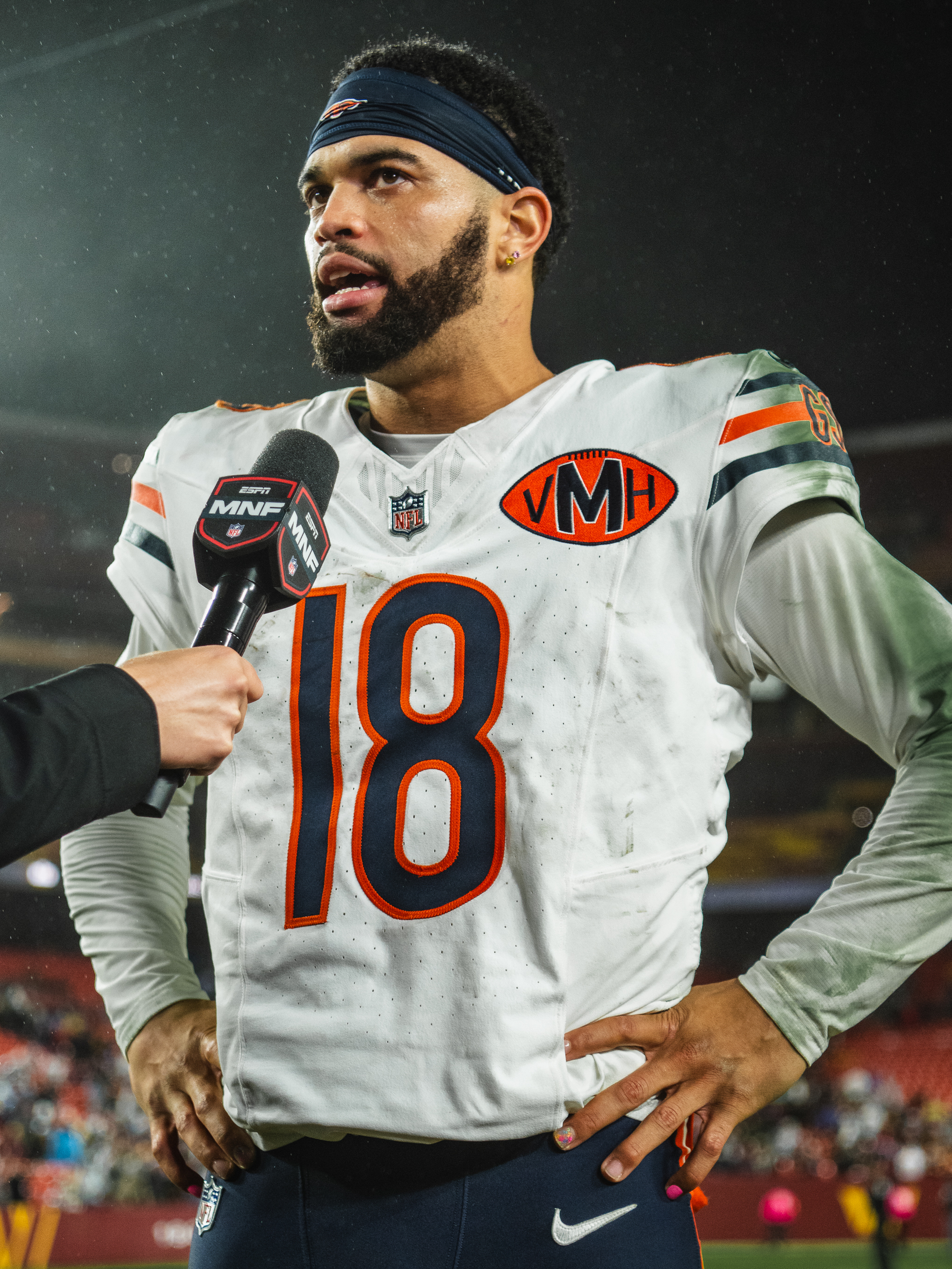
Caleb Williams with the Chicago Bears in October 2025. Photo: All-Pro Reels / Wikimedia Commons / CC BY-SA 4.0. Commercial reuse is permitted with attribution and share-alike terms. The crop was created from the original Commons file.
Minnesota’s clearest answer is Jefferson
Wentz threw for only 133 yards in Week 1, but the shape of the passing game was efficient: three touchdowns, no interceptions and a 63.2 percent completion rate. Jefferson caught eight passes for 92 yards and two scores. Minnesota does not need Wentz to chase Williams yard for yard if Jefferson keeps deciding red-zone and third-down snaps.
The Bears allowed 478 yards and 37 points to Carolina. Bryce Young threw for 361 yards, and Jalen Coker reached 138 receiving yards with two touchdowns. That is the warning against overreacting to Chicago’s record-setting offense. The Bears’ defense still surrendered explosive completions and let Carolina reach the red zone four times. Minnesota can build a plan around Jefferson’s leverage, underneath access for T.J. Hockenson and play action off Jordan Mason.
Mason’s 59 yards on 15 carries were modest compared with Chicago’s rushing totals, but Minnesota held the ball for nearly 33 minutes and converted more than half of its third downs. A patient drive profile can reduce Chicago’s number of possessions. The problem is that the Vikings may still need at least four touchdowns, because the Bears just produced scores from methodical red-zone drives and from explosive runs outside the red zone.
Pressure, turnovers and explosive plays
Minnesota’s four sacks create a real path to disruption, yet the public Week 1 summaries do not provide a comparable pressure rate for both defenses. Sacks and pressures are not interchangeable, so this preview does not manufacture a pressure percentage. The actionable fact is simpler: Chicago protected Williams well enough to avoid an interception and remained efficient on third down, while Minnesota’s defense generated enough negative plays to turn late Green Bay possessions.
The explosive-play matchup favors Chicago because it can create those gains without throwing deep. Monangai’s 61-yard touchdown and Swift’s consistent chunk runs force every defender to tackle in space. Minnesota’s explosive threat is more concentrated in Jefferson. That makes the Vikings dangerous but also more predictable: if Chicago brackets Jefferson on money downs, Wentz must show that the secondary options can win isolated routes.
Injury and availability checkpoint
The official matchup page showed no active game-status designations when checked at 12:30 p.m. Central on Wednesday, September 16. That is not a declaration of full health. Wednesday practice participation is the first meaningful Week 2 checkpoint, followed by Thursday trends and Friday’s final designations. Any offensive-line downgrade for Chicago would narrow the run-game advantage. Any limitation for Jefferson, Mason, Hockenson or a Minnesota corner would materially change the projected score.
The wider league context is available in Football Nation’s Week 2 injury report and the current NFL power rankings. Those files should be checked again after Friday’s reports rather than treated as substitutes for official game designations.
Fantasy football consequences
Williams belongs in the QB1 conversation after a five-touchdown team passing and rushing environment, but the floor is lower than the 59-point opener suggests. Minnesota can create sacks, and Chicago may lean on its backs again. Swift is a must-start while his red-zone role remains intact. Monangai is a high-upside flex whose Week 1 efficiency will be difficult to repeat on limited touches. Kalif Raymond’s eight catches provide a useful floor signal, not proof that he will lead the team every week.
Jefferson remains automatic. His touchdown role survived a low-volume passing day, which is exactly what elite fantasy managers want to see. Wentz is a superflex or two-quarterback option rather than a safe one-quarterback starter because Minnesota could again win without large passing yardage. Mason projects as a volume RB2 with touchdown upside, but Chicago’s offense could force the Vikings away from the run if the Bears jump ahead.
A useful change condition is simple: upgrade Minnesota’s passing volume if Chicago’s offense stays intact through Friday, because pace and scoreboard pressure can create more attempts. Downgrade both rushing attacks if multiple offensive linemen land on the final report. Do not chase Week 1 touchdown totals as if they were guaranteed roles.
The matchup swing points
Chicago must avoid the penalties and turnovers that fed Minnesota’s comeback against Green Bay. Minnesota must prevent the Bears from reaching third-and-short, where the entire playbook remains available. Red-zone defense is the largest unknown because Chicago went four for four against Carolina and Minnesota’s comparable official rate was not available in the matchup snapshot. Finally, the Vikings need one pass catcher beyond Jefferson to force the Bears out of bracket coverage.
Football Nation prediction
Chicago 34, Minnesota 27. The Bears are unlikely to score 59 again, and their Week 1 defensive leakage keeps the door open for Jefferson to control a quarter. The prediction rests on a broader set of repeatable advantages: Chicago’s rushing depth, Williams’ turnover-free efficiency, a plus-two Week 1 turnover margin and home-field control of the cadence.
Minnesota can flip the pick by winning the sack battle decisively and forcing two takeaways. The Vikings also have the best individual mismatch in Jefferson. On the evidence available Wednesday, however, Chicago has more ways to create efficient offense. Friday’s injury report is the final checkpoint before treating 34–27 as Football Nation’s settled score.


Comments