


What Is a Nub Formation? How a Tight End Changes the Defense
A nub formation places a tight end as the widest offensive player on one side of the formation. There is no wide receiver outside him. The tight end is the end man on the line, or another eligible player is aligned behind the line near him, while the rest of the eligible receivers are concentrated elsewhere.
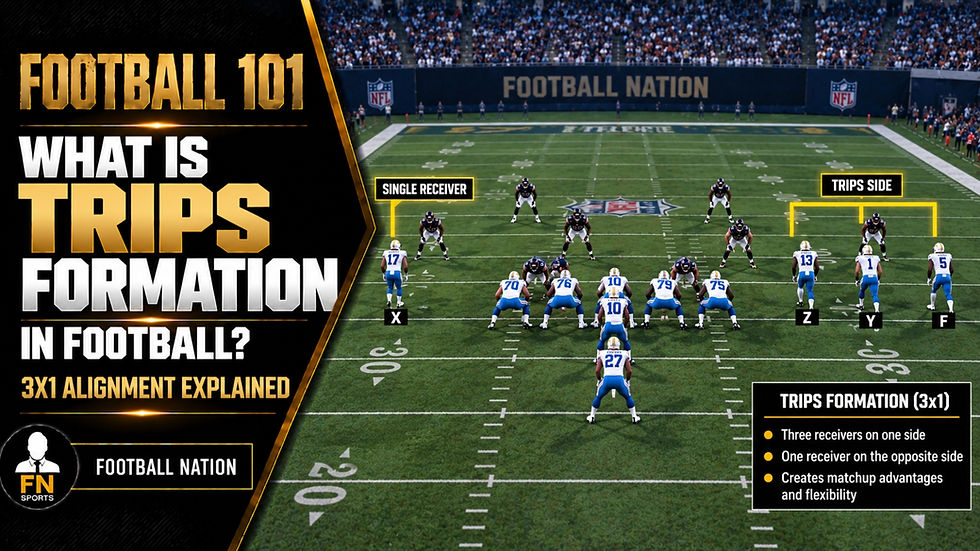
The picture often appears as trips to one side and a single attached tight end on the other. Coaches call that isolated side the nub. The name describes alignment, not personnel. An offense can create a nub from 12 personnel, 13 personnel, an empty backfield or a shift that moves a receiver away from the tight end.
That small change forces a large defensive decision. The defense must decide whether a corner, safety or linebacker will handle the tight end. It must also set the edge against the run without giving the offense an easy matchup in the passing game.
The basic picture
Imagine the ball in the middle of the field. Three eligible receivers align to the right. An attached tight end aligns on the left with no receiver outside him. A running back stands beside the quarterback in shotgun.
Trips side: three receivers stretch the coverage to the right.
Nub side: the tight end is the widest offensive player to the left.
Backfield: the running back can run toward either side or release into a route.
Defense: a corner may stay with the tight end, a safety may rotate down or a linebacker may widen.
Quarterback: the defensive response helps reveal coverage and box count.
The teaching key is simple. Find the widest eligible player on each side. If the tight end is the widest player on one side, that side is a nub surface.
Nub is a formation, not a personnel group
Personnel tells us which positions are on the field. Formation tells us where those players stand. Twelve personnel means one running back and two tight ends, but those two tight ends can align in many ways. One can be attached on the nub side while the other joins two receivers to create trips. Both can align together on the nub side. One can also move before the snap and change which side is the nub.
This distinction matters because defenses usually match personnel before they see the final formation. The offense can send in a heavy grouping, encourage the defense to use bigger bodies, then spread those tight ends into route positions. It can also shift from a balanced set into a nub and force the defense to communicate just before the snap.
Why offenses use a nub formation
It tests the defense's matchup rules
A defense that keeps a corner over the nub tight end may leave fewer defensive backs available for the three receiver side. A defense that uses a linebacker can create a favorable receiving matchup. A safety rotation can alter the middle of the field and tell the quarterback which side has help.
It changes run support
The nub tight end creates an extra surface for the running game without a wide receiver occupying the corner. The defense must decide whether the corner should enter the fit, whether a safety should become the force player and how the edge defender should align. If too many defenders bump toward trips, the offense can run toward the nub. If the defense loads the nub, the offense can attack the space it created elsewhere.
It creates clean play action pictures
A tight end aligned as the end man can block down, release to the flat, climb the seam or cross the formation. Those possibilities look similar at the snap. The offense can show outside zone, move the quarterback and release the tight end behind defenders who stepped toward the run.
Common run ideas from the nub
Outside zone can press the nub edge and make the defense declare its force player. Duo and power can use the tight end to widen the surface for a downhill run. Counter can pull blockers toward the nub after the backfield initially influences defenders the other way.
The offense can also run away from the nub. If the defense rotates a safety down and moves linebackers toward the tight end, the offense may have better blocking angles on the opposite side. The formation is valuable because it can change the count without changing the play.
A shift into a nub is especially useful. Patriots analysis of Seattle showed a receiver shifting away until the attached tight end became the widest player on that side. The boundary corner moved toward the line and the linebackers adjusted, giving the offense new angles for a productive run.
Common pass ideas from the nub
Boot action: the tight end blocks briefly or sells run before releasing to the flat.
Seam and wheel: two tight ends exchange vertical paths and stress man coverage communication.
Switch release: the inside and outside eligible players cross at the snap to create leverage.
Crossers: the nub tight end runs across the formation while trips routes occupy zone defenders.
Play action shot: the tight end releases vertically after the defense commits extra support to the run.
Running back release: the back exits near the nub and forces a linebacker to widen.
A recent Patriots film review offered a clear example. New England released two tight ends and the running back from a nub picture, producing three receiving threats from the same side. Another Patriots preview showed the Jets using 13 personnel from a nub, selling the run, sending one tight end vertically and opening the flat when the nickel defender reacted to the fake.
Two realistic examples
Example one: run toward the nub
The offense aligns in shotgun with trips right and an attached tight end left. The defense keeps two safeties deep and widens the weak linebacker toward the trips side. The quarterback counts only the corner and edge defender outside the left tackle. The offense runs outside zone left. The tight end reaches the edge, the corner is late to become the force player and the back turns the corner.
The football consequence is a favorable run count created by the defense's coverage spacing. The fantasy consequence is an ordinary rushing attempt for the back. The formation helped create the lane, but the tight end receives no fantasy credit for the block.
Example two: throw after the defense loads the nub
The offense shows the same alignment. This time the safety rotates down and the corner presses the tight end. The quarterback uses play action. The tight end releases up the seam while the back enters the flat. The safety drives the flat and the quarterback throws behind him to the tight end.
The football consequence is a two level stretch against one support defender. In point per reception formats, the tight end earns the catch and receiving yardage. If the defense continues to treat the nub as a run alert, that tight end can gain repeatable route value.
The 2026 NFL rulebook application
Nub is coaching terminology, not a separate rulebook formation. The alignment must satisfy the ordinary formation and eligibility rules.
Rule 7, Section 5, Article 1 requires at least seven offensive players on the line of scrimmage. Eligible receivers must occupy both ends of that line, and the players between them must be ineligible. A legal nub tight end can be the end man on his side. An illegal formation costs five yards.
Rule 8, Section 1, Article 5 says an offensive player on the end of the line is eligible when he wears an eligible number, which is 0 through 49 or 80 through 89, or when he has legally reported. Rule 8, Section 1, Article 6 makes a player ineligible when he is not on the end of the line and is not at least one yard behind it.
This creates the covering up problem. If a wide receiver mistakenly aligns on the line outside the tight end, the tight end is no longer the end man. He is covered and cannot be the first offensive player to touch a forward pass. Under Rule 8, Section 1, Article 8, intentional first touching or a catch by an originally ineligible offensive player is a five yard penalty from the previous spot.
Motion can create or remove the nub, but Rule 7, Section 4 still applies. The offense must be set together for one full second. After a shift, all players must stop together for one full second. At the snap, only one backfield player may be moving, and he must move parallel to or away from the line. Illegal shifts and illegal motion each cost five yards.
Rule examples and exceptions
Legal example: the tight end wears number 85 and is the left end man on a seven player line. A receiver who was outside him shifts into the backfield and stops for one full second. The tight end remains eligible because he is still the end man.
Illegal example: a receiver aligns on the line outside number 85 without either player correcting the alignment. The offense may still have seven players on the line, but number 85 is covered. If the quarterback throws to him first, illegal touching applies even if the route and catch looked normal.
An important exception arrives after the ball is touched by a defensive player or an eligible offensive player. Rule 8, Section 1, Article 5 makes all offensive players eligible after that touching. The original alignment still matters before the touch.
How defenses answer the nub
Defenses can keep the corner to the nub and treat the tight end like a wide receiver. They can roll a safety down, place a linebacker outside the tight end or use a six man front to close the run surface. They can also blitz the boundary corner, especially when the formation and field position make the run tendency obvious.
The strongest counterargument is that a nub does not automatically create an advantage. It can condense the offense into a loaded box and reduce space for the tight end. If the offense repeatedly runs from the same personnel and alignment, the defense can trigger downhill without hesitation. Patriots analysis has documented how predictable early down runs from nub formations produced poor results when the defense loaded the box.
The offensive answer is tendency balance. The offense must be willing to run toward and away from the nub, throw with and without play action, and shift into or out of the picture. The formation creates questions. The play caller still must punish the defense's answer.
Fantasy football consequences
A nub formation can be useful evidence for tight end route design, but it is not a target guarantee. The tight end may be isolated for a route, kept in to block or used as a decoy that moves coverage. Fantasy managers should combine alignment with route participation, targets, snap share and red zone usage.
Running backs can benefit when the formation changes the box count or identifies the force defender. Quarterbacks can gain easier presnap information because a defender who travels with a shifted receiver often suggests man coverage. None of those benefits produces fantasy points by itself.
Football Nation analysis assumes common standard, half point per reception and full point per reception formats. Platform scoring and later statistical corrections can differ. Check league settings before applying the formation to start and sit decisions.
Common misconceptions
A nub is not an empty side. The tight end is still an eligible receiving threat when legally aligned.
A nub is not the same as 12 personnel. Personnel names the players while nub names their alignment.
Trips does not automatically create a nub. The opposite side must place the tight end as the widest offensive player.
The tight end is not always eligible. A receiver on the line outside him can cover him.
A nub does not always mean run. Its best value may come from play action, switch releases and route matchups.
A defense does not have one required response. Coverage, front, field position and personnel all change the answer.
Frequently asked questions
Why is it called a nub?
The word describes the short or reduced side of the formation. In football usage, it commonly means an attached tight end is the widest player on that side.
Can there be two tight ends on the nub side?
Yes. One can align on the line and another as a wing or backfield player. Their exact positions determine which players are eligible.
Can a receiver motion into or out of a nub?
Yes. Motion and shifts are common ways to create the formation. The offense must still satisfy the full second set requirement and motion restrictions.
Does a corner have to cover the nub tight end?
No. The defense can use a corner, safety or linebacker depending on the coverage call. Who aligns there can reveal the defense's matchup plan.
Is the nub always on the short side of the field?
No. A nub can align to the boundary or the field. Coaches often use field position to influence how the defense fits the run and distributes coverage.
Football Nation conclusion
A nub formation removes the outside receiver from one side and makes the tight end the widest offensive threat. That forces the defense to solve the run surface, the receiving matchup and the coverage strength with the same eleven players.
The next checkpoint is the defense's first adjustment. Watch who walks over the tight end, which safety rotates, how the linebackers bump and whether the corner becomes part of the run fit. Those reactions explain why the offense chose the formation.
Continue learning
Start with What Is a Condensed Formation? to compare tight splits with a true nub.
Then review What Does 12 Personnel Mean? to separate personnel from alignment.
The opposite side often uses Trips Formation to stretch the defense.
Shifts and jet action are clearer after What Is Motion in Football?.
Nub boot concepts build on What Is Play Action?.
For the legal alignment details, continue with What Is an Illegal Formation?.
Eligibility changes are covered in Why Do Offensive Linemen Report as Eligible Receivers?.
Sources and factual cutoff
Information cutoff: October 24, 2026 at 12:01 PM CDT.
Official 2026 NFL Rulebook, Rule 7, Section 4; Rule 7, Section 5, Article 1; and Rule 8, Section 1, Articles 5, 6 and 8. Checked October 24, 2026 at 12:01 PM CDT. https://static.www.nfl.com/image/upload/fl_attachment/league/tqivdkzt9mu6wdgsh1ku.pdf
New England Patriots, After Further Review: Drake Maye film breakdown, defense review and quick hit film notes from Week 7 loss to the Bears. Checked October 24, 2026 at 12:01 PM CDT. https://www.patriots.com/news/after-further-review-drake-maye-film-breakdown-defense-review-and-quick-hit-film-notes-from-week-7-loss-to-the-bears
New England Patriots, Patriots Gameplan: Preparing for Seattle's Pressure Package, the Seahawks Playmakers and Key Matchups. Checked October 24, 2026 at 12:01 PM CDT. https://www.patriots.com/news/patriots-gameplan-preparing-for-seattle-s-pressure-package-the-seahawks-playmakers-and-key-matchups-in-sunday-s-showdown
New England Patriots, Patriots Gameplan: Prepping QB Drake Maye and Slowing Down Anthony Richardson. Checked October 24, 2026 at 12:01 PM CDT. https://www.patriots.com/news/patriots-gameplan-prepping-qb-drake-maye-and-slowing-down-anthony-richardson-in-sunday-s-game-vs-the-colts
USA Football, Learn how NFL teams utilize RPOs from heavier personnel groupings. Checked October 24, 2026 at 12:01 PM CDT. https://blogs.usafootball.com/blog/7248/learn-how-nfl-teams-utilize-rpo-s-from-heavier-personnel-groupings


Comments