


Fantasy Football Week 2 Trade Values: 3 Buys, 2 Sells, 1 Hold
The Week 2 trade answer: buy Drake Maye, Terry McLaurin and George Kittle; sell DJ Moore and Mark Andrews only for a steadier weekly role; hold Caleb Williams unless the offer prices him with the elite. Buy participation, sell inflated scoring and make Week 2 prove whether the role persists.
This board covers Week 1 through Monday night for 12-team redraft leagues. Half-PPR, full-PPR, one-QB and superflex prices are labeled where format changes value. Quarterback participation uses snaps, attempts and rushes rather than routes.
The factual baseline comes from official team recaps, gamebooks and schedules, including Football Nation’s Week 2 injury report and Week 2 waiver board. Snap and route context is separated from Football Nation analysis; an example package is a negotiation range, not a universal price.
For the Week 1 game context behind these values, revisit Seattle’s interception-driven win over New England, Philadelphia’s two-point escape against Washington, San Francisco’s Melbourne win, and the Lions–Bills Week 2 preview.
BUY: Drake Maye, Patriots QB
Role and baseline: Maye threw for 178 yards, one touchdown and three interceptions against Seattle, then rescued some fantasy value with 47 rushing yards on seven carries. All three interceptions came in the fourth quarter. The box score was poor, but the seven rushes preserved the dual-threat floor that made him an elite QB1 in 2025. New England losing A.J. Brown to a high-ankle sprain and injured reserve lowers the passing ceiling; it does not erase Maye’s legs.
Trade range and schedule: In one-QB leagues, offer a bench receiver in the WR35–45 range or a contingency running back, not an every-week flex. In superflex, this is a small discount window, not a clearance sale. Pittsburgh visits New England on September 20, followed by a trip to Jacksonville. The floor is 15-point territory when the passing game sputters; the ceiling returns to the weekly top five when 220-plus passing yards and 35-plus rushing yards meet.
Best counterargument: Brown’s absence could make the interception problem worse. What changes the call: two more games below 200 passing yards with fewer than five designed or scramble rushes would move Maye from buy to hold. Source: Patriots Week 1 notes.
BUY: Terry McLaurin, Commanders WR
Role and baseline: McLaurin caught two of four targets for 14 yards in Washington’s 24-22 loss at Philadelphia. That is the panic point. The better signal: he played 61 of 70 offensive snaps, an 87% share, while Stefon Diggs played 44. McLaurin also led the wide-receiver room in routes. His 2025 season was interrupted by injury, so one quiet opener against a difficult outside matchup should not outweigh an every-down role.
Trade range and schedule: In half-PPR, offer a touchdown-inflated WR3 plus a bench back; in full PPR, a volume WR3 is closer because McLaurin’s Week 1 target share must recover. Washington hosts Dallas on September 20 and Seattle on September 27. The rest-of-season floor is a volatile WR3 if Diggs owns the short-area volume; the ceiling remains a weekly WR2 if McLaurin returns to six-plus targets with the same route lead.
Best counterargument: Diggs drew nine targets, and McLaurin needed the final possession for both catches. What changes the call: if McLaurin loses the receiver snap lead or stays below five targets in each of the next two games, stop buying. Source: official Commanders stats and snaps.
BUY: George Kittle, 49ers TE
Role and baseline: Kittle’s two catches for 12 yards look like decline until the workload is added. He played 30 of San Francisco’s 65 offensive snaps and still drew five targets. He was less than eight months removed from the Achilles tear he suffered on January 11, and the 49ers had publicly said they would manage his workload. In 2025 he still produced 57 catches, 628 yards and seven touchdowns in 11 games.
Trade range and schedule: Offer a healthy TE8–12 type plus a bench receiver, or a low-end flex straight up if the Kittle manager needs immediate points. Full PPR raises the price slightly because five targets on a 46% snap share show the passing-game preference. Miami visits on September 20, then Arizona. The floor is fragile until he clears 60% of snaps; the ceiling is still a difference-making TE1 if the route share climbs without a setback.
Best counterargument: Kittle is 32 and returning unusually quickly from a major injury. What changes the call: if he remains below 40 offensive snaps in Week 3 or appears on the injury report with an Achilles-related setback, move from buy to hold. Sources: 49ers return timeline and Week 1 snap report.
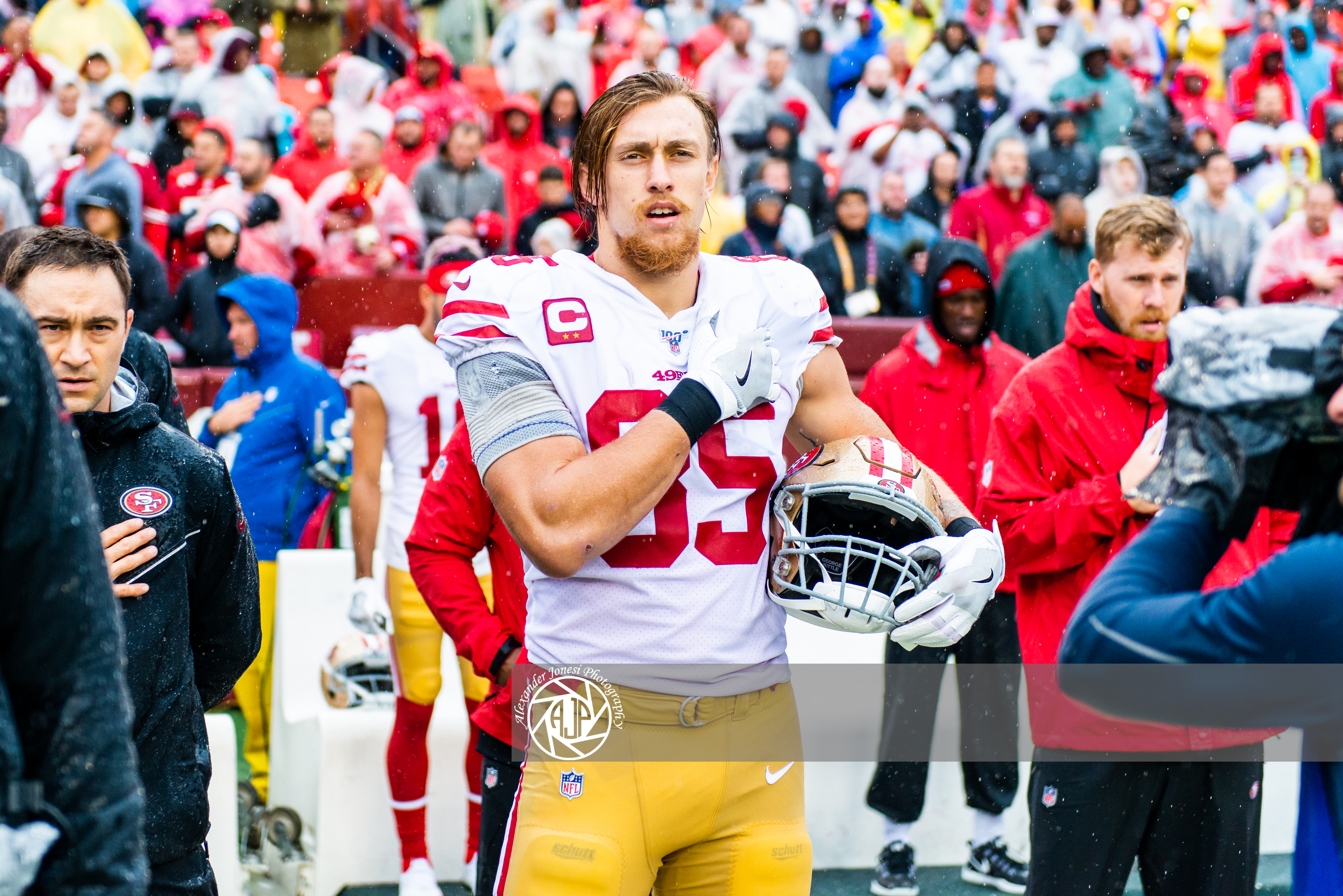
George Kittle with San Francisco in 2019. Photo by AlexanderJonesi, CC BY-SA 2.0 via Wikimedia Commons.
SELL: DJ Moore, Bills WR — only at a WR1 price
Role and baseline: Moore’s Buffalo debut was legitimately strong: five catches on a team-high eight targets for 100 yards and a touchdown. He also led Bills receivers with 44 of 58 offensive snaps, a 76% share. This is not a fade of his role. It is a price check after 43 yards and the touchdown came on one play in a 36-31 game where Josh Allen threw for 334 yards and Dalton Kincaid reached 130.
Trade range and schedule: Buffalo hosts Detroit on Thursday, a spot that can support another ceiling game, then the Chargers. Sell only if Moore can return a receiver with a stable eight-to-ten-target baseline, or package Moore with an RB3 to reach a true top-12 wideout. Otherwise hold. His floor is a usable WR2/3 because the snaps are real; his ceiling is a weekly WR1 if Allen keeps treating him as the primary outside read.
Best counterargument: Eight targets and the top wideout snap count may be the start of a new, sustainable role. What changes the call: eight-plus targets in each of the next two games, especially without another broken-play touchdown, changes Moore from sell-high to hold. Sources: Bills official Week 1 recap and Football Nation’s Bills-Texans recap.
SELL: Mark Andrews, Ravens TE
Role and baseline: Andrews caught four of six targets for 49 yards, an acceptable 8.9 PPR points. He also led Baltimore tight ends with 49 of 68 offensive snaps; Matthew Hibner played 23 and caught one pass for 13 yards. The problem is opportunity quality. Zay Flowers produced 150 yards before aggravating a hamstring, while Derrick Henry handled the goal-line work in a 41-point offense. Andrews may need touchdowns to separate from streamers.
Trade range and schedule: Do not dump Andrews. Try to turn the name into an upside WR4 or a high-value contingency back, then pair that return with a streaming tight end. Full PPR makes six targets more tolerable; standard scoring makes the lack of a touchdown more costly. Baltimore hosts New Orleans on September 20. His floor is replaceable TE production; his ceiling rises if Flowers misses time and Andrews regains red-zone priority.
Best counterargument: A 72% snap share and six targets are not a disappearing role, and receiver injuries could funnel more work inside. What changes the call: seven-plus targets with at least one red-zone target in consecutive games changes Andrews from sell to hold. Sources: Ravens Week 1 snap analysis and Football Nation’s Ravens-Colts recap.
HOLD: Caleb Williams, Bears QB
Role and baseline: Williams played all 75 offensive snaps and completed 21 of 29 passes for 269 yards and two touchdowns. He added 65 yards and two scores on 10 carries as Chicago set a franchise opening-day record with 59 points. The rushing usage is the market-moving fact; the two rushing touchdowns are the obvious regression risk. This was a real step forward, not a new expectation of four scores every week.
Trade range and schedule: Hold in one-QB unless the return is a top-five running back or wide receiver plus a usable quarterback. In superflex, hold firmly; do not trade a 24-year-old every-snap starter for skill-position depth. Minnesota visits September 20, followed by Philadelphia. The floor is a mid-QB1 when rushing remains part of the plan; the ceiling reaches the elite tier when efficiency and designed runs overlap.
Best counterargument: Carolina allowed 552 yards, and two quarterback rushing touchdowns will not repeat often. What changes the call: if Chicago removes designed quarterback runs and Williams falls below 25 rushing yards in both of the next two games, treat the Week 1 ceiling as matchup-driven and listen more aggressively. If he stays near eight rushes, hold becomes buy. Sources: Bears official recap and Football Nation’s Bears-Panthers recap.
Football Nation conclusion
Week 1 should change prices, not erase priors. Maye, McLaurin and Kittle still have the expensive part of fantasy value—rushing equity, routes or targets—without the Week 1 points. Moore and Andrews are sells only when another manager pays for the best interpretation of their opener. Williams is the opposite: his breakout deserves respect, but the correct action is to hold unless the offer assumes he has already joined the Allen-Jackson tier. Send offers in ranges, keep format scarcity in view, and make the next two games prove or disprove each trigger above.


Comments