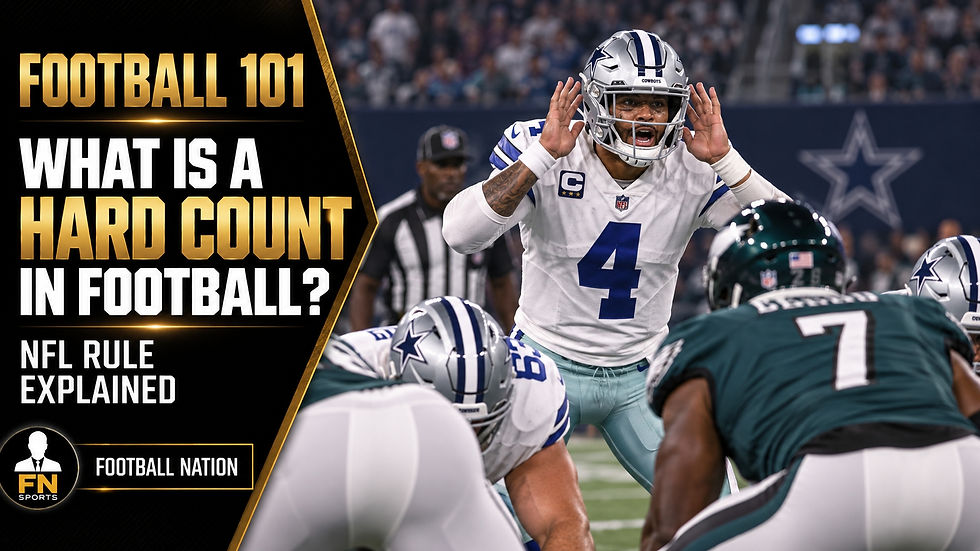
What Is a Silent Count in Football? How the Road Snap Works
- Football Nation
- 3 days ago
- 4 min read
A silent count is a nonverbal system an offense uses to start the play when players cannot reliably hear the quarterback. Instead of snapping on a shouted word or sound, the offense communicates readiness through visual cues, body movement or a tap relayed to the center. The center then snaps on a rehearsed timing.
The exact signal varies by team, but a common version looks like this: the quarterback gives a visual cue, a guard watches for it and taps or signals the center, and the center completes the count before snapping. The goal is not literal silence. It is to replace one shared sound with one shared visual clock.
Why offenses use a silent count
The system is most valuable on the road, where crowd noise can drown out the quarterback’s voice. Every offensive player must know when the ball will move, especially the tackles who are trying to block speed rushers. If the receivers hear the call but the line cannot hear the snap, the play is already broken.
A normal cadence can contain words, rhythm and changes in tempo. A silent count preserves the timing function without depending on sound. Offenses still use formation, motion and hand signals to communicate other information; the silent count specifically solves the problem of beginning the play together.
How the silent snap sequence works
First, the quarterback gets the offense set and surveys the defense. When he is ready, he shows a predetermined cue. That might be a leg lift, hand movement or another action the unit has installed. The cue tells the line to begin the silent sequence; it is not necessarily the snap itself.
Second, a guard who can see the quarterback confirms or relays the signal to the center. A tap is useful because the center is looking between his legs or toward the defensive front and may not have a clear view of the quarterback. The guard becomes the bridge between the backfield and the ball.
Third, the center uses the team’s practiced delay and snaps. The delay gives the guard time to reset his hands and lets the line anticipate the ball without moving early. Teams can vary the interval so defenders cannot simply key the first tap. Former quarterback Eli Manning and center Shaun O’Hara demonstrate a silent-count exchange in an official NFL video.

Who controls the snap?
The quarterback initiates readiness, but the center ultimately controls the ball. That distinction explains why a visible leg lift is not always an immediate command to snap. It may begin a short sequence, allow the offense to reset or tell the guard to pass the message. Viewers should watch the guard and center instead of staring only at the quarterback.
The offense can also pair the silent count with an audible. The quarterback may change the play through words, signals or both, then use the same silent mechanism to launch the new call. Changing the play and triggering the snap are related communication jobs, but they are not the same job.
Silent count vs. hard count
A hard count uses vocal rhythm or emphasis to tempt defenders into revealing pressure or jumping early. A silent count cannot lean on a shouted fake in the same way. It can still vary timing, but its first responsibility is synchronization, not deception.
That tradeoff matters. At home, the offense may control the rhythm with the quarterback’s voice. On the road, the visual cue can become easier for defenders to see. The offense gains reliable communication but gives edge rushers a signal they can study.
Why the silent count can help the pass rush
A defensive lineman does not need to hear anything if he can read the guard’s movement or the center’s routine. The NFL’s analysis of a Rams-Seahawks game noted that the silent count benefited Seattle’s defensive linemen because they could time the sequence. A great get-off can erase the small advantage the offense hoped to gain by knowing the count.
Offenses counter that problem by changing the delay, disguising the cue or occasionally using a different trigger. But the line cannot vary so much that its own players lose the rhythm. The best silent count balances predictability for teammates with uncertainty for the defense.
What can go wrong
The most obvious failure is a false start. A tackle may anticipate the snap and move before the ball, or the guard may fail to reset after signaling. Football Nation’s false-start guide explains why an abrupt pre-snap movement by the offense can cost five yards.
The opposite failure is lateness. If the cue is missed, the offense can run out of play-clock time. A bad snap is even worse: the center may snap before the quarterback expects it, sending the ball past him or forcing a hurried recovery. The 2026 NFL rulebook supplies the governing rules for the snap, pre-snap fouls and delay of game; “silent count” itself is coaching terminology, not a separate play type in the rulebook.
How to spot a silent count on television
Look for a road offense in loud conditions, then watch the interior line. The quarterback may raise a leg or make a visible readiness gesture. A guard may turn his head, tap the center or settle back into his stance. The center pauses and snaps while the quarterback remains in shotgun or under center.
Do not assume every leg lift is the same command. Teams build multiple meanings into familiar movements, and broadcasters rarely know the exact private code. The useful observation is the chain: visual cue, relay, shared timing. If the edge rusher explodes off the ball at the same instant, he probably studied that chain too.
Football Nation takeaway
A silent count is the offense’s answer to a communication problem, not a special formation. It replaces an audible snap word with a rehearsed visual sequence so eleven players can begin together in noise. The advantage is coordination; the cost is that defenders can watch the same cues. Follow the quarterback, guard and center in order, and the road snap becomes one of the easiest hidden systems to recognize before the ball is even moving.


Comments