


Smash Concept: Reading the Cornerback Between Hitch and Corner
Updated: Sep 13
The Smash concept is a two-route passing combination that puts one defender in a vertical bind. The outside receiver settles on a hitch while an inside receiver runs a corner route over the top. If the cornerback sinks under the corner, the quarterback throws the hitch. If the cornerback drives the hitch, the corner route opens behind him. That simple high-low answer is why Smash remains one of football’s most recognizable ways to attack a two-deep structure.
The concept is easy to draw, but it is not automatic. The quarterback must identify the coverage, confirm how the underneath defender is playing the hitch, and place the ball away from the deep safety. Route spacing, protection and timing decide whether the chalkboard answer survives at full speed.
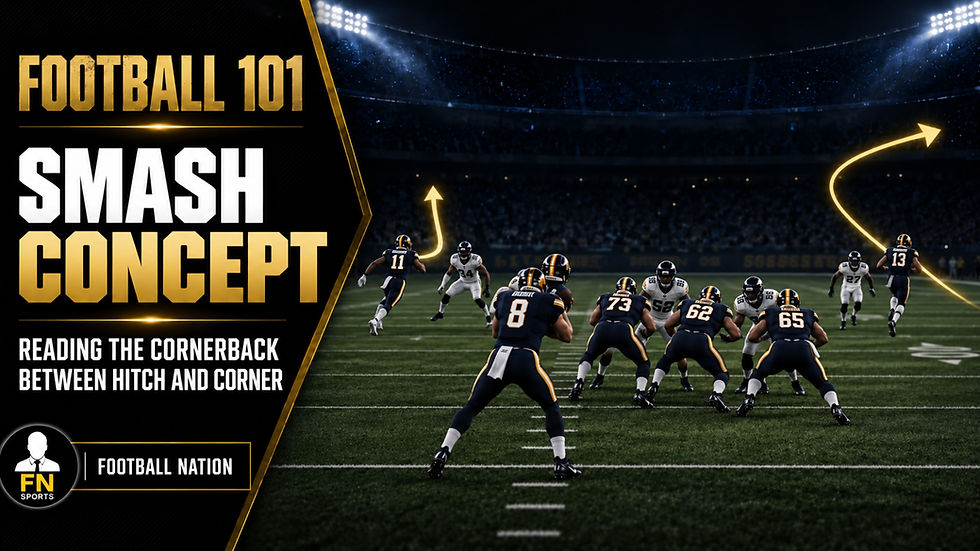
How the Smash concept is built
The classic version places the hitch outside and the corner route inside. The outside receiver pushes vertically, turns back toward the quarterback and presents a quick completion. The slot receiver stems vertically before breaking toward the sideline at an angle that threatens the space between the cornerback and safety. Coaches may adjust the stems and landmarks, but the relationship between the routes matters more than a universal yard line.
A typical teaching version uses a five- or six-yard hitch and a corner break around 10 to 12 yards. Those depths are examples, not rules. Down, distance, field position and a team’s terminology can change them. USA Football’s sprint-out package describes the same basic pairing as a flat or short outside route underneath a corner route, showing how offenses can preserve the high-low structure while changing the presentation.

Football Nation original teaching diagram. Typical depths are shown; exact landmarks and progression vary by playbook.
What is the quarterback reading?
The quarterback usually starts with the alignment and leverage of the cornerback and safety, then reads the defender responsible for the outside short zone. Against a traditional Cover 2 look, that is often the cornerback. The quarterback wants to make that defender wrong.
When the cornerback stays low, widens with the hitch or drives forward, the quarterback can layer the corner route into the window before the safety arrives. When the cornerback gains depth and carries the corner route, the hitch should be available underneath. The throw must be made on time: a late corner ball gives the safety time to overlap, while a late hitch lets the cornerback recover downhill.
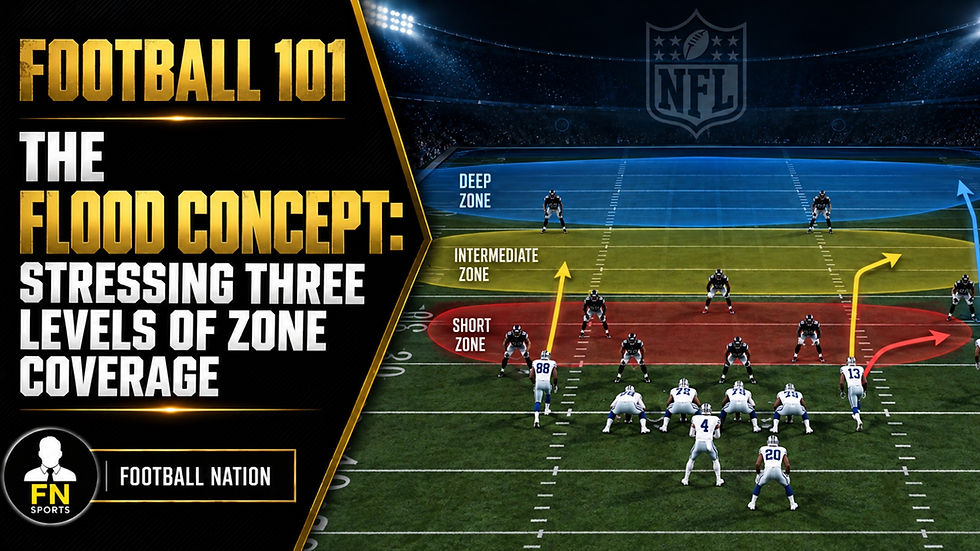
This is the same family of defender-conflict thinking readers see in the Curl-Flat concept, although Curl-Flat stresses a flat defender horizontally and Smash more directly stretches an outside defender vertically. The Flood concept expands the idea into a three-level sideline stretch.
Why Smash is associated with Cover 2
Smash is often taught as a Cover 2 answer because Cover 2 divides the sideline between a shallow cornerback and a deep-half safety. The hitch occupies the cornerback, and the corner route attacks the space outside the safety. An NFL breakdown of Andrew Luck and the Colts highlighted a Smash completion against a Cover 2 look, illustrating the basic stress at professional speed.
But “Cover 2 beater” is a useful label, not a guarantee. A cornerback can sink beneath the corner route, a safety can widen early, or the defense can pattern-match the releases. Nick Saban’s match principles, explained by USA Football, include a specific communication answer for the outside hitch and inside corner combination. That is the defensive counterpunch: do not simply occupy static zones; pass routes off according to their distribution.
What changes against Cover 3, quarters and man coverage?
Against Cover 3, the outside corner normally owns the deep third and can stay over the corner route. That often makes the hitch the safer answer, but the curl-flat defender may expand underneath it, and the quarterback cannot force the short throw into a closing window. Offenses may convert the outside route, add a backside concept or use motion to create a cleaner pre-snap picture.
Against quarters, the corner route can run into a defender with outside leverage and help from a safety reading the slot. The offense must understand whether the defense is playing spot-drop quarters or matching routes. Against man coverage, Smash stops being a tidy zone high-low and becomes a route-winning test. The hitch must separate at the break, and the corner runner must defeat leverage without drifting into the sideline.
That coverage-dependent logic is why Smash belongs beside concepts such as Mesh rather than being treated as a magic play call. Mesh creates natural traffic and horizontal separation against man; Smash is at its cleanest when a zone defender must choose between two vertical levels.
Common Smash variations
Offenses rarely present the concept the same way every time. A tight end can run the corner route from a condensed split. The outside receiver can replace the hitch with a quick out, a flat route or a delayed stop. Motion can reveal man coverage or widen the underneath defender. Sprint-out action can shorten the quarterback’s throw while changing the defense’s angles.
Teams also pair Smash with a backside answer. If the defense rotates a safety toward the two-route side, the quarterback can work a slant, glance, isolation route or another full-field progression away from that rotation. Some offenses attach a screen pass or run option so the quarterback can punish a light box before entering the dropback read.
In timing-based systems, the combination fits naturally with the principles explained in our West Coast offense guide: defined footwork, precise spacing and a throw tied to the receiver’s break. The concept is simple enough for youth football and flexible enough for the NFL because the read is clear while the presentation can keep changing.
The biggest misconception
The biggest mistake is assuming that seeing two high safeties means the corner route must be open. The quarterback still has to identify whether the cornerback is squatting, sinking or matching; whether the safety has enough width to overlap; and whether a linebacker or nickel defender can disrupt the slot’s release. Two-high shells can rotate after the snap, and modern defenses disguise their final responsibility.
The other misconception is that the hitch is merely a decoy. It is a real answer. If the defense gives away five yards to protect the corner route, a disciplined offense should take the completion and stay on schedule. Smash succeeds by forcing the defense to concede one level, not by demanding the spectacular throw.
What to watch on the next broadcast
First, find the outside receiver and slot aligned to the same side. Watch for the outside receiver to stop while the slot bends toward the sideline. Then ignore the ball for a moment and watch the cornerback. If he drives downhill, look for the quarterback to throw over him. If he retreats, expect the ball underneath. Finally, locate the safety: his width and closing angle determine how much room exists for the corner throw.
Also notice the field location. From the wide side, the corner route has more space but demands a longer throw. Near the red zone, the route may flatten because the end line compresses the defense. On third-and-medium, the hitch can be the correct answer even when it looks less ambitious than the corner route.
Football Nation takeaway
Smash is best understood as a defender-conflict concept, not a pair of memorized route depths. The offense places a short route below a corner route and asks an outside defender to cover both. The quarterback reads that defender, confirms the safety’s leverage and delivers the ball before the window closes. Against Cover 2, it can create a textbook high-low. Against match coverage, Cover 3, quarters or man, the offense needs a complementary answer.
The practical lesson is straightforward: when you see a hitch under a corner route, watch the cornerback. His choice usually tells you where the ball should go.


Comments