


What Is Trap Coverage? How a Corner Baits the Short Throw
Information cutoff: October 23, 2026 at 4:07 a.m. Central. Scheme descriptions were checked against NFL, team and USA Football teaching material. Rule references come from the official 2026 NFL Rulebook checked at the same time.
Trap coverage is a defensive call that invites a quarterback to throw a short outside route, then sends a cornerback downhill to attack it. The corner initially presents a picture that suggests he will carry the outside receiver vertically or protect deep space. A safety takes responsibility over the top. When the inside receiver or a back breaks toward the flat, the corner can leave the vertical route and drive on the shorter target.
That is the simple answer, but the name is not universal. Coaches can use trap, palms, two read, cloud or squat language for related ideas, and their rules can change by formation. The assignment matters more than the label. If the corner reads an inside route while a safety protects the outside vertical threat, the defense is using the core trap principle.
Why the coverage can fool a quarterback
Many passing concepts tell the quarterback to take an easy completion when the corner retreats. A quick out, speed out, flat route or swing pass can look uncovered because the corner appears to be giving away the short outside area. Trap coverage turns that normal answer into the bait.
The quarterback sees the corner move with the widest receiver and assumes the flat defender has been removed. The corner is really reading the route distribution. When the short route declares outside, he plants and attacks. The safety replaces him over the top so the defense does not simply abandon the go route.
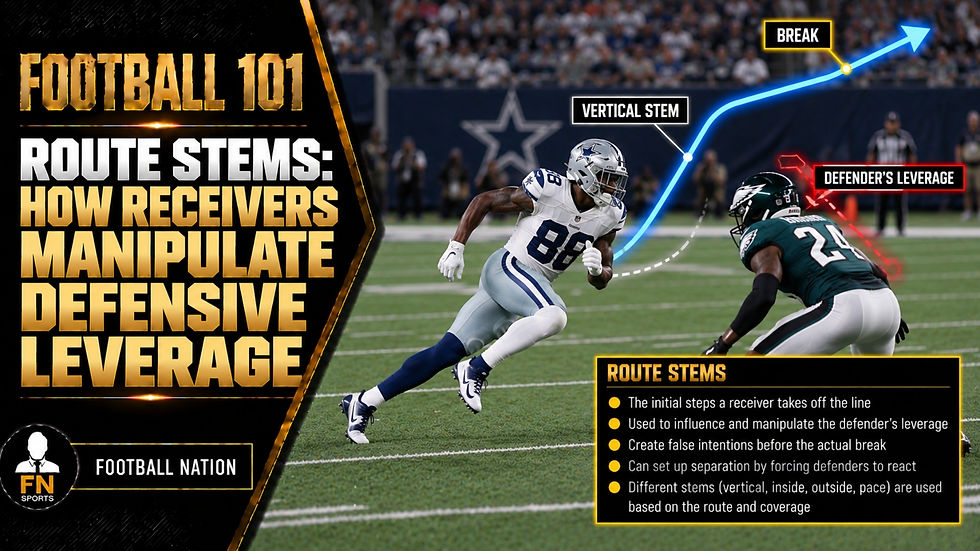
This is why route stems matter. A vertical stem can hold the safety and make the corner delay his decision. A careless stem can reveal the short break early and give the trap corner a clean angle.
The basic assignments
Defender | Primary read | Typical job | Main danger |
Outside corner | Release by the inside receiver plus the widest receiver | Show vertical responsibility, then drive the out or flat when the call triggers | Leaving too early and exposing the deep sideline |
Deep safety | The widest vertical threat | Overlap the route the corner releases | Arriving late or being moved by an inside route |
Inside defender | Slot or back release | Wall inside access, communicate and help define the corner read | Losing leverage and opening the seam |
Pass rush | Protection and quarterback clock | Force the throw before the disguise expires | Giving the offense time to uncover the rotation |
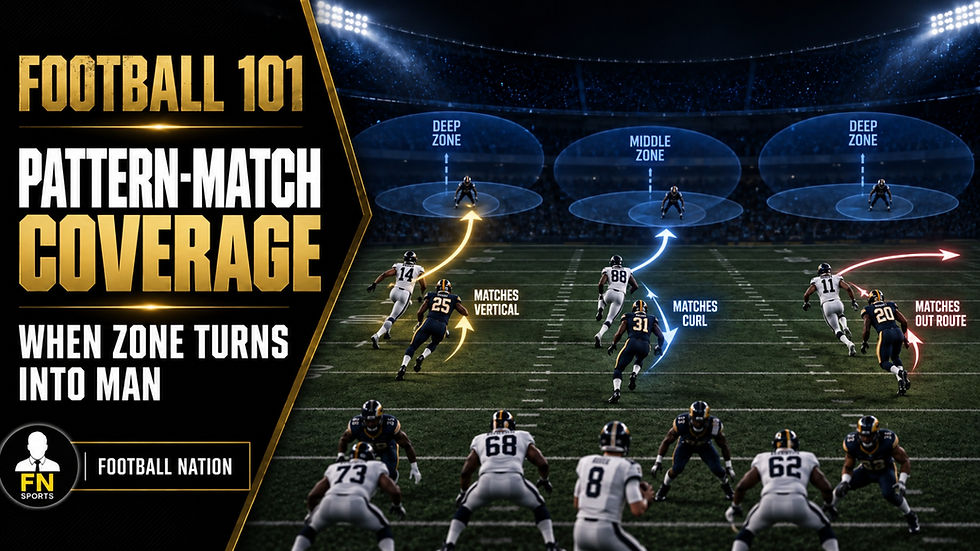
Trap coverage often begins from a Cover 2 or quarters family. It is also related to pattern match coverage because the routes determine which receiver each defender ultimately handles. A static diagram cannot be a universal playbook because the same formation can trigger different rules in different systems.
Teaching example one: the slot runs an out
The offense aligns with two receivers to the right. No. 1 is widest and No. 2 is in the slot. At the snap, No. 1 pushes vertically while No. 2 runs a short out route. The corner begins with depth and outside leverage, which encourages the quarterback to throw the out.
The safety takes No. 1 over the top. Once No. 2 commits outside, the corner leaves the vertical route and drives toward the sideline. If the quarterback throws on his first picture, the corner can arrive at the catch point or undercut the pass.
The offense can answer by using a pump fake, an out and up route, or a vertical route by No. 2 that keeps the corner from triggering. Protection must last long enough for that answer. If pressure compresses the read, the bait becomes much more dangerous.
Teaching example two: the corner squats in a three deep structure
Trap principles are not limited to one two high shell. A defense can show a three deep picture and let an outside corner squat on an anticipated short throw while another defender protects the deep outside area. USA Football has described this as a turnover minded gamble: the soft look tempts the short throw, but the corner breaks forward once the quarterback commits.
The risk is space behind the corner. If the safety cannot reach the vertical route or if the quarterback buys extra time, the offense can create an explosive play. That risk explains why trap calls are selective tools rather than automatic answers on every passing down.
How an offense attacks trap coverage
Send No. 2 vertically. A slot fade or seam can occupy the safety and prevent a clean exchange.
Use double moves. A short route that turns up the sideline can punish a corner who drives too aggressively.
Flood the deep outside area. Three receivers at different levels can force the safety and corner to sort more threats than the trap call comfortably handles.
Run the ball at light spacing. Two high structures can remove a defender from the immediate box.
Change the launch point. Movement can alter the corner's angle and give the quarterback a later view of the rotation.
The smash concept is a useful comparison because its hitch and corner route stress a short defender and a deep defender at two levels. Trap coverage tries to change that expected read by letting the corner attack the short route while the safety protects the vertical or corner route.
The exact NFL rules that govern the technique
Rule 8, Section 4, Article 1 allows a defender to chuck an eligible receiver within five yards when the contact meets the rule's conditions. Article 2 limits illegal contact within that five yard zone. Article 3 prohibits a defender from initiating contact beyond five yards against a receiver trying to evade him while the passer remains in the pocket. Illegal contact costs five yards and an automatic first down.
Rule 8, Section 4, Article 6 defines defensive holding when a defender grasps an eligible player or uses an arm to cut off or encircle him. The penalty is five yards and an automatic first down. Rule 12, Section 1, Article 6 supplies the broader defensive holding rule and the same enforcement.
Rule 8, Section 5 governs pass interference. Once the ball is in the air, a defender cannot restrict a receiver's opportunity to catch it by playing through his back, grabbing an arm, cutting off his path through contact without playing the ball, or similar acts. Defensive pass interference gives the offense a first down at the spot of the foul, with special goal line enforcement.
Application example one: the corner can read the out route and drive on the throw without a foul if he reaches the ball or the catch point legally. Application example two: if he grabs the receiver to recover after leaving too early, holding can be called before the throw and pass interference can be called for prohibited contact while the ball is in the air. Incidental contact while both players compete for the ball can be permissible, and a clearly uncatchable pass is an important pass interference exception.
Football and fantasy consequences
The football consequence is volatility. A well timed trap call can create an interception or a negative play because the quarterback throws into a defender who was hidden by the original picture. A failed trap can surrender the exact explosive route the safety was supposed to cap.
For fantasy football, one interception should not automatically downgrade a quarterback or receiver. Managers should ask whether the offense repeatedly failed to identify the same rotation, whether protection forced hurried decisions, and whether the defense has the personnel to repeat the call. Trap coverage can reduce easy targets to a slot receiver or receiving back, but vertical answers can create higher value opportunities outside.
A receiver's box score can also hide his real effect. The widest receiver may draw the safety and open the trap opportunity underneath even if he never receives the pass. Conversely, the short target can be blamed for an interception that was actually caused by the quarterback reading only the corner's first movement.
Strongest counterargument
The strongest objection to calling a play trap coverage is that television angles rarely reveal the complete call. A corner might be freelancing, responding to a route rule, playing palms, executing a Cover 2 rotation or simply recovering from a mistake. Without the defensive call sheet, one snap cannot prove the coordinator's terminology.
That objection is correct. The responsible conclusion is functional, not absolute: identify the corner reading an inside release, the safety replacing him over the top and the defense attacking the short outside throw. Repeated examples across the game strengthen the diagnosis. One isolated interception does not.
Common misconceptions
Trap coverage is not the same as a defensive lineman trap in the running game.
It is not automatically Cover 2. The same bait principle can appear inside several coverage families.
The corner is not simply abandoning his receiver. A safety or another rule must replace the vertical threat.
Every interception on an out route is not proof of trap coverage. Bad timing, a tipped pass or a freelance break can look similar.
A soft presnap cushion does not guarantee soft coverage after the snap.
Compare the corner's initial spacing with Football Nation's guide to coverage cushion. Then compare the two defender cooperation with bracket coverage. Trap coverage is designed around baiting a route distribution, while a bracket is designed around closing two paths for a priority receiver.
Trap coverage FAQ
What route is the corner trying to steal?
Usually a short outside route by the slot, tight end or back, such as an out, flat or swing. The exact trigger depends on the call.
Who covers the outside vertical route?
A deep safety normally replaces the corner when the trap triggers. The safety's leverage and arrival time are central to the call.
Why not call it every play?
The corner must take an aggressive angle, which creates space behind him. Repeated use also lets the offense build double moves and vertical answers.
Can trap coverage work against three receiver formations?
Yes, but the distribution rules become more complicated. The defense must account for three vertical threats, motion and route exchanges without overloading one safety.
What should a viewer watch first?
Watch the outside corner, then the safety above him. If the corner leaves a vertical receiver to attack a short route and the safety replaces that vertical threat, the trap principle is visible.
Football Nation takeaway
Trap coverage weaponizes the quarterback's normal answer against soft outside leverage. The corner sells depth, the safety protects the vertical route, and the short outside throw becomes the target. It can create a turnover, but it asks the secondary to exchange jobs with precise timing.
The next checkpoint is the next full game in which a defense repeatedly uses the same corner and safety exchange. Confirm the concept across several route distributions before assigning a specific playbook label.
Sources
Official 2026 NFL Rulebook, including Rule 8, Sections 4 and 5, and Rule 12, Section 1. PDF checked October 23, 2026 at 4:07 a.m. Central.
New England Patriots trap coverage analysis, checked October 23, 2026 at 4:07 a.m. Central.
New England Patriots Cover 2 trap corner example, checked October 23, 2026 at 4:07 a.m. Central.
NFL.com discussion of palms and trap rules, checked October 23, 2026 at 4:07 a.m. Central.
USA Football Cover 3 squat teaching example, checked October 23, 2026 at 4:07 a.m. Central.
Official rulebook PDF, checked October 23, 2026 at 4:07 a.m. Central.

Comments